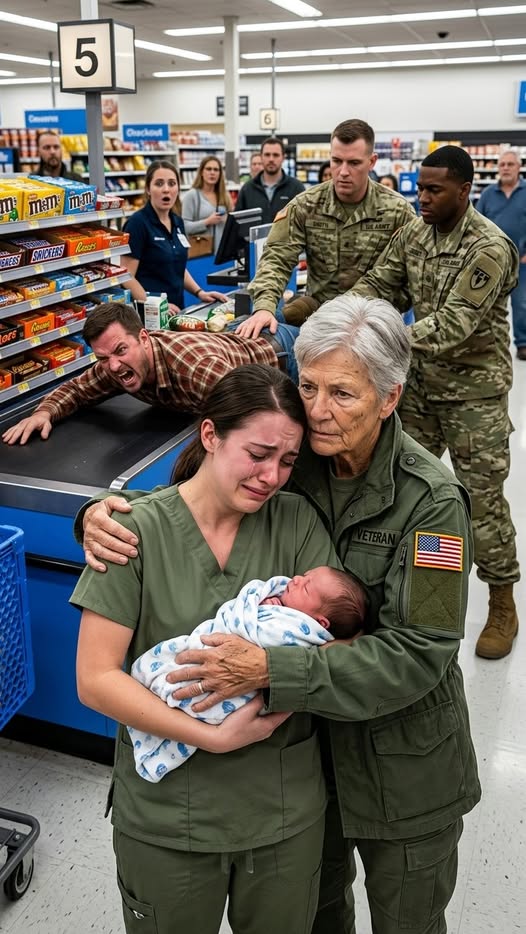
It was almost midnight, the time of day when everything seems heavier than it should.
The small grocery store’s fluorescent lights buzzed softly overhead, illuminating the half-stocked shelves and vacant aisles with a pale glow. The store itself seemed to be struggling to remain awake longer than it wanted to, as evidenced by the sharp and frigid mixture of cleaning chemicals and refrigeration that permeated the air.
I was waiting in line with a nearly empty basket. An egg carton. A coffee can. the essentials. This type of purchase is more indicative of habit than necessity.
People don’t give you a second glance when you’re seventy-three. You turn into the background. It’s just another silent person passing through a location that doesn’t really need you anymore.
I was just that that evening.
That is, until he spoke.
A man who appeared to have never been told no in his life stood behind the woman working at the register. Polished shoes, an expensive suit, and a watch that serves as a reminder to others of the value of their time rather as a timepiece. He kept checking it, each look more dramatic than the last, as if the seconds were taunting him.
A woman in front of him appeared to have given her all before continuing on.
Her hair was pulled back in a sloppy, loose knot, and her scrubs were faded and old. Under her eyes, dark circles resembled bruises from a fight she hadn’t had time to heal from. A small baby rested against her chest in a sling, barely making a sound, as if it already understood how fragile the moment was.
She attempted to make a payment.
The device beeped.
declined.
Her shoulders lowered slightly, as if she had anticipated it but prayed she was mistaken.
“Please,” she muttered. “Are you able to try again? I should have received my paycheck.
Once more, she swiped the card.
The same sound.
This time it was louder, or perhaps that’s just how it seemed.
The man behind her laughed impatiently and sharply.
“For heaven’s sake,” he yelled. “A few of us don’t have all night.”
She recoiled, reflexively moving to protect the infant.
She apologized once more, this time in a nicer tone. All I need is this formula. He hasn’t had any food.
The dude went too far at that point.
He made sure everyone in the store heard him when he remarked, “If you can’t afford a baby, you shouldn’t have one.” Because you are unable to handle your own life, you are delaying the queue. Set aside to provide room for someone who truly contributes.
Like poison, the words lingered in the atmosphere.
The cashier remained silent.
The few others in line didn’t say anything.
This is the typical course of events like this. People are aware of it. They sense it. However, they don’t intervene.
I had been in uniform for forty years, witnessing the consequences of quiet.
I didn’t that evening.
I said, “Stand down.”
Not very loudly.
Not with rage.
However, the entire front of the store appeared to cease breathing as a result of the force used.
With his hand halfway to her cart, the man stopped in his tracks.
His irritation was already turning into something more acute as he turned to face me.
I took a step forward, bringing us closer together.
I didn’t have to speak up once more.
I remarked, “I’ve seen men with less power than you show more respect than you’re capable of right now.” “You can’t talk to her that way.”
He stood up straight, attempting to regain his self-assurance.
He remarked, “You have no idea who I am.” “This is not something I have time for.”
I said, “I don’t care who you are.” “What you just said matters to me.”
The atmosphere changed.
Not very dramatic. Not evident.
But enough.
I took out my card and set it down on the counter.
I instructed the clerk to “ring up everything she has.” “And add anything she requires for the infant.”
The man scoffed, but his confidence had diminished.
He asked, “You think throwing money around fixes anything?”
“No,” I replied. “But it resolves this.”
I then gave him another, closer look.
I whispered, “You can go now.” “You can’t take back what you say before you say something else.”
He paused.
Then, without saying anything more, he scooped up his one item and left.
The ensuing quiet felt odd.
lighter.
With tears in her eyes that she had been suppressing, the woman turned to face me.
Her voice was hardly steady as she said, “Thank you.” “I will reimburse you. I swear.
I said, “You owe me nothing.”
However, I noticed something as I gave her the receipt.
On the counter, her phone flashed up.
A picture appeared on the screen.
And my entire being came to a halt.
My son was there.
A face like that is one you never forget.
He was standing erect, wearing his dress uniform, and grinning, something he hadn’t done much of when he was younger. She was encircled by his arm.
all around her.
“That man,” I murmured softly. “Who is he?”
Her face quickly transformed.
Everything else was replaced by grief.
She said, “That’s my husband.” “Elias. He was deployed. He… didn’t come back.”
The words hit harder than anything else that night.
Elias Vance.
My son.
I had buried him ten months earlier.
Or at least, I had buried what they gave me.
I had spent months wondering what his life had been like outside the pieces he chose to share. He had kept everything apart. His efforts. his relatives. even from me.
And now look at her.
in front of me.
He was carrying his child.
With a shaky voice, she questioned, “How do you know his name?”
I glanced at the infant.
tiny. Silent. observing everything with wide eyes that, at first, I couldn’t quite put my finger on.
Then it dawned on me.
The same eyes.
The exact same hue.
“I am his dad,” I declared.
The words felt unreal even as I spoke them.
She stared at me, trying to process it.
“He never told me much about his family,” she whispered. “He said he wanted to keep us separate. That it was easier that way.”
That was how he had always been.
carrying objects by themselves.
“I was unaware of you,” I remarked.
She answered, “I didn’t know about you either.”
As two strangers joined by a deceased person, we stood there.
The infant made a quiet noise as it moved a little.
Her voice broke as she replied, “He never got to meet him.” “I gave him the name Leo. following his dad.
I reached out, not to take the child, but just to be close enough to see him clearly.
That moment seemed impossible in every way.
I had only anticipated making a quiet purchase when I entered that store.
Instead, I found the part of my son’s life he never had the chance to bring home.
And standing there, looking at that child, I realized something I hadn’t allowed myself to feel in a long time.
Loss doesn’t always take everything.
It occasionally leaves anything behind.
something you were unaware you could still own.