I used to think that hearing that my husband wouldn’t be returning home was the scariest phone call anyone could ever get. That call broke my world eight years ago, leaving me to raise our son, Grayson, in the silent shadows of sadness. I believed that I had already experienced the worst that life has to offer. I was mistaken. On a Tuesday morning, the second call arrived at precisely 7:43 a.m. It came from the police station in the area. I was positive that my life was going to fall apart for the second time as I gasped and looked at the caller ID.
You must comprehend the life we have created in the wake of tragedy in order to comprehend that morning. My father, my kid, and I have lived alone in a small, dilapidated rental on the outskirts of town for almost ten years. I spend a lot of my evenings and days at a nearby diner. The weight of a coffee pot and the math of crumpled tips define me as a woman. My father, a man of few words and great dignity, manages our household and frequently acts as though he doesn’t notice when I nod off at the kitchen table while still wearing my apron. Despite our lack of resources, we had a rhythm. And when the floor feels like it’s made of glass, rhythm is the only thing that keeps a family upright, as anyone who has experienced hardship understands.
Fourteen-year-old Grayson was raised in that quiet. He is a boy who watches instead of taking part. After working two shifts, he observes that I have a minor limp and adjusts the laundry basket so I don’t have to. He stealthily removes the mower from his grandfather’s hands when he realizes that his breathing becomes labored while working in the yard. He has a sensitive heart, the kind that makes a mother feel proud even while she fears that the world would someday find a way to break it.
I became aware of Grayson’s altered behavior a few months ago. I gave him $2 for an after-school snack, but he began to refuse it. He would look away and remark, “I’m not hungry, Mom.” A mother is able to distinguish between a child who is giving up something and one who is full. He developed an obsession with change; crumpled singles, nickels, and pennies started to vanish into a rusting cookie tin that was kept under his bed. He gave me a cryptic response when I inquired what he was saving for: “Something I need to do.”
Eventually, my father filled in the details. Grayson had been taking on every odd job in the area in addition to saving his snack money. After finishing his homework, he walked the neighbor’s fidgety terrier and manicured lawns before school. Driven by a cause he wasn’t yet ready to reveal, he was a young man on a mission.
I finally sat him down one evening after supper. “Talk to me, Grayson. Why are we doing all of this?
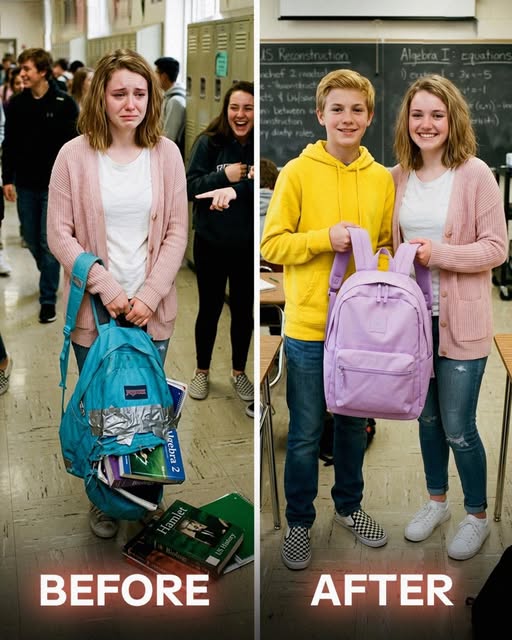
His hands were clenched on the table as he paused. He then informed me about Tessa. Months prior, a home fire had destroyed the life of a girl in his class. Everything had been taken from her, including her books, clothes, and sense of security. She lived at an aunt’s house with her mother in a cramped room. Tessa continued to attend school every day, retaining both her dignity and her grades, but she bore the scars of the fire in the shape of a half-burned, melted rucksack that was kept together by layers of duct tape.
With the distinct empathy of a fourteen-year-old, Grayson said, “The tape gave out in the hall yesterday.” Her books were all over the place. A few children chuckled. I saw her face, Mom, even though she simply knelt down and scooped them up as if it were nothing.
Grayson insisted on purchasing the backpack, despite my promise to do so. “No. I’d like to do it. I must do it.
At that moment, I understood that my son was regaining a portion of someone else’s humanity rather than merely purchasing a bag. Over the course of eight years of witnessing my survival, he discovered that a soft heart is the only remedy for a difficult life. He carefully examined every zipper and seam of a robust, deep-blue backpack while we were at the department shop. The cashier’s eyes misted as he solemnly counted out his hard-earned bills at the register.
He left the backpack on Tessa’s desk the following day before anyone showed up. He did not sign a card. He was not interested in the credit. That night, he informed me, “Kindness is what matters, Mom.” “Not the person who did it.”
That night, I fell asleep with a deep sense of tranquility. I believed I had successfully negotiated the perilous terrain of being a single mother. However, the sound of the phone ringing the following morning disturbed that tranquility.
“This is Officer Hale, ma’am. Please bring your son down to the station right now.
Panic and secret prayers filled the blur of the trip to the station. I glanced at Grayson, whose hair was still wet from his morning shower and his face was pallid. “Did something occur at school?” My voice was shaking as I asked. Did you engage in combat? Have you taken anything?
“No, mother. He answered in a weak, scared voice, “I swear.”
My heart was pounding against my ribs as we entered the station. Before I could ask for an explanation, a tall officer came up to us and raised a hand. “Ma’am, inhale. It’s not a crime that brought your son here. Because of what he initiated, he is here.
Tessa and her mother emerged as the door to a side room opened. Tessa was holding on to the brand-new blue backpack as though it were a lifesaver. Mrs. Hale, the officer’s wife and a middle school teacher, stood behind them. It was she who had witnessed Grayson abandon the present. The tale spread like a tidal wave throughout our small, interrelated town after she told her husband and he notified the station.
The next scene was a whirl of cardboard boxes and tears. For the past twenty-four hours, a response to Grayson’s “anonymous” act had been planned by the local police, the principal of the school, and a number of local business owners. They had brought us there to demonstrate that compassion is a mirror, not only to express gratitude.
A local fund had been formed as a result of Grayson’s sacrifice. For a year, Tessa’s family’s utility bills were paid for when they moved into a furnished apartment. However, the community didn’t end there. They had set up a grocery gift card program and a scholarship fund for Grayson’s future after realizing the difficulties faced by a single mother working double shifts at a diner. Bins filled with new clothes, school supplies, and even art supplies for Tessa were present.
As the crowd exploded in soft, sincere applause, Grayson muttered, “I didn’t mean for all this.”
I felt the strength of my son’s character and the calluses from the lawnmower as I grasped his hand. At that moment, I understood that the “scary” phone call was actually a call to see a miracle rather than a sign of impending disaster. By using his pocket money to purchase a bag for a classmate, my kid unintentionally taught the entire community how to take care of itself.
The atmosphere was different that night as we sat at our own supper table. The house felt more like a home than a place where we were just getting by. Tessa texted Grayson, saying, “Thank you for making me feel normal again.” At last, my father stopped pretending that the pepper was causing his eyes to moisten and started crying. We had survived the fire and emerged from it whole, not simply standing.