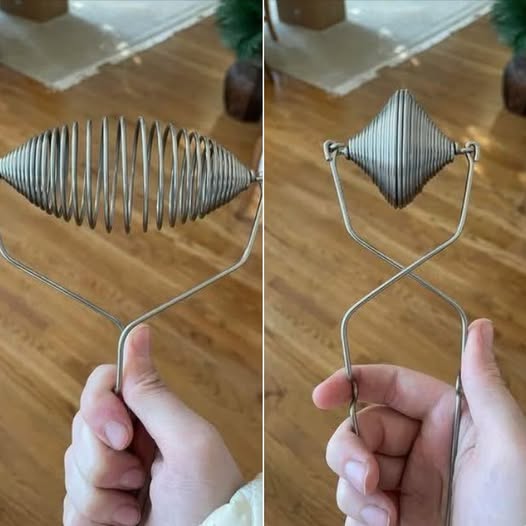
A unique artifact from a bygone era of cooking can be found tucked away in the dark, velvet-lined corners of antique drawers, frequently hidden behind hefty rolling pins and tarnished silver. It is a utensil made of simple steel and springy coils, a reminder of a period when the kitchen was not a high-tech lab of convenience but rather the home’s rhythmic heartbeat. The flour wand is this. It may appear like an odd, large piece of jewelry or a discarded industrial part to the modern eye, used to the roaring power of stand mixers and the smooth lines of silicone spatulas. However, for the baker of the early twentieth century, this straightforward wire spiral made the difference between a crumb that vanished like a cloud on the tongue and a tough, leaden bread.
The flour wand is a silent reminder of a bygone period of domesticity, when baking was a daily need that required both physical endurance and a sophisticated knowledge of ingredients rather than a carefully planned weekend endeavor meant for a social media feed. Every batch of bread, pie crust, and sponge cake needed a careful touch before the invention of heavy-duty electric motors and the homogeneity of commercial flour. The tool for that delicacy was the flour wand. Its distinctive design, which consists of a flexible, bouncing wire coil fastened to a strong handle, was designed to dance through dry ingredients. It aerated, not just stirred. It integrated rather than merely mixing. It was a device that sifted and blended concurrently without the need for a heavy, separate sieve in order to break up the tenacious clumps that sometimes afflicted stone-ground flours.
The flour wand was an extension of the arm in the hands of an expert home cook. No electric whisk could ever match the tactile sensation it provided. The baker could sense the precise time when the wet and dry elements had reached a perfect, united condition by feeling the resistance change as the coil passed through the batter. This was important because over-mixing is the biggest threat to a flaky pastry or a sensitive cake. The gluten in the flour is developed when a batter is beaten with the mechanical force of a contemporary mixer, transforming what should be a light delight into something dense and rubbery. Tenderness was guarded by the flour wand. Because of its open structure, it was able to pass through the mixture and gently fold in the flour, keeping the valuable air bubbles that give a biscuit its lightness and a cake its lift.
The physics of the flour wand has a certain poetry that has almost been overlooked in our haste for efficiency. Long hours of preparation work felt less like labor and more like a meditative dance because to the tool’s springiness, which produced a rhythmic, bouncing motion. Before stand mixers took over the heavy lifting, a woman may spend hours in the kitchen, using her strength as the only source of food for the household. The flour wand, a clever piece of low-tech ingenuity that made repeating seem effortless, was a concession to that effort. Designed to enhance the productivity of a single human hand, it was the first ergonomic kitchen tool.
These days, our kitchens are filled with specialized appliances that claim to be able to do everything for us. We have computerized scales that measure down to the milligram, blenders that can liquefy stone, and bread machines that knead silently. However, something has been lost in the changeover despite all of this technology. The closeness of the process has been lost. You are a spectator to your own cooking when you use an electric mixer. A machine does a task when you flip a switch. However, you are a participant when you handle an ancient flour wand. You are linked to the past of all those who stood in front of a wooden bowl and used flour and water to create life.
Do not write off one of these wire spirits as trash if you are fortunate enough to find one while organizing a grandmother’s cupboard or perusing a dusty section of a thrift store. It serves as a useful historical artifact. A well-made steel flour wand is practically unbreakable, in contrast to contemporary plastic instruments that break or melt. After giving it a short rinse, it can be hung back on the wall and used for another hundred years. It is a solid reminder that the best outcomes in life frequently emerge from the most straightforward methods—that ability, perseverance, and a strategically placed piece of wire can transform everyday cupboard items into enduring memories.
Nowadays, using a flour wand is a protest against the hectic speed of contemporary life. You have to slow down as a result. It allows you to listen to the peaceful, rhythmic, and essentially human sound of the wire whisking on the side of a ceramic bowl. It serves as a reminder that baking is a transformational craft. We are investing not just our time but also our attention when we take the time to fold our ingredients by hand. We are observing how the colors blend together, how the texture changes from grainy to smooth, and how the flour smells when it hits the butter.
The tactile is incredibly comforting in a day when everything is digital and throwaway. The flour wand, a tool designed to outlive its original users, serves as a tangible link to the past. It stands for a mentality that prioritizes craftsmanship over convenience and quality over quantity. It serves as a reminder that the purpose of a kitchen is to create connections rather than just generate meals. One careful fold at a time, we preserve our forefathers’ traditions as we bake with their utensils.
Therefore, think about putting the electric mixer away the next time you’re getting ready to bake a cake or a batch of muffins. In the drawer’s back, look for that strange, springy coil. Feel the wire’s bounce on the bowl and the handle’s weight in your palm. As you combine, consider the generations of bakers who fed their family during harsh winters and joyous summers by using this exact technique. Even though you don’t see the flour wand very often these days, its legacy is evident in every soft, properly risen loaf of bread and every delicate crumb. It is a tiny bit of metal that has a great deal of heart, serving as a reminder that the hand that stirs a recipe has always been its most crucial component.