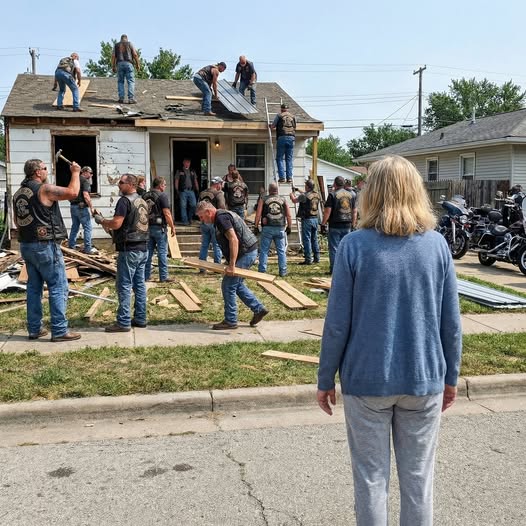
Before the earth broke apart, the sky over our little village had turned a bruised shade of purple. Not only did the tornado remove the shingles from my mother’s roof in four minutes, but it also obliterated forty-one years of history. As a sixty-four-year-old widow, my mother Dorothy was already drowning in a new type of silence. No amount of time seemed to be able to replace the vacuum at the breakfast table left by the unexpected death of my father, Frank, in January. The only thing she had left of him was the house he had constructed in 1986 with his own rough hands. After the storm, her life was reduced to a pile of broken pine and a jagged foundation.
Although Mom relocated into my basement, she wasn’t actually there. Her clothes hung off a frame that appeared to get smaller every day, and she stopped eating. I used to lie awake at night, listening to her sobbing through the floorboards in a muted, repetitive sound. She had no savings to rebuild and no insurance at all. Convinced that her story had died along with my father and their house, she was waiting for the end. That is, until our neighbor called in a panic on a Friday morning, begging us to come to the lot right away because something unbelievable was happening.
I applied the brakes hard as we rounded the curve onto her street. Black leather and shiny chrome lined the asphalt for two city blocks. There were hundreds of motorcycles parked in a beautiful line. An army of strangers was already working on the vacant patch of earth where the house formerly stood. It appeared to be a motorcycle group staging a military operation. With a coordinated intensity that defied rationality, ladies with tattoos on their arms and men with graying beards were swinging hammers, running electrical wire, and unloading lumber.
I walked up to a huge man who was examining a set of blueprints while leaning over the hood of a truck. His arms were like corded oak, and he wore a patched vest. He just put a heavy hand on my shoulder when I asked him who had sent them and who was funding the enormous project. He informed me that they were come to address the one issue they could because my mother had suffered enough in a single year. The neighborhood was filled with the steady rhythm of building and the sound of saws for seventy-two hours. From sunrise till the stars in the midnight sky became hazy, they labored. As a new home emerged from the dust of the old one, my mother sobbed for three days in a row while sitting in a lawn chair across the street.
The street was quiet by Monday morning. The bikers had disappeared as fast as they had come. They were replaced by a house that was a work of art. It was a resurrection rather than merely a replacement. Even the particular wrap-around porch my father had created, complete with the handcrafted swing where my parents loved to watch the sunset, had been replicated. One sealed envelope was sitting on the new kitchen counter inside. When my mother saw the four words scrawled on a piece of notebook paper, she opened it with trembling fingers and fell into my arms.
I became fixated on identifying these individuals for the following two weeks. My father was a modest man who had a little repair company as a local contractor. He was the type of man who wore flannel shirts and went to bed by nine; he wasn’t a biker. I was engrossed in the mystery until I was directed to the Iron Horses Veterans MC by a neighbor. I found them in The Rusty Chain, a smokey, dark pub sixty miles south. I felt strange as I walked in there in my khakis and polo shirt, but as soon as I said my father’s name, everything changed.
The man with the blueprints, Sal Marchetti, sat me down and told me a story about my father that completely changed my upbringing. He described how, as a convicted felon with nowhere to go, he entered my father’s shop in the late 1990s. My father had only inquired if Sal could arrive on time and put in a lot of effort; he hadn’t checked his record or his tattoos. Sal was only the first. My father had run a secret underground railroad for the forgotten and the broken for thirty years. He employed struggling veterans, recovering addicts, and ex-convicts who the rest of the world considered unemployable.
He never told me, and he never told my mother either. He thought that boasting about a nice deed turned it into a transaction rather than a gesture of goodwill. Sal calculated that my father’s shop had seen more than a hundred men and women. In addition to providing them with a salary, he also helped them launch their own enterprises, taught them a profession, got them out of jail on bond, and escorted them to meetings. A network of thankfulness that stretched hundreds of miles was created when the tornado struck. Every every nail and pipe was given by former workers who now ran plumbing businesses and lumber yards. With their tool belts in their sidecars, men who hadn’t seen one another in decades drove through the night.
Frank Patterson saw a human being worth preserving thirty years ago, which is why they built the house, not because they were bikers. They regarded him as a brother, a man who upheld a code of silent integrity that they respected with their sweat and abilities, which was all they had.
The next week, when I took my mother to the bar, everyone in the room silently saluted me. The enormous guys in leather dwarfed my small mother, who thanked them for the house. However, she then informed them that they would never again be permitted to leave without saying anything. They are now family, she informed them, and family stays for dinner.
The calm neighborhood is now filled with the faint roar of engines every other Sunday. Serving pot roast to a room full of individuals the world had given up on, my mother is a chef for an army. She is an honorary member of the club that saved her life, and she wears a black leather vest over her Sunday cardigan. A foreman who upholds the same standards as my father continues to operate my father’s shop. The family name is still on the sign outside, but the words “Everyone deserves a chance” have been added at the bottom. Instead of leaving us a fortune in the bank, my father gave us a legacy made of stone, wood, and the unwavering devotion of two hundred people who demonstrated that the good you put into the world always finds its way back home.