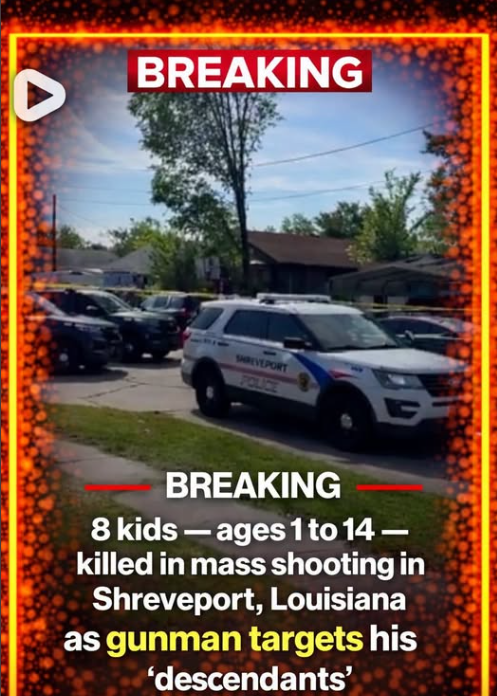
The screams began almost before anyone could process what was happening. In the quiet, unassuming neighborhoods of Shreveport, where the rhythms of life were usually measured by the laughter of children, the bark of a dog, or the occasional passing car, terror erupted suddenly and without warning. Three homes—each seemingly ordinary, each a sanctuary of family life—were transformed into killing grounds within minutes. A gunman moved through the streets and interiors with calculated precision, targeting children in their own bedrooms, living rooms, and play areas. The horror was compounded by the fact that some of the victims were his own descendants, making the violence both incomprehensible and deeply personal. Among those lost were babies who had barely learned to crawl, toddlers discovering the first joys of speech, and teenagers with their own budding independence. Ten shots rang out in succession, each one a rupture in what had been a calm night, and eight young lives were extinguished almost instantly. What followed was a frantic scramble—a desperate carjacking, a harrowing chase through the streets, and a final confrontation that left only devastation in its wake.
The aftermath left a silence so thick it felt almost tangible, pressing down on neighbors and first responders alike. In the homes once filled with the ordinary sounds of life, officers moved cautiously, room by room, beneath flashing red and blue lights, encountering the unthinkable: children who had gone to bed expecting only another ordinary night, now gone forever. Investigators determined that the shooter had specifically targeted three homes, killing children ranging in age from just one to fourteen years old. Then, abandoning the residences, he fled on foot, forcing a driver from a vehicle at gunpoint in a chaotic bid for escape. Witnesses recall the terror as surreal, the kind that freezes your heart while the world around you seems to continue moving, utterly indifferent to the unfolding nightmare.
Law enforcement eventually intercepted the suspect near the intersection of West 79th Street and Linwood Avenue. The pursuit ended in a violent confrontation, with officers firing in response and ultimately killing the gunman in the street. Behind this resolution lay an “extensive” crime scene stretching across two blocks, encompassing three homes that had been shattered both physically and emotionally. Shattered glass, overturned furniture, and blood-streaked walls told a story of lives interrupted, futures erased. Families huddled together, struggling to comprehend how someone could turn on their own blood with such callous determination. Friends, neighbors, and city officials struggled to find words that could encompass the scale of grief, fear, and outrage that now blanketed the community.
Shreveport’s police chief addressed the media in the hours that followed, outlining the sequence of events with somber clarity, yet the facts alone could not convey the depth of trauma. Families confronted a dual reality: mourning the young lives stolen and grappling with the sheer randomness of violence entering spaces meant to be safe. Community members spoke of a city that now bore an invisible scar, wondering how a place defined by its shared routines and small joys could begin to breathe again. Vigil vigils, candlelight gatherings, and neighborhood meetings sprang up almost immediately, a testament to collective grief and the human need for connection in the face of incomprehensible loss. Shreveport, like so many communities before it, was left with the impossible task of honoring the eight children lost while also wrestling with the terrifying awareness that safety—once assumed—was fragile and contingent.
The tragedy sparked broader questions about the intersections of domestic violence, mental health, and gun access, raising urgent debates in city hall, at kitchen tables, and across social media platforms. Experts, advocates, and ordinary citizens wrestled with the same painful reality: how could a person commit such atrocities, and how could future tragedies be prevented? Yet even amid discussions of policy and prevention, the immediate, human grief remained unassailable—the parents, siblings, and friends who would now navigate life without the bright presences of their children. The city, once punctuated by ordinary sounds of everyday life, had been forced to reckon with silence heavier than any noise it had known, a reminder that some forms of loss leave marks that no measure of time or reason can fully erase.