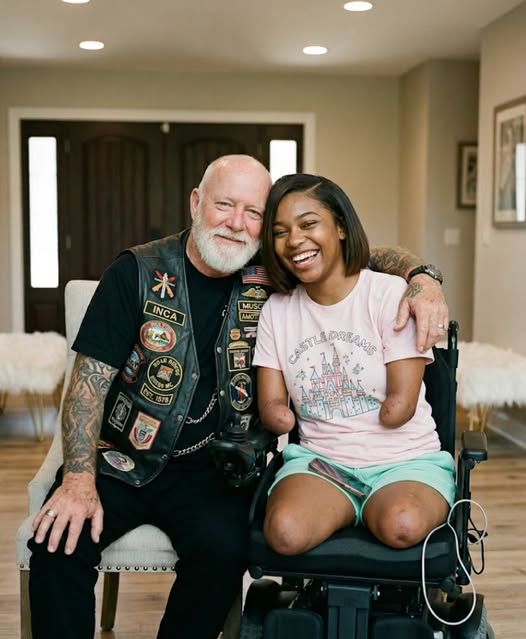
My whole life, I thought I was the kind of girl people helped, not the kind they kept. I learned early how quickly attention faded—how doctors spoke gently but briefly, how social workers promised things that sometimes never materialized, how people looked at my wheelchair first and my name second, if they remembered it at all. I built my expectations around that pattern. Temporary care. Temporary interest. Temporary everything. So when a stranger in a worn leather vest walked into the cold, fluorescent-gray state building and said the one word no system, no file, no caseworker had ever dared attach to me—adopt—it didn’t feel real. It felt like a mistake someone would correct any second.
I tried to push him away the way I had learned to push everyone away: not with anger, but with honesty sharpened into a weapon. I listed the things that usually made people leave. My legs. My medical history. The appointments, the uncertainty, the nights that ended in hospital hallways instead of sleep. I told him what I had been taught to believe about myself—that I was complicated in the way people admire from a distance but don’t choose for a lifetime. I waited for the flinch. I waited for the polite retreat. But Robert didn’t move. He didn’t soften into pity either. He just listened, like my words were information, not warnings.
And then he stayed.
Not dramatically. Not loudly. Just stayed. In the meetings. In the waiting rooms. In the uncomfortable silences where most people eventually found excuses to leave. He showed up again and again until my defenses stopped feeling like protection and started feeling like walls I no longer needed. Eight months later, when the judge’s gavel finally fell and the paperwork became something real instead of just a possibility, I didn’t know what to do with the sound of it. It felt too final for something I had spent my entire life believing would never happen.
Outside the courthouse, I expected awkward congratulations or quiet dispersal. Instead, I was met with the low, growing thunder of engines. A whole line of motorcycles filled the parking lot like a perimeter around something sacred. Men and women I barely knew, all there because Robert had called them, all there because in his world, family didn’t end at paperwork. When the engines roared in unison, it wasn’t chaos. It was recognition. It was claim. It was belonging announced loudly enough that even I couldn’t misunderstand it.
That was the moment everything inside me shifted. Not because the noise was overwhelming, but because for the first time, it felt like it was meant for me.
That was the day I stopped believing I was temporary.
I remember the quiet after the gavel more than anything else. The way the courtroom seemed to exhale, like even the building itself understood something had changed. Robert didn’t turn it into a performance. He didn’t try to make it bigger than it was. He just placed a steady hand on the back of my wheelchair, grounding me the way he always did when the world felt too fast, and said, almost casually, “Let’s go home, kid.” Those three words landed harder than any speech ever could. Because they didn’t sound like permission. They sounded like certainty.
Outside, the bikes waited in formation, not as spectacle but as protection. As if my arrival mattered enough to be guarded. For someone who had spent her whole life being something people passed through, it was disorienting in the best possible way.
In the years that followed, the miracle didn’t turn into perfection. That part is important. Love didn’t erase reality. Robert still has nights where his PTSD pulls him somewhere I can’t follow, where silence becomes heavier than words. And I still have my own moments—old fears that surface without warning, reflexes built from years of expecting abandonment. We’ve argued in kitchens at midnight. We’ve misunderstood each other in ways that hurt more than either of us meant. But something fundamental changed the moment the judge said yes.
We don’t leave.
When the nightmares come, they don’t happen in isolation anymore. His or mine, there’s always someone awake enough to say, I’m here. That changes everything—not because it fixes the past, but because it interrupts its ability to repeat itself.
Angela’s letter still sits folded in my top drawer, worn at the edges from how many times I’ve opened it and closed it again. Her words feel less like a memory now and more like a bridge—between the girl who waited to be chosen and the daughter who learned what it feels like to already be claimed.
I used to think love was measured by how long it took for people to leave.
Now I understand it differently. It’s measured in the ordinary days where no one walks away. In the quiet mornings where the world doesn’t demand proof. In the steady, unremarkable truth that I am not waiting to be kept anymore.
I already am.