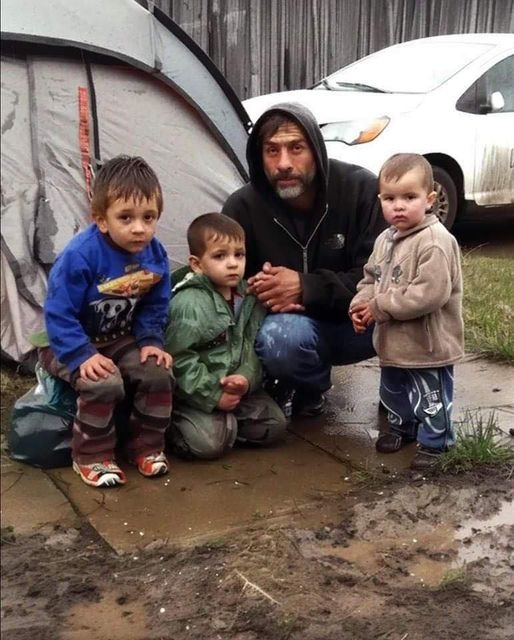
Sean was already broken long before the test ever arrived. Not the dramatic kind of broken that announces itself loudly, but the quiet kind that settles into a person after too many losses in too short a time. No stable job, no permanent place to sleep, and three children looking at him every day with the kind of hunger that went beyond food. At the end of that long, collapsing stretch of life, there were only two crumpled dollars left between them and complete uncertainty. Not enough for a meal, not enough for gas, not enough for even a few more hours of stability. Just enough to make the next decision feel like a verdict on who he was as a father.
The car appeared out of nowhere on that empty roadside, its engine coughing as it slowed beside him. The driver leaned out, frantic, voice shaking with urgency. His wife, he said, was in labor. They were stranded. They needed gas—just enough to reach the hospital. He had no time to explain more, only desperation spilling through every word. Sean looked at him, then at his children sitting quietly behind him, and felt something inside him fracture further. Those two dollars in his hand suddenly felt heavier than anything he had ever carried. Every instinct told him to keep them. Every calculation of survival screamed that his own children came first. And yet, beneath all of that, something else rose—something quieter, older, and harder to ignore.
He didn’t make a rational decision. There was no time for that. It was a moment where thought and instinct collided and neither fully won. His fingers closed around the money, and for a second he simply sat there, frozen between two unbearable truths: to refuse meant protecting his own children in the most immediate sense, and to give meant risking them for a stranger he might never see again. He thought that was the entire choice. A private moral collapse happening in the middle of nowhere, witnessed only by dust and silence.
He handed the money over.
The stranger didn’t argue or hesitate. He took it with shaking gratitude, promising to repay him, promising everything and nothing at the same time, then disappeared down the road in a rush of fading engine noise. Sean sat there long after the car was gone, staring at his empty hands, expecting regret to arrive like a punishment. Instead, what he felt was a strange, hollow stillness—like something had been taken from him, but also something had been quietly recorded.
What Sean did not know was that the breakdown on that road had not been an accident of circumstance alone. The man he helped was not simply a desperate husband. He was part of something far larger and more deliberate than Sean could possibly imagine in that moment. The situation had been observed from a distance, not in a way that interfered, but in a way that studied. Every hesitation, every glance toward his children, every tremor in his decision had been noted by someone who understood exactly what it meant to choose generosity when survival itself was unstable. To Sean, it had been chance. To someone else, it had been a measurement.
Days later, when Sean had almost convinced himself it had been a meaningless sacrifice, the stranger returned. But he did not return as someone in need. He returned as someone carrying consequences and opportunities that had already been prepared long before that roadside encounter. He spoke differently now—calmer, more certain. He knew Sean’s name. He knew his situation. And he knew exactly what Sean had given up without being asked. There was no dramatic reveal of identity at first, only the quiet unfolding of intention: work arranged in advance, housing already secured, support systems already waiting to be activated the moment Sean was found to be what they were looking for.
What changed Sean’s life was not just generosity, but recognition. Someone had been watching for a specific kind of decision under pressure—the kind that reveals character when everything else has been stripped away. Sean had passed that invisible threshold without knowing it. And in doing so, he stepped into a life that had been quietly prepared as a response, not to his desperation, but to the integrity he showed within it.
The transition was not instant in the emotional sense. Stability did not erase memory. Even as his children began eating regularly again, even as walls replaced tents and uncertainty gave way to routine, Sean carried the imprint of that road with him. He understood, more than ever, how thin the boundary is between giving and losing, between kindness and self-destruction. That understanding did not harden him into bitterness. Instead, it reshaped him into something more deliberate.
As time passed, Sean began to see other versions of himself in the people he passed—men and women standing at intersections of need and impossibility, trying to calculate outcomes that could not be calculated. He remembered the weight of those two dollars. He remembered the feeling of choosing without safety nets. And slowly, he began to act again, not because someone was watching, but because he knew what it meant when no one does.
He used his work, once it stabilized, not only to rebuild his own life but to quietly extend it outward. Meals for families who had none. Small shelters for people who had nowhere to sleep. Conversations with people who felt invisible. Not grand gestures, not public declarations, but steady, repeated acts that filled spaces he once occupied.
And somewhere in that process, Sean came to understand something simple but unshakable: the moment on the roadside had not just been about survival or reward. It had been about definition. Not who he was when life was stable, but who he chose to be when it was not.
Years later, his story would circulate in fragments—not as a tale of sudden rescue, but as something more unsettling and more honest. A reminder that moments of extreme scarcity do not strip people down to nothing; they reveal what remains when nothing else is left to hide behind. And that what you choose in those moments does not disappear into the past.
It follows you.
And sometimes, if you are fortunate—or chosen—it comes back to meet you on the road again, in a very different form.