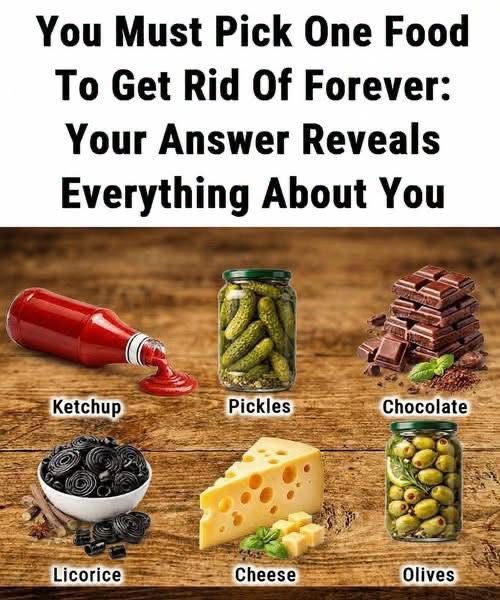
Imagine you’re sitting across from someone who asks you what seems like a harmless dinner-table question, the kind of light prompt people throw around in conversations or online threads. The idea sounds simple: if you had to eliminate one specific food from your life forever, which would it be? Not for a week, not for a challenge, not with any exceptions for holidays or special occasions. Once you name it, it disappears completely from your world, as if it never existed at all. No loopholes, no “just this once,” no cheating the rule. A permanent and total break from that food.
Most people react at first with amusement. They answer quickly, almost without thinking, picking something they already dislike—Brussels sprouts, maybe, or a strong cheese they avoid anyway. It feels like a clever way to “win” the question. But as the silence lingers and the reality of permanence sets in, the tone changes. The lightness fades. People hesitate. And in that hesitation, something more serious begins to appear.
Because once you take the question seriously, you realize it’s not really about food at all. It’s about memory, identity, and the quiet emotional weight attached to everything we eat. Choosing to erase a food is not just removing a flavor from your life—it’s removing entire chapters of experience tied to it.
If you say pizza, for example, you aren’t just losing dough, cheese, and sauce. You are also losing late-night celebrations, shared boxes with friends, family movie nights, and spontaneous moments of joy after something good happens. If you choose to eliminate soup, you might unknowingly be cutting away memories of being cared for when you were sick, perhaps by a parent or grandparent who made it with patience and love. Every option carries invisible emotional connections you only notice when you’re forced to let them go.
That pause before answering becomes revealing. It shows how deeply food is tied to emotional memory. Our minds begin scanning years of experiences, realizing how many important moments are anchored to something as ordinary as a meal. We don’t just eat food—we build our lives around it in small, unnoticed ways.
Some psychologists argue that what we are willing to give up reflects how we organize our inner world. People who quickly discard sweets or indulgent foods may prioritize discipline, control, or structure. For them, food is functional. Others, who struggle to give up comfort foods, often connect eating with emotional stability, joy, or security. A single dish can act as a grounding ritual in a chaotic world. So the answer to the question quietly reveals what someone relies on most to feel emotionally balanced.
The foods people refuse to lose are just as telling. Bread, for many, feels almost essential—like a symbol of stability and daily life itself. To remove it feels like removing something foundational. Chocolate, on the other hand, often represents ritual rather than necessity: a small, private comfort at the end of a difficult day. Losing it isn’t about hunger—it’s about losing a moment of peace that belongs only to you.
The scenario also highlights something about modern life: abundance. We live surrounded by endless food choices, available almost instantly from anywhere in the world. Because of that, we rarely think about scarcity. But this question introduces artificial limitation, and suddenly every choice feels heavier. Even something as simple as an apple becomes more valuable when you imagine never being allowed to taste it again. The mind reacts with a subtle form of grief—not for what is gone, but for the idea of losing it.
There is also a social layer to the answer. People often unconsciously choose foods based on the identity they want to project. Someone might say fast food, not because they truly want to lose it, but because it aligns with an image of health or discipline. Yet privately, they may still feel attached to the comfort and simplicity it represents. The question exposes the difference between how we present ourselves and what we actually rely on.
And if someone struggles to answer at all, that hesitation says something deeper: it suggests a life where even ordinary meals are tied to meaningful experiences, where nothing feels easily disposable because everything carries some emotional weight.
In the end, the question works like a mirror. It isn’t really asking about taste—it is asking about attachment, memory, and identity. It forces you to confront what you value enough to keep and what you are willing to sacrifice, even hypothetically. And the longer you think about it, the clearer it becomes that food is never just food. It is time, place, people, and feeling compressed into something you can hold in your hands.
So when you finally answer, you aren’t just naming a dish. You are revealing a small map of your life—what shaped you, what comforts you, and what you might not be ready to lose.