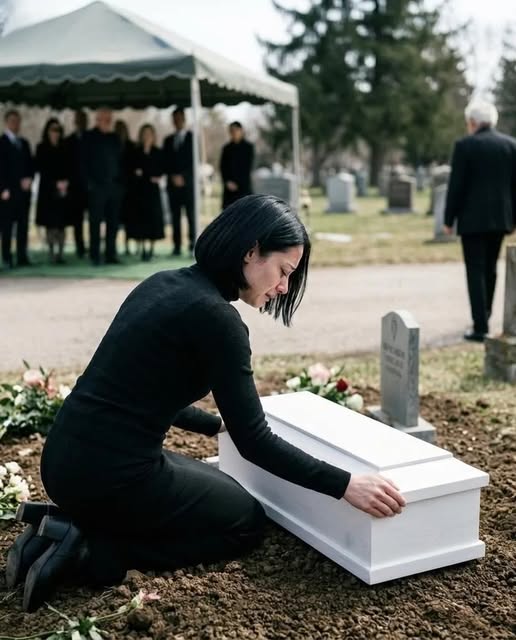
The day I said goodbye to my daughter, the world turned into something cold and silent, defined by a grief so heavy it felt like it was physically pressing on my chest. Standing in that quiet, somber room, I was filled with an emptiness no words could ever truly describe—a hollow ache for a life that had only just begun to bloom.
But as I looked around at the small gathering of friends and distant relatives, the most painful part of the day wasn’t the grey sky or the flowers. It was the absence of the two people who were supposed to be my anchors. My parents—the very people who brought me into this world—chose not to attend their own granddaughter’s farewell. Their reasons were distant and detached, tied to other obligations they considered more important. In that moment, something inside me broke. The illusion of a supportive family vanished, replaced by a clarity that would change everything.
For years, I had believed the support I gave my family was mutual—that it was love expressed through quiet responsibility. I had inherited a significant estate from my grandmother, who believed wealth should be used to create stability. Following her example, I had spent years quietly holding my family together financially. I helped my brother keep his struggling business afloat. I eased my parents’ financial burdens without ever asking for recognition or thanks. I thought that was what love looked like.
But standing by my daughter’s small casket, I understood something I had refused to see: my kindness had become invisible. My parents had grown so accustomed to my support that they no longer saw me as someone who could be hurting. I was no longer their daughter in grief—I was simply the system that kept their comfort running.
Later that same day, still surrounded by the scent of lilies and the weight of loss, I didn’t turn to comfort. I picked up my phone and called Rebecca, my attorney. She had helped me navigate my grandmother’s estate years earlier and understood the structure of the trusts I managed. My voice was steady as I told her I had reached a point where generosity without respect was no longer sustainable.
With her guidance, I began the process of withdrawing the financial support I had provided my family for years. It wasn’t about revenge. It was about boundaries. The funds supporting my brother’s business were redirected. The monthly allowances that had quietly sustained my parents’ lifestyle were brought to an end. Everything was handled legally, carefully, and clearly. But the message was unmistakable: things would not continue as they had.
The reaction came quickly. Within two days, my phone filled with messages—confusion, anger, and disbelief. It was striking how quickly those who had been “too busy” to attend a funeral found time to argue about money. They accused me of being cruel, of acting out of grief. But what I saw was something different: not concern for my daughter, but panic over losing comfort.
That realization hurt in a way I can’t fully explain, but it also brought clarity. For the first time, I saw the true shape of my relationships without the illusion of obligation holding them together.
In the weeks that followed, everything shifted. Conversations became harder, stripped of old assumptions. Some ended in silence. Others slowly revealed truths that had been buried for years. I spent most of my time visiting my daughter’s resting place, learning how to grieve without the noise of expectation or guilt.
I began to understand that moving forward didn’t mean forgetting. It meant refusing to continue living in a pattern where my pain was invisible and my worth was measured only in what I could provide. I was no longer willing to be the quiet foundation for people who could not show up when it mattered most.
Gradually, I rebuilt my life around something different—relationships grounded in respect rather than dependency, honesty rather than assumption. I learned that love cannot be bought, and presence in the darkest moments reveals everything about where you truly stand in someone’s life.
My grandmother once told me that wealth was responsibility, not power. I finally understood what she meant. My responsibility now was not to carry others at the expense of myself, but to protect my own heart and honor my daughter by living a life that was honest and whole.
What happened next is not just a story of family and finances—it is the story of a woman who found her voice in the middle of unbearable silence. My parents may have missed their granddaughter’s final goodbye, but in doing so, they also lost the version of me that had spent a lifetime trying to hold everything together for them.
Now, I move forward differently. The grief remains, but it no longer sits beside the bitterness of being taken for granted. I have learned to choose peace over obligation, truth over illusion, and boundaries over silence. And for the first time, my life belongs fully to me.