A captain deployed overseas. A grandmother’s lake house. And a single folder that turned a long-running family story into a legal case that could not be ignored.
The photo arrived at two in the morning, Qatar time. I was lying on a cot in temporary barracks I shared with three other officers when my phone lit up the ceiling before I even fully registered what I was seeing.
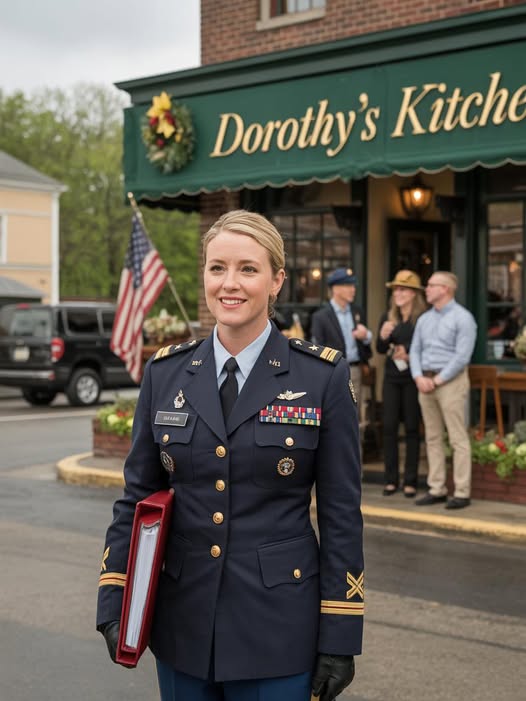
My sister Sabrina stood in front of a restaurant storefront, arms spread wide, wearing an apron and a smile that belonged to someone who had just won something she deeply wanted. Behind her, a polished wooden sign in gold lettering read Dorothy’s Kitchen. She had named it after our grandmother—the same grandmother who had been buried four months earlier while I watched a shaky livestream from six thousand miles away, because my father had told me not to come home.
The message beneath the photo read: Thanks for your service—followed by a smiley face.
I set the phone down.
I lay there in the dark listening to the air conditioning unit rattle against the wall. I didn’t reply. Not that night. Not the week after. Not for months.
To them, my silence meant surrender. That was how they had always interpreted me—quiet as agreement, distance as acceptance, endurance as compliance. They assumed deployment had finally worn me down enough to return home, sit at the table, and absorb whatever version of reality they had prepared.
They were wrong.
I wasn’t disappearing.
I was preparing.
In the Vance household, hierarchy wasn’t explained. It was absorbed.
My father, Roy Vance, had spent twenty-two years managing a bank branch and brought that logic into the home like an operating system. Anything over fifty dollars required approval. Every disagreement eventually circled back to his final word. When he spoke, the room adjusted. When he decided, everyone else adapted until it looked like agreement.
My mother, Elena, hadn’t worked in decades. Her role had slowly become indistinguishable from her personality: smoothing tension, reinforcing my father’s position, repeating your father knows best until it no longer sounded like a sentence and more like weather.
My sister Sabrina was three years older. She never stayed with anything long enough to be defined by it, but she stayed close enough to remain safe inside the family system. My father paid her rent. My mother defended her choices. She was the one who stayed nearby, and that proximity was rewarded in ways I learned to recognize early.
I was the opposite.
I joined ROTC without asking permission. I accepted my Army commission and told my father over Thanksgiving dinner during my junior year of college.
He set his fork down slowly.
“You’ll regret this,” he said. “The military doesn’t care about you, Janice.”
My mother pressed her napkin to her mouth. Sabrina stared at her plate. No one defended me.
The only person who didn’t treat my decision like a disruption was my grandmother, Dorothy Vance.
She was seventy-four, barely five feet tall, and the one person in that family who never confused authority with truth.
On the morning I left for Officer Basic, she drove me to the airport herself. She got out of the car, pulled me into a hug, and said:
“This house will always be here for you. And so will I.”
I didn’t know then that it would be the last summer I would spend at the lake house without it becoming something I would have to fight for.
I was fourteen weeks into a logistics deployment at Al Udeid when I learned she was dead.
Not by phone call.
By email.
2:47 a.m. local time. Four sentences. No softness. No ceremony. My grandmother had passed on Tuesday. Funeral on Saturday. They understood I couldn’t come.
The woman who had taught me how to balance a checkbook and clean a fish and hold my ground in a room full of people trying to talk over me had been reduced to a notification.
I requested emergency leave immediately. It was approved.
I called home to say I was coming.
My mother told me everything was already arranged. The flowers were ordered. The service was handled. There was no need to disrupt things.
I could hear my father in the background. Then my mother returned and said, softer, that it would be better if I stayed. That rushing back and forth wouldn’t help. That Grandma would have wanted me focused on my duty.
They didn’t want me there.
I didn’t yet understand why that mattered so much to them.
At 3:00 a.m., I watched the funeral through a livestream. The camera shook. The room was full of people I knew. None of them had called me.
Sabrina stood at the podium and said Grandma would have wanted us to stay together.
I turned my phone off.
I told myself it was thoughtlessness.
I was still trying to find explanations that didn’t require betrayal.
Two weeks later, an email arrived from the estate attorney.
Attached was a PDF.
The will was simple.
Her savings divided between my father and me.
And the lake house—valued at roughly $520,000—left to one person.
Me.
Not “the family.”
Me, by name.
Signed. Witnessed. Notarized.
Three weeks before her death, my grandmother had driven herself to the attorney’s office and said, it’s done. Janice gets the house.
I called my father immediately.
“I can’t believe she left me the lake house,” I said.
His silence wasn’t confusion. It was calculation.
“We need to talk about that,” he said finally. “Your grandmother wasn’t thinking clearly.”
“She sounded clear every time I spoke to her.”
“You weren’t here,” he said. “You don’t know what she was like.”
He hung up before I could respond.
When I called the attorney back, he confirmed probate was proceeding normally.
I believed him.
I shouldn’t have.
The deployment intensified. Fourteen-hour shifts. Constant logistical changes. I emailed my father twice about the estate. No response.
My mother said everything was being handled.
Sabrina didn’t answer at all.
Something felt wrong, but I couldn’t name it. It sat in the background like pressure in the air before a storm.
At night I dreamed of the lake house dock stretching farther and farther away, my grandmother standing at the end, never getting closer no matter how far I walked.
One night, I called Eleanor Briggs, my grandmother’s neighbor.
She answered immediately.
She mentioned a for-sale sign she had seen near the lake. She wasn’t sure which property.
I told myself it didn’t matter.
It did.
It took me forty minutes to find the county records.
When the page loaded, the details were simple:
Property: 2147 Shoreline Drive
Owner of record: transferred
Sale date: March 14
Seller: Janice Vance (via power of attorney, Roy Vance)
Sale price: $520,000
My name was on a transaction I had never agreed to.
I called my father.
“I counted on it,” he said. “It was the right decision. Sabrina needed capital. The restaurant is for the whole family.”
“You forged my name,” I said.
“I made a decision for this family,” he replied. “That’s what fathers do.”
Then he hung up.
That was the moment something inside me stopped being negotiable.
Not breaking.
Hardening.
Major Ethan Caldwell from JAG didn’t waste time on comfort when I emailed him. I sent the property record, my grandmother’s will, and Sabrina’s restaurant photo.
His first question was simple:
“Were you in the state when this happened?”
“No.”
“Did you sign anything?”
“No.”
“Did you authorize anyone?”
“No.”
He wrote notes without looking up.
“This is forgery,” he said. “Possibly fraud depending on financial transfer. And there’s something in your favor—you were deployed under federal orders. The Servicemembers Civil Relief Act matters here.”
“This isn’t a family dispute,” he added. “It’s a criminal case.”
He told me not to contact my family.
So I didn’t.
I built a folder.
Lanier.
And my family, believing silence meant defeat, gave me everything I needed.
The messages escalated.
My mother: guilt, then anger, then apology, then “we’re family.”
Sabrina: photos of the restaurant, warm lighting, captions about legacy.
My father: when you’re ready to act like an adult, call me.
They didn’t realize they were documenting everything.
Every message. Every post. Every contradiction.
I saved it all.
Then I spoke to Eleanor again.
She confirmed what my grandmother had said before the will was finalized:
Roy will try to take it. That’s why it’s only in Janice’s name.
My grandmother had known.
And they did it anyway.
Then came the final piece.
Eleanor wrote, almost casually, that my grandmother had tried calling me for years. That my father always answered. That messages never reached me.
She had died believing I had stopped caring.
That was the moment I broke—not for the house, but for the lost time I could never recover.
I cried for the calls I never received.
Lauren Whitaker, a real estate fraud attorney, reviewed everything without small talk.
She showed me the forged power of attorney.
At first glance, it was close.
But not close enough.
“The signature was practiced,” she said. “But not yours.”
Then she added something else:
“The notary is someone your father knew professionally.”
That was the structure.
Not confusion.
Not mistake.
A system built on familiarity, trust, and assumption that no one would look closely enough to challenge it.
She looked at me.
“And they’re wrong,” she said.
The photo arrived at two in the morning, Qatar time. I was lying on my cot in temporary barracks, sharing the room with three other officers, and the glow of my phone lit up the ceiling before I even fully processed what I was seeing.
My sister Sabrina stood in front of a restaurant storefront, arms spread wide, wearing an apron and a smile people use when they are extremely proud of themselves. Behind her was a polished wooden sign in gold lettering that read Dorothy’s Kitchen.
She had named it after our grandmother. The same grandmother who had died four months earlier, while I watched the funeral through a shaky livestream from six thousand miles away because my father had told me not to come home.
Under the photo was a single message: Thanks for your service, followed by a smiley face.
I set the phone down. I didn’t respond. Not that night, not the following week, and not for three months afterward.
My family interpreted my silence as surrender. They had always been trained to read my quiet as acceptance, and they read it that way again now. They assumed the distance and deployment had worn me down enough that I would eventually return home, sit at the table, and accept whatever they had decided for me.
They were wrong. I was not disappearing. I was preparing.
Growing up in the Vance household, you understood the hierarchy early without ever needing it explained. My father, Roy Vance, worked for twenty-two years as a bank branch manager and brought that structure into the home. Every major decision ran through him. Every expense was subject to his approval. When he spoke, you listened. When he decided, you complied.
My mother Elena did not work outside the home and had long ago settled into the role of maintaining peace, aligning herself with my father’s position, repeating that “your father knows best” so often it no longer sounded like a choice.
My sister Sabrina was three years older than me. She drifted from interest to interest without settling into anything stable. My father financially supported her, and my mother defended her choices. She was the daughter who stayed close, who was easy, who did not challenge the structure of the family.
And I was the other kind.
I joined ROTC in college without asking permission. When I told my father I had accepted an Army commission, I watched him set his fork down and look at me like I had crossed a permanent line.
“You will regret this,” he said. “The military doesn’t care about you, Janice.”
No one defended me at that table.
The only person who didn’t treat my decision as a problem was my grandmother, Dorothy Vance. She was seventy-four, barely five feet tall, and she drove me to the airport herself when I left for Officer Basic. Before I went inside, she held me and said something I carried through every deployment:
“This house will always be here for you, Janice. And so will I.”
I did not know then it would be the last summer I would spend with that promise still intact.
I found out she had died through an email from my mother at 2:47 in the morning. Four sentences. No warmth. No detail. Just information.
I tried to come home for the funeral, but my father told me not to. He said it would disrupt things. I watched it instead through a livestream, seeing Sabrina speak about family unity while I sat alone thousands of miles away.
Two weeks later, I received an email from the estate attorney.
My grandmother had left me the lake house.
Only me.
But my father immediately contested it, claiming she had not been mentally clear. I knew that wasn’t true. He was already trying to reshape what she had decided.
Then I discovered something worse: the property had already been sold. With a power of attorney bearing my signature.
A signature I had never made.
When I investigated further after returning from deployment, the truth became clear. My father had forged my signature, used it to create a false power of attorney, and sold the property. The money had gone directly into Sabrina’s hands to fund her restaurant.
What they thought I would accept quietly, I instead documented.
Every message. Every post. Every voicemail. Every contradiction.
They believed I was silent because I had given up.
In reality, I was building a case.
A military JAG officer confirmed what I already suspected: this was not a family misunderstanding. It was fraud.
Forgery. Real estate fraud. Potential wire fraud.
Because I was deployed at the time, the Servicemembers Civil Relief Act also strengthened my position.
I was told not to contact my family. Everything they said would only weaken the case.
So I didn’t.
I let them continue speaking.
And they kept providing evidence without realizing it.
When the lawsuit was filed, everything changed.
A forensic document examiner confirmed with near certainty that the signature on the power of attorney was not mine.
The case moved quickly from civil dispute to criminal investigation.
My father, mother, and sister were all named.
When the process server arrived at their house, I was told my father’s face went pale instantly.
And for the first time, the story they had controlled for years began to collapse.
In court, the evidence was presented clearly: forged documents, illegal notarization, sale records, and financial transfers.
My father tried to argue “family intent.” The judge stopped him immediately. There was no authorization. There was only fraud.
My grandmother’s close friend testified that she had been fully aware of my father’s tendencies and had explicitly placed the house in my name to prevent exactly this outcome.
And then came the part that changed everything:
My grandmother had tried to reach me for years, but my father had intercepted those calls. I had never known. She had died believing I had stopped caring.
That was the part that hurt the most.
Not the property.
The time I lost with her.
The judge ruled in my favor.
Full restitution. Damages awarded. Case forwarded for criminal prosecution.
My father collapsed in his seat afterward, as if the structure holding his authority together had finally given way.
But I did not feel victory.
I felt finality.
In the aftermath, everything in their life began to unravel. The restaurant failed. Financial stability collapsed. My sister left to work elsewhere. My parents downsized to a small rental.
I did not follow their lives closely after that. It was no longer my responsibility.
I used part of the settlement to create a scholarship in my grandmother’s name for students entering service careers.
Because she had always said: help the ones who have no one in their corner.
And she had been right.
One day I drove past the lake house. It had new paint, a new fence, and new owners. Nothing of it belonged to me anymore.
But the memory did.
And I understood something clearly:
What is taken through lies is never truly owned by the people who take it.
My name is Janice Vance. I am a captain in the United States Army. And I am my grandmother’s granddaughter.
And she knew exactly what she was doing when she left that house to me.