My name is Christopher Hayes, and for most of my life I could almost tell the exact time of day just by the way a hospital smells.
It might sound strange to begin like that, but there is a reason. After more than thirty years flying commercial aircraft across the country, I learned to rely on sensory detail. At thirty-seven thousand feet, drifting into abstract thought is dangerous. A cockpit demands presence. Every reading, every sound, every instrument matters. You notice everything—or you eventually pay for the consequences of not noticing.
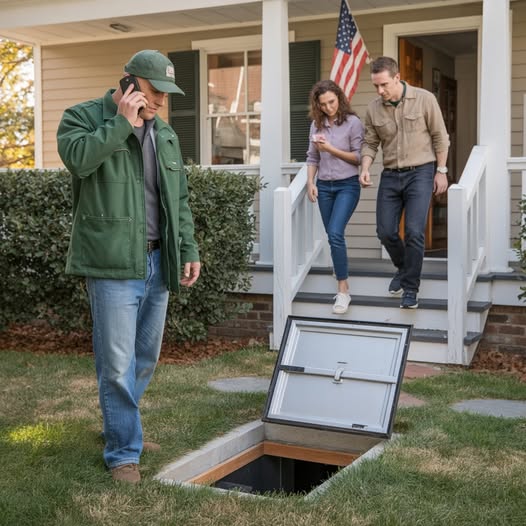
I was sixty-one when Gary Thompson called me from my front yard on a quiet Tuesday morning. I had just finished my second cup of coffee when his name appeared on my phone. Gary had been mowing my lawn every Tuesday for six years. He was steady, dependable, and he never called unless something was wrong.
“Mr. Hayes,” he said, his voice hesitant, careful in that way people use when they don’t want to disturb you. “Sorry to bother you, but there’s something here you should hear.”
My hand froze around the mug.
“There’s crying,” he continued quietly. “Coming from your basement. It’s been going on for a while. Soft… like someone trying not to be noticed.”
I looked toward the kitchen window. Gary was standing on the front path beside his mower, phone to his ear, staring at the small basement windows just above ground level. My daughter Cassandra had left for her gallery in the city less than an hour earlier. The house should have been empty.
“I’ll check it,” I said.
I went down the basement stairs slowly, holding the railing. Sixteen steps. I had walked them thousands of times over the twenty-three years we had lived in this house—the colonial on Ashford Lane that my wife Margaret and I had bought when Cassandra was nine and Felicia was four. Back when laughter filled the rooms, and Margaret hummed while tending plants by the window. That life felt like another lifetime. Margaret had died ten years ago. Felicia had disappeared eight years ago, at nineteen, leaving nothing behind except questions that never stopped hurting.
Now it was just Cassandra and me. My older daughter, thirty-two, successful, talented, running a jewelry business from the basement studio she had built herself.
At the bottom of the stairs, I stopped and listened. Silence. Only the furnace and the faint electrical hum of lights. I opened the studio door and turned on the light.
Everything looked normal at first. The worktable was neatly arranged, tools organized exactly as Cassandra always kept them. Glass display cases lined the walls with silver and gold pieces reflecting light. Everything looked professional, controlled, intentional.
But something felt off in a way I couldn’t immediately define.
I stepped closer to the main table. A glass sat on the edge, condensation still visible. I touched it. Cold. Recently used. The wall clock read 7:43. Cassandra had left at seven. The small sink nearby still had a damp faucet handle. There was a faint scent of lavender soap in the air.
Then I noticed the back wall.
It matched the rest of the studio in color—dove gray, the same paint Cassandra and I had applied together years ago. But the surface looked slightly different. Smoother. Fresher. As if it had been redone after the original work.
I pressed my hand against it and knocked gently.
It sounded hollow.
“Mr. Hayes?”
I turned. Gary was standing at the bottom of the stairs, gloves in his hands, tense. He wasn’t the kind of man to imagine things.
“You find anything?” he asked.
“Just an empty studio,” I said, though the words didn’t feel right.
“I heard it clearly,” he insisted. “A woman crying. Like she was trying not to be heard.”
Neither of us believed the room was truly empty.
Then footsteps came from upstairs.
Heels on wood.
Cassandra appeared at the top of the stairs, surprised to see both of us there.
“What’s going on?” she asked.
“Gary thought he heard something while mowing,” I said. “We came to check.”
“Crying,” Gary added gently.
Cassandra gave a light laugh. “Oh—that must’ve been my podcast. True crime stuff. Sometimes the interviews get emotional. I probably left it running on a timer. I’m sorry if it worried you.”
She touched Gary’s arm briefly, polite and reassuring. Then she said she had forgotten her presentation portfolio, went back to retrieve it, apologized again, and left the house.
I watched from the kitchen window as her Audi drove away down Ashford Lane. Gary went back to mowing.
I should have left for my flight to Seattle. Instead, I went back downstairs.
The glass was still cold. The soap smell was fresh. Cassandra hadn’t worked late the night before—I would have heard her, especially the fifth step that always creaked. It always did.
I knocked again on the wall. Hollow.
My phone buzzed. A message from Cassandra.
Thanks for covering, Dad. Love you.
The word “covering” stayed in my mind longer than it should have.
That night I couldn’t sleep. I lay in the bed I had once shared with Margaret, watching the clock move slowly through the dark hours, listening to the house settle.
And I started remembering things I had ignored.
Strange sounds from the basement years ago. Cassandra saying it was new equipment.
Groceries bills doubling. She said it was for clients.
Late nights seeing her carrying trays of food downstairs.
And Felicia.
The thought I had avoided for eight years began forming fully for the first time: what if she had never actually left?
I sat up suddenly and grabbed my phone. I opened my notes and began listing everything like evidence, the way flying had trained me to think in emergencies.
The crying. The cold glass. The hollow wall. The groceries. The food. The patterns.
And the question underneath everything:
What if Felicia was still alive?
The next morning I called Steven Harper, my longtime friend and lawyer. He had handled my will after Margaret’s death and managed the trust set up for Felicia when she was sixteen—five hundred thousand dollars meant to be released when she turned twenty-one. After Felicia disappeared, Cassandra had been made temporary trustee.
Steven asked me to meet him immediately.
In his office, he laid out financial documents. Bank records. Transfers. Spreadsheets.
The trust fund had been drained slowly over eight years.
It started just weeks after Felicia vanished.
Large sums had gone to Cassandra’s then-boyfriend. Other payments were labeled as construction expenses for a company in Iowa—yet no permits or renovations were ever recorded at my home.
“I thought the gallery was funded by loans,” I said.
“It wasn’t,” Steven replied. “It was funded by this.”
Then he told me not to confront Cassandra. Not yet. If Felicia was still alive, any warning could destroy the chance to uncover the truth.
I went home and acted normal.
The next morning, my neighbor Dorothy Green arrived at my door. She was seventy-two, once my wife’s closest friend. She looked nervous, carrying a canvas bag.
“I’ve been writing things down,” she said, placing three worn notebooks on my table.
Entries filled years.
Cassandra going into the basement late at night.
Crying heard from my house.
Strange activity at odd hours.
She had even called the police once, but Cassandra had explained everything calmly, and they had left.
Then Cassandra had warned her—politely, but clearly—that curiosity could cause problems.
Dorothy also handed me a USB drive.
“I installed a camera,” she admitted. “I needed to know.”
What I saw were years of recordings.
Cassandra moving things in and out of the basement at night. Deliveries. Bags. Boxes. Late-night visits from unknown men. Careful checks to see if anyone was watching.
Forty-seven clips. Eight years of hidden activity.
I looked at Dorothy.
“Why are you telling me this now?” I asked.
“Because Tuesday morning I heard your landscaper on the phone,” she said. “He’d heard crying too. And I realized that if there was another witness, I couldn’t stay silent anymore.”
Riley Summers found me on LinkedIn that same afternoon, her message marked urgent. Felicia’s best friend from college—the one who had called me every week for the first six months after Felicia disappeared, and whose voice had finally broken on the last call she ever made: I can’t keep doing this to myself, Mr. Hayes. I’m so sorry.
I hadn’t heard from her in seven years.
She met me at a coffee shop on Hennepin Avenue, holding an iPad, with the expression of someone who had carried something unbearably heavy for too long and had finally found a place to set it down. She placed Cassandra’s jewelry line side by side with photographs from Felicia’s college sketchbook, which she had kept locked in a box for eight years.
Fifteen designs. Fifteen perfect matches. The curve of a vine, the spacing of leaves, the way a stem wrapped around a pendant center—identical in every detail.
“Look at the engraving,” Riley said, zooming in on one piece. Her finger traced the edge of a leaf. Hidden in the negative space—almost impossible to notice unless you were searching for it—was a tiny engraved letter F.
“Felicia used to do that,” Riley whispered. “She signed her work with a hidden F. She said if people cared enough to look, they’d find her.”
Fifteen designs over three years. My daughter had been screaming for help through every piece of jewelry her sister sold, and for years almost no one had bothered to look closely enough to hear her.
“She’s alive,” Riley said. “And she’s been trying to tell us.”
That night, I went down into the basement again—alone—at 11:30, after Cassandra’s bedroom door clicked shut.
I had prepared. I measured everything twice—once from outside, once from inside the studio. The math didn’t work. Fifteen feet of space was missing behind the back wall. The left wall of the studio wasn’t structural. It was fresh drywall pressed against a tall bookshelf I had never questioned.
I knelt at the base of the shelf. Four caster wheels, locked in place with steel pins. A small electronic keypad was hidden in the frame, its red LED glowing softly.
The code I chose wasn’t Cassandra’s birth year, mine, or Margaret’s. It was 2016—the year Felicia disappeared. The year everything broke.
I entered it.
Green light.
The shelf rolled forward silently, revealing a narrow gap in the drywall—and behind it, a steel door. Industrial. Heavy. A deadbolt mounted on the outside.
I stood there with my hand on the handle, unable to move. My chest tightened. My vision blurred at the edges.
Then I pressed my ear against the metal and held my breath.
A breath answered me back. Soft. Shallow. Someone trying not to make a sound.
“Felicia,” I whispered.
The breathing stopped.
Five seconds of silence.
Then a sharp inhale. A broken sob caught halfway in a throat that had forgotten how to cry freely. Then a voice—hoarse, fragile, trembling with eight years of waiting:
“Dad.”
My knees nearly gave out. I grabbed the doorframe.
“Baby… is that you?”
A sob shattered through the door. Small. Raw. Endless.
“Dad… you came. I knew you would.”
Footsteps echoed upstairs. Cassandra’s door opening.
I pressed my forehead against the steel.
“I’m going to get help,” I whispered. “I’m calling the police right now. I’m getting you out tonight. I promise.”
“Please,” she whispered back, barely audible. “Don’t leave me alone again.”
“I won’t. I’m right here.”
My hands were shaking as I dialed 911. The operator picked up on the second ring. I gave my address and said the words I had never fully allowed myself to believe: my daughter was in the basement. She was alive. I needed officers immediately.
Detective Linda Bennett arrived with Officer Torres and a warrant. Cassandra came down the stairs in pajamas moments later, her face drained of color. Bennett told her they were entering the room whether she agreed or not. Cassandra requested a lawyer. They proceeded anyway.
Behind the steel door was a room roughly fifteen by twelve feet. A narrow bed. A small desk covered in paper. A portable toilet. A sink. Basic plumbing. The walls were covered floor to ceiling with drawings—hundreds of them. Birds. Trees. Faces. My face, repeated over and over again, drawn from memory in a place without windows.
And on the bed, curled against the wall, shielding her eyes from the sudden light, was a woman. Thin. Fragile. Her hair long and tangled. Her skin pale. But I knew her.
“Felicia.”
She lowered her arm slowly, blinking. Her eyes moved across the room until they found me.
“Dad,” she whispered.
I dropped to my knees and wrapped my arms around her. She felt unbearably light.
“I’m so sorry,” I choked out. “I’m so sorry.”
She clung to me, shaking.
“You came,” she whispered. “I kept drawing you. I knew you’d find me.”
Detective Bennett turned away, wiping her eyes. Cassandra stood frozen in the hallway.
Paramedics arrived. Felicia was too weak to walk.
As they lifted her onto the stretcher, her eyes locked on Cassandra.
“Why, Cassie?” she whispered. “Why did you do this?”
Cassandra didn’t answer. She broke down as Officer Torres read her rights.
I rode in the ambulance holding Felicia’s hand as we left the house behind.
“You found me,” she whispered.
“I did.”
“Did you ever stop looking?”
The question hit harder than anything else.
Because the truth was—I had.
But I couldn’t tell her that.
“I never stopped,” I said.
She closed her eyes, just slightly smiling, and held on tighter.
What followed was weeks of treatment and months of investigation. Then a trial that ended quickly once the truth came out.
Derek Hamilton confessed. Fake accident. Fake impersonation. Years of cover-up funded by gambling debt.
An audio specialist proved every voicemail I had received over the years was AI-generated—Felicia’s voice reconstructed and manipulated.
A contractor admitted building the hidden room for cash, calling it a “wine cellar” to avoid thinking about it.
Another witness came forward describing the staged accident and Cassandra’s presence.
Twenty-five years.
Judge Sullivan said it clearly: love does not imprison. Love does not steal a life.
As Cassandra was led past me, she stopped.
“I did it for us, Dad,” she said softly. “I’m still your daughter.”
My voice shook.
“You were my daughter,” I said. “I don’t know who you are anymore.”
She left in silence.
Six months later, I stood at the back of a bookstore as Felicia spoke to a crowd of two hundred people.
She had gained weight. Her hair was short. Her eyes—more importantly—were alive in a way that wasn’t just survival, but something rebuilt.
Her book lay on the table: The Hidden Room.
“I spent eight years believing I was a murderer,” she said. “My sister convinced me the world was safer without me. That I was broken. Dangerous. Unworthy of love. But I wasn’t broken. I was manipulated.”
She spoke about the sparrow she had saved in the basement. About hope. About survival.
She spoke about the drawings of my face, made over years in darkness, because remembering me was the only thing that kept her human.
Her eyes met mine in the crowd.
She smiled.
And for the first time in years, something inside me finally stopped shaking.
Afterward, we went home—an apartment filled with light, windows on every side, sky always visible.
She asked me if she would ever have to forgive Cassandra.
“I don’t know,” I said. “Maybe. Maybe not. But forgiveness isn’t something you owe. It’s something you give when you’re ready—or not at all.”
She rested her head on my shoulder.
“Thanks, Dad.”
Later, I stood at the window while she slept.
I thought about everything I missed. Everything I ignored. Every moment I explained away.
I thought about voices, receipts, sounds in the night.
I thought about the man I used to be—someone who believed absence meant choice.
And I thought about the stairs I finally walked down.
Because that’s what it came down to in the end.
Not genius. Not fate.
Just whether I finally went downstairs.
I turned off the light.
And for the first time in eight years, the darkness didn’t feel like it was pressing on me anymore.
Felicia was alive.
And so, finally, was I.