A bus pass for her sixteenth. A Toyota 4Runner for her eighteenth. And a grandmother who had been planning the difference for two years and six months.
The Honda was not the first time my parents chose Paige over me. It was only the first time someone outside the house was watching. We live in Ridgemont, Ohio, the kind of town where everyone knows what every family drives and whose child made varsity, and the Whitfield woman from next door was standing close enough to our yard to hear my mother’s voice and store the information for later, which she did, and which would end up mattering more than any of us realized that afternoon. Ridgemont looks ordinary from the outside. White siding, decent lawns, three-bedroom homes that reveal nothing about the calculations happening inside them. Our house is like that. Normal from the curb. From the inside, the numbers never quite balanced.
Paige’s bedroom was repainted every two years. Lavender first, then sage, then a soft blush pink she chose from a Pinterest board with the precise editorial eye of someone designing a magazine spread. New curtains each time. A desk from Pottery Barn Teen. My room still had the sky-blue walls I’d had since I was twelve and the particleboard bookshelf my father had assembled slightly incorrectly, so it leaned to the left with the patient, permanent tilt of something nobody was ever going to fix. I did not keep score at first. Children don’t. You assume your parents have reasons, and you wait for those reasons to reveal themselves, and when they don’t, you assume you simply haven’t been paying close enough attention.
But the reasons kept piling up.
Paige got a new iPhone every fall because she needed it for the cheerleading group chat. I used my mother’s old phone with the cracked screen and a battery that died by two in the afternoon. Paige got new cleats every season. I wore the same sneakers until the sole began to separate, pressing it back each morning with the automatic habit of someone who has learned to maintain what she has because replacement is not an option. You have always been more low-maintenance, Audrey, my mother would say, in the tone of someone offering a compliment, as if wanting less were a personality trait I had chosen rather than a condition I had been trained into.
The week before junior year, I found a receipt in the kitchen trash. Eight hundred dollars for Paige’s new cheerleading uniform, warm-ups, and travel bag. That same week I asked my mother for sixty dollars for an AP Biology textbook the school didn’t cover, and she made the face she always made when money came up, a slight tightening around the mouth, and told me the budget was tight that month and I should try finding it used online. I found it used online. Eighteen dollars, shipping included, cover bent at the corner. I highlighted every page and scored a five on the AP exam. Paige wore her warm-ups once and then left them in her locker for three months.
My sixteenth birthday was September 14th, a Tuesday, and there was no party. No guests. I came downstairs and found an envelope resting against the fruit bowl on the kitchen counter, not even placed with intention, just left there between bananas and a stack of grocery coupons. Inside was a Metro Valley thirty-day bus pass and a card that said happy birthday in gold foil. My mother was pouring coffee and didn’t look up when she said this is practical, you’ll thank us later. My father had signed the card, but the handwriting was hers.
I said thank you. I smiled. I took the envelope upstairs and sat on my bed for a long time, turning the bus pass in my hands. It had a magnetic strip and a cartoon bus logo that looked like it had been designed for a second grader. That night, after the house was quiet, I cried in the bathroom with the faucet running so no one could hear. Not because of the bus pass itself. Because of how she had given it to me, the complete absence of any recognition that it might not be enough, the ease of it, the certainty of it, as if of course this was sufficient for me, as if I were the kind of daughter you didn’t throw a party for or stay up thinking about or stand in a kitchen at midnight worrying whether you had gotten it right.
The next morning I was at the Route 7 stop at 5:45. Still dark. September in Ohio, the air already carrying the first bite of autumn. A man in a hard hat nodded at me. I nodded back. That was my entire welcome committee. I told myself it didn’t matter. I told myself that many times over the next two years, with the practiced repetition of someone who has learned that something feels more manageable if you say it often enough, whether or not it becomes true.
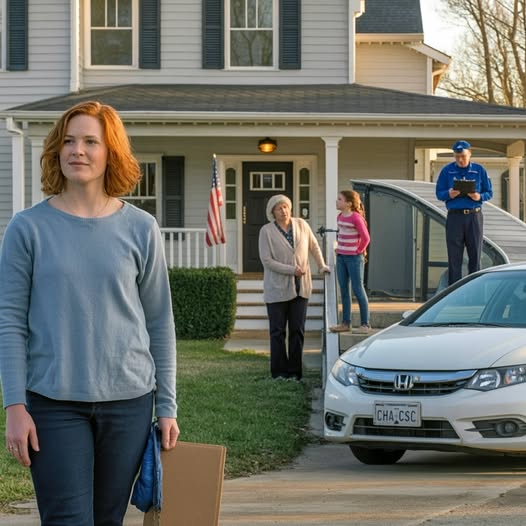
Two years later, Paige turned sixteen in March, and the party my mother organized had twenty-five guests and a three-tier cake from a real bakery on Main Street, not the grocery store, with fondant and sugar flowers and string lights my father hung the night before. In the driveway, under a red bow the size of a beach ball, a white Honda Civic sat with dealer plates still in the window. Paige screamed so loudly the Whitfields’ dog barked two houses down. She ran to the car, ran back, hugged both parents, ran to the car again. My mother had her phone out before Paige even touched the door handle. The Facebook post went up within the hour. Our baby girl deserves the world. Forty-seven likes by dinner.
I stood near the cooler holding a plate of cake I wasn’t eating. I clapped when everyone clapped. I told Paige it was a beautiful car, and I meant it, because it was. I simply couldn’t understand why beautiful things always moved in her direction instead of mine. Nobody asked how I felt. Nobody looked at me long enough to wonder.
Except my grandmother.
Ruth Foresight was sitting on the porch in a wicker chair, coffee in her left hand, right hand resting on the armrest. She watched the Honda. She watched Paige scream. She watched my mother film. And then she looked at me, standing at the edge of the yard with my paper plate, and something in her face tightened slightly, like a decision being made behind steady eyes.
Mrs. Whitfield leaned over from next door. Didn’t Audrey just get a bus pass for hers?
Grandma Ruth set her coffee down. She did, she said.
Two words. But they carried two years of planning I wouldn’t understand until a tow truck turned onto Maple Hill on the most important evening of my life.
The next two years, I built myself from nothing, because no one else was building anything for me. Three weeks after Paige’s party I got hired at Milstone Coffee. Five-thirty in the morning, Tuesday through Saturday, before school. The owner, Mr. Delaney, was ex-military and ran the place with the no-small-talk efficiency of someone who believed competence was respect. He taught me espresso, cash register balancing, opening alone. I saved everything. Tips in a Mason jar, paychecks into a savings account Grandma Ruth helped me open at the credit union downtown. Two years. No car. No major purchases. Three thousand two hundred dollars, earned one latte at a time while my sister slept until seven-thirty and drove to school in her Civic.
My GPA stayed at 3.8. I applied for four scholarships and got two. I took the bus to every interview, every volunteer shift, every AP study session at the public library. Once, just once, I asked my mother to borrow the family van for a forty-minute internship interview north of town. She barely looked up from her phone. Paige needs it for practice. I took the bus. I arrived ten minutes late. The interviewer noticed. I told the truth: I didn’t have a car. She considered it, nodded, and I got the placement anyway.
Every month I went to Grandma Ruth’s house. We sat on her porch with tea. She never mentioned the car. She asked about my life. That was its own kind of love.
Three months before my eighteenth birthday, my college acceptance arrived. Westfield College, forty minutes from Ridgemont. Accounting program. I read the packet carefully and found the line I feared: no bus route.
I sat with my parents Sunday evening. Index cards. Numbers. Facts, not feelings. I had saved $3,200. A used Corolla cost $4,000–$5,000. I just needed help with the gap.
My mother cut in before I finished.
We can’t afford that right now, Audrey.
I don’t need all of it. Just the difference.
The budget is tight with Paige’s cheer regionals.
I have most of it saved.
Then figure it out. That’s what adults do.
That night I found the family iPad on the bathroom counter, still unlocked, showing a car leasing comparison. For Paige.
I set it down and looked at myself in the mirror. There’s a moment when surprise turns into recognition that it was never going to be different. I rinsed my mouth, turned off the light, and went upstairs.
I called Grandma Ruth.
She said: don’t decline anything. Two weeks.
No explanation. Just certainty.
My mother started telling people I preferred the bus. I overheard it. I texted Grandma: she is lying.
She replied: I know.
My father finally said quietly: it’s not fair, kiddo.
And I understood something: he knew, but he wouldn’t change it.
On my eighteenth birthday, I woke at 6:12. Coffee. Envelope. Fifty dollars. “Proud of you.” The most direct thing he had ever said.
Paige drove off in the Civic. I stood in the kitchen.
By evening, my grandmother arrived—with witnesses.
Dinner became something else. Questions were asked. Truths surfaced.
And finally, my mother said: I gave you everything you needed, Audrey. A roof. Food. School. What more do you want?
I wanted to be treated the same.
Life is not always equal.
No. But it should be fair.
Something shifted in the room. Not loudly, but permanently. Brenda set her fork down. Tom looked at his wife. Mrs. Whitfield reached for the pie. My father’s hand lay flat on the table, the posture of a man who knows the next thing will matter and cannot find his voice.
Grandma Ruth set her teacup back into its saucer. The clink was small, but it cut through the room like a bell.
You are right, Diane, she said. Life is not equal.
She pushed her chair back and stood, smoothing her emerald blouse with both hands, a gesture I had seen a hundred times in my life. The gesture she made when she was about to close something. She walked to the front door, opened it, and looked back at me.
Audrey, come outside.
Not a question.
The porch light was already on. The streetlights had just come on too, that amber Ohio dusk that turns Ridgemont into something like a movie set for about thirty minutes every evening. The air smelled like cut grass and someone’s charcoal grill a few houses down.
Then I heard it. A low diesel rumble from the end of Maple Hill, growing closer. Headlights, large ones, the kind that belong to something with more than four wheels. A flatbed tow truck turned onto our street, moving with the deliberate slowness of something that knows exactly where it is going and is in no hurry to arrive. It pulled into our driveway.
On the flatbed, strapped down and gleaming under the streetlight, was a Toyota 4Runner. Nautical blue. The temporary tags were still in the window. The chrome caught the last light of sunset and threw it back in small gold flashes. New enough that the tires had barely touched anything that was not a dealership lot.
The driver climbed out. Young, clipboard, steel-toed boots. He looked at the group of people on the porch like he had arrived in the middle of a service.
I am looking for Audrey Foresight, he said.
My voice did not sound like mine. That is me.
He walked over and placed a set of keys in my hand. Toyota fob, two metal keys on a plain ring, and a small paper tag tied with twine. Happy birthday, he said, and pointed toward the 4Runner on the flatbed. She is all yours.
I looked at the keys. I looked at the truck. I looked at Grandma Ruth, standing beside me on the porch with her hand on my shoulder, light but steady, the hand of someone who had been waiting two years and six months for this exact moment.
She nodded once. She did not say anything. She did not need to.
Behind me, a coffee cup hit the concrete step.
My mother had followed everyone outside, still holding her mug, the white one with the chipped handle she used every evening. When the driver said my name, her fingers had gone slack. The mug fell, breaking into three clean pieces, and coffee spread across the welcome mat and onto her shoes. She did not bend down. She did not move. She just stared at the 4Runner like it had fallen from the sky.
My father was behind her. His reaction was different. He looked at the truck, then at Ruth, and laughed. Not loud, not cruel—just a short, quiet sound from somewhere deep. The laugh of a man watching someone do something he had been too afraid to do for eighteen years.
Paige came out last, phone half-raised, eyes moving from the 4Runner to her Civic parked on the other side of the driveway. Back again. The size difference alone told the story. She lowered her phone without taking a picture and swallowed, saying nothing.
Aunt Brenda gripped Glenn’s arm. Ruth, you didn’t.
Mrs. Whitfield, holding her purse with both hands, said quietly: about time.
Uncle Glenn stood behind Grandma Ruth with his arms crossed and a grin on his face, the grin of a man who had been holding a very good secret and was now watching it arrive in a blue Toyota in his sister’s driveway.
I looked down at the tag tied with twine. Grandma’s handwriting, small and careful.
You were always worth it. Grandma.
It took my mother about forty-five seconds to move from shock into control. I had seen that shift before. The straightening spine, the lifted chin, the voice sliding into that tone between authority and outrage that usually brought the room back under her.
She stepped forward, past the broken mug.
Mother, this is too much. You cannot buy my daughter a car without consulting me.
She is eighteen, Ruth said. The title is in her name.
That stopped her mid-sentence. The words landed exactly as intended. Title. Name. Legal. Things that cannot be undone with a phone call or a dinner conversation or guilt.
You cannot just—Mom started.
I can, and I did, Ruth said. Calm. Flat. Final. The same way she closed deals in real estate for thirty years. The same way people speak when everything is already done. The same way you bought Paige a car without asking me.
The porch went silent. Even the dog across the street stopped barking.
Mom turned to my father. Keith. Say something.
And Keith Foresight, the man who had said almost nothing meaningful for eighteen years, looked at his wife, then at his mother-in-law, then at me, and said three words.
She is right.
It was not dramatic. It did not need to be. It landed with the weight of something that had been true for a very long time.
My mother looked around the porch. Glenn. Brenda. Tom. Mrs. Whitfield. No one met her on her side. She bent down, picked up the broken pieces of her mug one by one, and walked back inside. The screen door closed with a soft click that sounded like an ending.
The tow truck lowered the 4Runner with a hydraulic whine that echoed down Maple Hill. Neighbors had come out onto their porches. Glenn guided the truck into the open space beside Paige’s Civic, which suddenly looked like it belonged to an entirely different story.
When the truck finally left, I hugged Grandma Ruth. Not quickly. Not politely. I held on, and she patted my back twice—firm, steady, final in the way she always was.
You earned this by being who you are, she said quietly. Do not let anyone tell you different.
I pulled back. My eyes were wet, but I wasn’t fully crying. It felt more like my body was releasing something it had been holding for years.
Go sit in it, Glenn said. That is the rule.
I opened the driver’s door. The new-car smell hit me immediately, clean and sharp. The leather seats were cool. The dashboard lit up in blue and white. My hands found the steering wheel, and they were shaking.
Not from fear. From being seen after a lifetime of not being seen by the people who were supposed to see me first.
On the passenger seat was another envelope. Ruth’s handwriting on the front: Open at home.
I didn’t wait.
Inside were the registration papers, six months of insurance already paid, and a small card with Wallace and Pratt written on it, the internship address. Beneath it:
Monday, 8:00 a.m. Do not be late.
The next morning my mother was waiting in the kitchen.
Your grandmother is overstepping, she said. She is trying to make me look bad.
I poured my coffee slowly. She is not making you look anything, I said. She is showing what you did not.
That is not fair.
I think you believe that.
Her eyes filled. Real tears, not performance. That made it harder, not easier.
So what now? she said. You hate me?
No. I love you. But I am keeping the car. I am going to my internship. And I am not going to apologize for Grandma seeing what you chose not to see.
She sat with that. The clock ticked. The refrigerator hummed. Outside, a lawnmower started.
Then she left the room.
My father found me later in the garage.
I should have said something sooner, he said.
Yeah, I said. You should have.
We stood in that truth without escaping it. Then, quietly, he said: I am proud of you.
I told him it mattered—but it would have mattered more earlier. He nodded.
Later he helped me check the tire pressure on the 4Runner. That was the longest useful conversation we had ever had.
Paige came to my room that night.
I did not know, she said.
I know, I said.
It is the worst part, she said.
I know.
And I meant it.