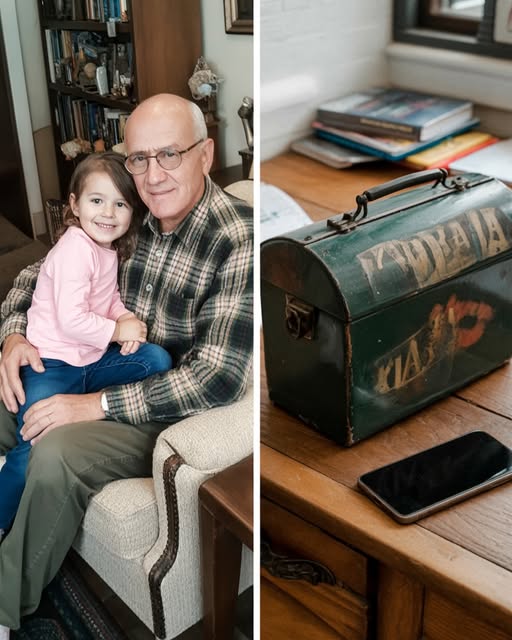
What Grandpa left Angelica looked like nothing. That was the point.
Every morning at five o’clock, without fail, I would hear him moving through the kitchen. His footsteps had a specific rhythm—unhurried, certain. Then the soft clunk of the coffeemaker starting its routine, followed by the familiar metallic snap of his lunchbox closing. That sound was the signal of the morning in our house for as long as I can remember.
He would take that lunchbox out to his truck in the dark, and I would lie in bed listening to the engine start, then fade as he drove away. Only then would I drift back to sleep—the kind of sleep children fall into when they trust that the world is stable, that someone capable is holding it together.
My name is Angelica. I’m twenty-five years old, the youngest of five. For most of my life, that lunchbox was just part of him—no more remarkable than his glasses or his old coffee mug. I never thought about it. I never asked. I didn’t understand its meaning until three days after his funeral, sitting on a park bench with it in my hands, trying not to cry where strangers could see me, and failing anyway.
My parents died when I was two. A truck ran a red light on a Tuesday evening in October, and that was the end of them. I survived in the back seat of my car seat—a fact that has followed me all my life like something heavy I never chose to carry and cannot set down.
My grandfather, Walter, took us in without hesitation. He was in his mid-fifties then and suddenly responsible for five children in a small house on a factory worker’s salary, plus whatever he could stretch carefully from a ledger he kept at the kitchen table on Sunday nights. He was not the kind of man people call soft in the obvious way—he didn’t speak in sentiment or wear emotion openly. His softness was steadier than that, like wood that bends instead of breaks. He adjusted where he needed to, held firm where it mattered, and never once made me feel like I was something to be apologized for.
I can’t say the same for everyone else in that house.
My siblings left as soon as they could. Matthew, then Jake, then Kirk, then Jessica—each of them drifting into different cities, building lives that moved them farther away from Ridgemont, from Clement Street, and from each other. I understood the leaving. People are supposed to leave. But they also left something behind—an idea about me, about the accident, about what my existence had supposedly cost.
I was sixteen when I first heard it clearly.
I was walking past the hallway when Matthew’s voice carried through, loud and careless in the way people speak when they think they are alone. If she hadn’t been born, they wouldn’t have been driving that night.
He meant my parents. He meant the crash. He meant me.
I stopped where I was. I remember not moving for a moment, like stillness could undo meaning. Then I went to my room and sat on the edge of the bed, letting the words settle fully into place—because part of me had always known they were there, even if I had never let them form so cleanly before.
My siblings had never really liked me. They were polite when required, absent when possible. The resentment wasn’t spoken often, but it didn’t need to be. It ran underneath everything anyway, like something nobody wanted to name because naming it would require admitting it might not be fair.
Grandpa tried to counter it.
He insisted on family dinners, organized with the quiet determination of someone trying to keep a structure from collapsing. They would come when it was convenient. They would smile, say the right things, eat, and leave. And the room would change again as soon as they were gone.
He noticed. Of course he noticed. He always noticed everything.
And he adjusted for me. Quietly. Without announcement. He made sure I had a place in that house where I wasn’t defined by anyone else’s interpretation of me.
After college, I moved back in with him. He was in his eighties by then—slower, but still exactly himself. Same mornings. Same news at night. Same lunchbox, still carried every day even after retirement.
I once asked him why he still used it.
He looked at it for a moment, then at me.
“Habit,” he said.
It wasn’t the full answer. But with him, you learned not every door was meant to be opened further.
“You don’t have to stay,” he told me often in the evenings, as we watched television.
“I know,” I always said. “I want to.”
And I meant it. Staying wasn’t duty. It was the first place I had ever felt like I could exist without performing something.
He died on a Thursday morning in March. Quietly. In his bed. Exactly the way he had always said he would prefer.
The house changed immediately. Not visually at first—but in feeling, like something essential had left the air. I sat with him longer than I needed to before calling anyone. I wasn’t ready to move him into memory yet.
The funeral was small. My siblings arrived, performed their roles, said the appropriate words. We did not speak about anything beneath the surface. There was no space for that kind of truth at a graveside.
Afterward, Matthew suggested we arrange the will reading quickly. I noticed, even then, how quickly “practicality” arrived after grief became inconvenient.
Three days later, we sat in Mr. Collins’s office downtown. A small space. Framed landscapes. The smell of cleaned carpet.
I expected nothing complicated. Grandpa hadn’t been wealthy. I assumed everything would be divided simply, evenly, predictably.
Mr. Collins began.
Matthew received the house.
Jake received the car.
Kirk and Jessica each received twenty thousand dollars.
I listened, calculating quietly, expecting the rest to come to me in some form that made sense.
“And to Angelica,” Mr. Collins said finally, adjusting his glasses, “your grandfather left you his personal lunchbox.”
For a moment, my mind refused to process the sentence. It replayed it, unchanged, as if repetition might eventually reveal a hidden meaning.
Then he placed it on the table.
The same metal box I had heard my entire life without ever really seeing. Worn edges. Faded paint. The latch smoothed down by years of use.
Silence settled.
Then Jake laughed.
“You’ve got to be kidding,” he said.
Jessica shook her head.
Matthew looked at the box, then at me, like something had just been confirmed in the way he always expected it would be.
“That box isn’t worth the hassle,” he said.
There were murmurs of agreement.
I didn’t respond. There was nothing in that room that would have understood anything I could have said.
So I stood up, picked up the lunchbox, and left.
I didn’t cry until I was outside.
Then I just walked.
Not because I knew where I was going, but because standing still felt impossible. Twenty minutes later I found myself in the park Grandpa used to take me to when I was little—the one with the old bench near the maple tree and the fountain that only worked in summer.
I sat down.
The lunchbox sat beside me.
And for a long time, I just looked at it—carrying everything I had been given, and everything I had just been told it was worth.
Only then did I open it.
The latch released with the same snap I had heard every morning for years, and I lifted the lid. My first reaction was confusion, which quickly shifted into something heavier as I looked more closely. Inside was not food, though I hadn’t really expected it to be. Instead, there was a carefully arranged stack of papers—mostly receipts—dozens upon dozens of them, layered with the density of something gathered over a long span of time. Grocery slips, hardware store tickets, diner checks, bus transfers. Beneath them sat a small spiral notebook, its pages blank, its cover softened by years of handling.
For a moment, I almost laughed. Not out of amusement, but out of the particular exhaustion that comes when you’ve just been publicly humiliated by the people you grew up with and then discover that the only thing you were left is a box of grocery receipts. I muttered something under my breath that didn’t deserve to be repeated, then forced myself to slow down. Because slowing down—looking more carefully—was what I did when nothing else made sense.
On the first receipt, I noticed a single digit circled in pencil. Not the total. Not the date. Not an item. Just one digit, isolated in the middle of the printed line. I set it down and picked up another. The same pattern appeared again—one circled digit, different from the first. I checked five receipts. Then ten. Then twenty. Every single one contained the same quiet anomaly. The pencil marks were faint in places, firmer in others, but the pattern never broke.
My grandfather didn’t do random. That much I knew as fact. He moved through the world with a precision that showed up in everything small: the Sunday ledger he kept at the kitchen table, the exact route he drove without deviation, the way he folded newspapers before setting them down. These receipts had been handled by the same kind of mind. And that mind did not circle numbers without reason.
I spread everything across the bench and began sorting them by date. It took longer than expected because there were more than I had first realized—stretching across several years. I opened the notebook, turned to the first page, and started writing the circled digits in order, line by line.
At first, I tried to make them into totals. Then phone numbers. Then dates. Nothing worked. I rearranged them, regrouped them, stared at them until the light shifted. Hours passed without anything clicking into place. Then, slowly, the structure revealed itself—not as numbers in sequence, but as two distinct sets. Coordinates.
I wrote out the first set in full and stared at it. My throat tightened. I actually said, “No way,” under my breath, and then repeated it again when the realization didn’t change.
When I was a child, my grandfather used to leave me scavenger hunts. Small notes hidden around the house, each one leading to the next: a clue, a direction, sometimes a riddle. They always ended in something simple—a piece of candy, a book he thought I’d like, once even a snow globe that played a song I had mentioned once without thinking it mattered. He would watch quietly as I worked through them, never helping too soon, always saying the same thing when I got stuck: Go find it.
I hadn’t thought about those hunts in years. Sitting there on the bench, I felt them return—not as memory alone, but as something sharper. Grief and recognition at the same time. Like hearing a song you once loved and realizing it was never gone.
I gathered everything back into the box, closed it, and let the latch snap shut. The sound felt familiar in a way that made my chest tighten.
“Okay, Grandpa,” I said quietly. “I get it.”
That night I was back at the house, sitting at the kitchen table with my laptop open and the notebook beside me. My siblings had already scattered back to their lives. The house, for now, was mine—temporarily, at least, until Matthew decided what he wanted to do with it. I was living in it the way I had been for years anyway: not as a guest, but as someone who had quietly become part of its structure.
I entered the coordinates one by one. The first pointed to a part of town I recognized but had never paid attention to. The second was across the city. By the time I was done, five locations were marked—spread out, deliberate, unrelated on the surface.
I leaned back in my chair.
“What are you trying to tell me?” I asked the empty kitchen.
The kitchen didn’t answer. It never would. But my grandfather never relied on answers being spoken directly. He built systems instead. And systems meant steps. And steps meant movement.
So I stopped trying to solve it from the table.
The next morning, I went.
I didn’t sleep well. My mind kept drifting between memory and possibility—him at the kitchen table with his ledger, him watching me quietly as I worked through childhood clues, him placing that lunchbox down on the counter every morning like it was nothing more than routine. Now I understood it had never been routine at all.
The first location was an auto repair shop tucked into a street I had passed a hundred times without noticing. I sat in my car for a moment before going in. That had become a habit already—pausing, bracing myself, reminding myself that everything I was stepping into had been placed there deliberately.
Inside, a man in his sixties looked up from behind a counter cluttered with paperwork and old catalogs. He had the calm stillness of someone who had been waiting a long time for something that finally arrived.
I said my grandfather’s name.
His expression changed immediately—not surprised, but confirmed.
“You must be Angelica,” he said. “He said you’d come.”
He reached into a drawer and placed a sealed envelope on the counter.
“He told me to give this only to you.”
I asked why he hadn’t just given it to me while he was alive.
The man gave a small, knowing smile.
“He liked you working for it,” he said simply.
I opened the envelope in my car. One page. One sentence in his handwriting:
You are on the right track. Don’t stop now.
The second stop was a diner. The smell of coffee hit me the moment I walked in, and something in my chest tightened so sharply it almost hurt. It wasn’t just coffee—it was five-o’clock mornings, kitchen light, the sound of that lunchbox snapping shut.
The woman behind the counter looked at me before I even spoke.
“You’re his youngest,” she said.
Then she reached under the counter and placed a key in front of me.
“He said you’d be the one to finish it.”
By the third stop—a library—I had stopped trying to predict anything. The librarian didn’t even ask questions. He just nodded, stood up, and led me to the back room.
In a drawer was a file. Inside it: bank records. Years of deposits. Carefully tracked, carefully structured. Small at first, then growing.
My hands went still as I realized what I was looking at.
By the fourth stop, an accountant named Diane confirmed what the numbers were already telling me. Investments. Properties. Growth over decades. And beneath that, withdrawals—large ones, repeated over years.
All tied to my siblings.
“They came to him when they needed help,” she said gently. “He always gave it.”
I asked the question I already knew the answer to.
“And me?”
She hesitated just long enough to make the answer land properly.
“You never asked.”
By the fifth stop, I already knew what the key would open.
A bank box.
Inside were deeds. Properties. Multiple addresses across the city. All owned through holding structures I had never heard of. And beneath them, account records that made my breath slow without me realizing it.
At the very bottom was a folded page.
His handwriting again.
I opened it.
You stayed when leaving was easier. This was never about fairness. It was about trust.
I read it once.
Then again.
And then I just sat there in the quiet of the bank room, unable to move, because it wasn’t the money that hit first—it was the sentence. The idea that he had been watching not what I had, but what I chose. What I endured. What I didn’t ask for.
That he had understood the shape of my life better than I had understood it myself.
The months that followed were not simple. Nothing about property, accounts, legal structures ever is. Meetings replaced shock. Paperwork replaced disbelief. Slowly, everything began to settle into place under Mr. Collins’s guidance.
My siblings received what the will stated: the house, the car, small inheritances. I received what had been hidden beneath all of it.
The lunchbox, in the end, had not been a joke.
It had been the beginning of everything.
I didn’t move far. Eventually I found a small house nearby—quiet, lived-in, real in a different way. The lunchbox came with me. It sits on a shelf in the kitchen now, unchanged. I didn’t clean it or restore it. I couldn’t. It needed to stay exactly as it was when he last snapped it shut.
Six months later, I returned to the park.
Same bench. Same tree. Different light.
The lunchbox sat beside me.
I opened it again. Empty now, except for memory.
All those mornings, I thought. All those snaps in the kitchen I never questioned.
He hadn’t been carrying lunch.
He had been building a map.
And I had been following it my entire life without realizing.
I closed the lid. The snap echoed through the park like it always had. A pigeon startled, then settled again.
I held the box in my lap and said, quietly, “Thank you.”
Not for the money.
Not for the inheritance.
But for the fact that someone had seen me so completely that even after he was gone, I was still being led forward by the way he had once paid attention.
That was what he left me.
Everything else… was just the receipt.