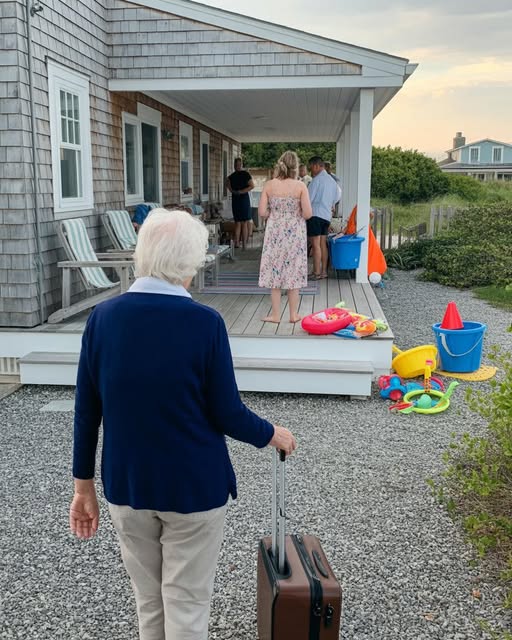
All she had wanted from the weekend was silence.
At seventy, Eleanor Bishop had developed something close to a philosophy about her own wants. Over time, they had become fewer, simpler, and far more honest—especially after Henry died. She no longer pursued invitations that did not genuinely appeal to her. She stopped answering calls from people who only remembered her when they needed a hem repaired, a casserole delivered, or a patient ear to absorb whatever they could not carry themselves. At this stage of her life, she felt entitled to small, steady comforts: a solid chair, a warm mug, a clean porch, and the Atlantic Ocean continuing its patient, familiar rhythm just beyond the dunes. She had come to understand that small desires, consistently fulfilled, created a more reliable happiness than large ones endlessly postponed. And so she shaped her life around that truth.
The beach house stood at the center of this quieter existence. She had bought it seven years after Henry’s death, using savings she had built gradually over forty-two years of work at a sewing machine. People were often surprised that a seamstress could afford a beach house, but Eleanor never understood their surprise. She had never lived beyond her means, and she had never stopped working. For four decades, she had altered waistlines, mended torn seams, and rebuilt hems for other people, and without ever stating it aloud, she had been doing two things at once: helping others hold themselves together, and slowly, stitch by stitch, building a life of her own.
The house itself was modest. The porch rail needed repainting every other year. The guest-room windows stuck when the air was damp. A floorboard near the kitchen sink creaked in a way she had stopped trying to fix, eventually accepting it as the house’s way of announcing itself—like a familiar voice before a face appears. Everything in the house had passed through her hands. The blue-and-white curtains were sewn from clearance fabric she had loved immediately. The yellow quilt in the guest room was assembled from twenty years of fabric scraps, each piece carrying a faint memory of a dress, a customer, a measuring tape held steady against a living body. Henry’s seashell lamp still stood in the hallway, slightly askew, casting the same warm oval of light it had once cast in their bedroom. The house held memory, but not like a museum; it remained alive. That balance, Eleanor knew, was rare—and never accidental.
She had worked carefully to keep it that way. Every spring she planted geraniums from seed and set them outside only after the last frost had truly passed. She replaced worn items instead of preserving them for sentiment alone. She learned to cook the kind of clam chowder a woman at the fish counter once taught her—thick, briny, finished with butter—and made it every first Friday of October without exception. The house endured because she maintained it, just as she had always maintained everything important in her life. No announcement was needed for that truth.
Robert had once understood this.
When he was younger, he had said the house smelled like peace—a comment that had surprised Eleanor with its accuracy. He used to sit on the porch steps eating peanut-butter sandwiches, telling her the ocean sounded like someone breathing in sleep. In those moments, she had seen something in him that felt larger than his everyday habits, something still forming. She had believed he might grow into someone who would sit with her in the good chairs, look out at the water, and simply be at ease.
But adulthood had thinned him. Work took too much of his time. Apologies came too quickly. He married a woman who mistook access for entitlement and proximity for ownership. Eleanor had not immediately disliked Megan. At first, she had extended the benefit of the doubt, believing people softened as they felt more secure. Megan’s sharpness had seemed like nervousness, her competitiveness like youth.
She had been wrong. Slowly, inevitably, she realized it—like noticing a leak long after it had begun, until the accumulation could no longer be ignored.
It started with remarks about the house. Not openly hostile at first—just suggestive, edged with humor that allowed aggression to hide in plain sight. “Wasteful” was the word Megan once used in Eleanor’s kitchen, referring to the idea that she lived alone in a three-bedroom house. As if a woman who had paid for her home through decades of labor, who maintained it herself and used it regularly, were somehow misusing it. Megan had smiled while saying it. Eleanor had said nothing, storing the comment away in the quiet place where she kept things she was not yet ready to confront.
At another dinner, Megan remarked that it was a shame such a nice property sat unused when younger people could benefit from it. The word younger lingered. It was not neutral; it carried implication. A suggestion that age diminished worth, that Eleanor’s reduced physical activity somehow reduced her right to space. She had changed the subject, passed the bread, and later, driving home, felt anger settle in her chest—steady, unspoken, unresolved.
Megan’s mother had begun asking practical questions over the following year: how many bedrooms, how far from the boardwalk, how crowded August became, what the property taxes were. Eleanor answered politely, because that was her nature, but afterward she felt something uneasy in her politeness—as though it were drifting too close to permission. Megan’s sister followed with similar curiosity. It formed a pattern Eleanor could not quite prove, but could no longer dismiss. Like many women of her generation, she tried not to become “the difficult one.” So she ignored tone, changed subjects, and hoped manners would do what directness should have done.
She had been shedding that habit for months when the Friday afternoon arrived that ended it completely.
She turned into the driveway a day earlier than expected, intending only to open the house for the weekend. What she found made her stop with her hands still on the wheel.
Cars filled the gravel. Some were half on the grass. One blocked the drive so poorly she had to maneuver carefully to get past. Music poured through her closed windows even before she stopped the engine, bass vibrating through glass and bone in a way that felt invasive. Children she did not know ran across the yard. One kicked a ball directly into the geranium bed she had nurtured through spring. The flowers lay scattered. The stems were broken beyond recovery.
Eleanor did not turn the engine off immediately.
She sat there, hands still on the wheel, looking at the house she had built through forty-two years of careful labor. Something settled in her chest—not anger yet, but something older. Recognition. The kind that arrives when patience has finally reached its limit and clarity takes its place.
Then she turned off the engine.
She stepped out and closed the door with deliberate control.
The front door was propped open. Laughter and music spilled into the air, mixing without restraint. Her porch chairs had been moved into the yard. A cooler sat on stonework Henry had laid decades earlier, water dripping into the gaps between carefully placed stones. She stood for a moment, looking at it, then stepped inside.
The smell hit first—perfume, beer, fried food. Her living room was occupied. Strangers sat on her sofa. Others leaned against her kitchen counters. A man had his feet on her coffee table. Someone had draped a wet towel over a dining chair.
She stepped further in.
“Excuse me,” she said.
No one responded.
“Excuse me,” she said again.
A few heads turned.
Then Megan appeared, already smiling, moving through the room with practiced ease.
“Oh, Eleanor! You’re early.”
Eleanor let the silence stretch.
“I live here,” she said.
Megan waved a hand lightly, as if smoothing out an inconvenience.
“Yes, of course, but Robert said tomorrow, so we thought we had time. Since everyone’s already here, we didn’t think you’d mind. It’s just family and friends. We were just making use of the space.”
Eleanor looked around—at strangers, at shoes near her door, at sand on her floor, at glass she recognized from an estate sale years ago.
She looked back at Megan.
“Ask them to leave,” she said.
The room shifted. Conversation faltered in uneven pieces.
Megan blinked. “Sorry?”
“Ask them to leave. This is not your house.”
The man on the sofa lowered his feet. Music volume dropped. People looked toward exits.
Megan’s smile tightened. “Don’t be like this. It’s one weekend. Honestly—”
Her tone changed slightly. “It’s selfish, isn’t it? Keeping all this space when you barely use it.”
There it was. No longer implied.
Eleanor felt something inside her settle fully into place.
“I said,” she replied, “ask them to leave.”
Megan crossed her arms. “Or what? You’ll throw out your own family? After everything Robert does for you?”
Eleanor met her eyes.
“My son does not do anything for me that I have not already arranged for myself.”
“That’s not how it looks,” Megan said sharply. “You’re sitting on property people could actually enjoy. That’s not generosity—that’s—”
She stopped, then let it land.
“—leech behavior.”
The word clarified everything. No ambiguity left.
Eleanor exhaled once.
“Get out,” she said.
The room fell completely silent.
Her voice did not rise. It did not shake. It simply carried the finality of a decision already made.
“I want everyone out of this house. Now. If I need to, I will call the police.”
That was enough.
People began leaving quickly. A glass was set down. A chair scraped. Within minutes, the house emptied until only Eleanor and Megan remained.
“You’re overreacting,” Megan said, but less certain now.
Eleanor walked to the hallway desk. The folder had been placed there weeks earlier. She took it out calmly.
Megan’s eyes followed it.
“What is that?”
All she had wanted from the weekend was quiet.
At seventy years old, Eleanor Bishop had reached a kind of settled understanding with her own desires. Over time they had narrowed, not out of loss but out of clarity. Since Henry’s death, she no longer chased gatherings she didn’t truly want to attend. She didn’t answer every call from people who only remembered her when they needed a hem fixed, a meal prepared, or someone patient enough to absorb their frustration. She had arrived at an age where she felt fully justified in wanting only small, steady things: a comfortable chair, a warm drink, a clean porch, and the ocean doing what it always did just beyond the dunes. She had learned that small, reliably fulfilled wants created a deeper peace than large ones endlessly postponed, and she had built her life around that truth.
The beach house was the center of that quieter existence. She had bought it seven years after Henry passed, paying for it in layers of savings she had carefully built across more than four decades of sewing work. People were often surprised that a seamstress could own a house by the sea, but Eleanor never understood their surprise. She had never lived beyond her means, never stopped working, and had spent her life altering, repairing, and rebuilding clothing for others while slowly, stitch by stitch, building something for herself as well.
The house was modest. The porch railing needed repainting every other year. The guest room windows resisted opening when the air was damp. There was a spot in the kitchen floor that creaked near the sink, and she had long since stopped trying to fix it, instead thinking of it as the house announcing itself. Every part of the place carried her touch. The curtains were sewn from fabric she had found on clearance and loved instantly. The quilt in the guest room was made from decades of leftover fabric scraps, each piece tied to a memory of a dress, a customer, a moment of measuring and pinning. In the hallway stood Henry’s seashell lamp, slightly uneven, still casting the same warm oval of light it always had. The house felt alive without becoming a museum, and Eleanor understood that this balance was rare.
She had worked to keep it that way. Each spring she planted geraniums in the front beds, starting them from seed after the last frost. She replaced worn mats instead of sentimentalizing them. Every October, on the first Friday, she made clam chowder the way the fish counter woman had once taught her—thick, briny, finished with butter. The house endured because she continued to care for it. That was never in doubt.
Robert had once understood this too.
As a younger man, he had said the house smelled like peace. He had sat on the porch steps eating peanut butter sandwiches, listening to the waves and describing them as if they were breathing. Eleanor had watched him then with the soft attention reserved for moments when a child reveals something unexpectedly deep. She had believed he might grow into someone who could share this place with her as an adult, someone who would understand its silence.
But adulthood had altered him in ways she had observed without being able to stop. He worked too much, apologized too easily, and had married a woman who treated access as entitlement. Eleanor had not always disliked Megan. At first she had extended patience, believing insecurity explained the sharpness. She had thought time might soften it.
She had been wrong.
It began subtly. Small remarks about the house, delivered with a smile that disguised their edge. Wasteful, Megan had once called it, standing in Eleanor’s kitchen, referring to a three-bedroom home occupied by one woman—as if Eleanor’s years of labor and maintenance did not justify it. Eleanor had said nothing, only stored the comment away.
At another dinner, Megan suggested it was a shame the house “sat empty” when younger people could use it. The emphasis on younger lingered in Eleanor’s mind afterward. It implied a hierarchy of worth tied to age, as if her time had diminished her right to comfort.
Later, Megan’s family began asking careful, pointed questions: about rooms, location, taxes, rental potential. Eleanor answered politely, as she always had, though each answer felt increasingly like participation in something she did not consent to. She ignored the pattern for as long as she could, as many women of her generation learned to do.
She stopped ignoring it shortly before the afternoon that changed everything.
She arrived at the house a day earlier than expected, intending only to prepare it quietly. What she found halted her before she even fully turned off the engine.
Cars filled the driveway, some parked poorly, one half on the grass. Music vibrated through the air even before she stepped out. Children she did not recognize ran across the yard. One kicked a ball through her geranium bed, flattening months of careful growth.
Eleanor sat still for a moment, hands on the wheel, absorbing the scene without movement. Something in her settled—not anger yet, but recognition. The understanding that something had crossed a line that could not be uncrossed.
She stepped out and walked to the house.
The front door was open. Inside, noise and music mixed with the smell of alcohol, food, and unfamiliar bodies. Her furniture had been rearranged by strangers. Her porch chairs were outside in the yard. A cooler sat on the stone path Henry had laid decades earlier, melting water pooling between the stones.
She stood in the doorway for a long moment.
Then she spoke.
“Excuse me.”
No one reacted.
She repeated it, louder this time.
A few heads turned. Megan appeared from the kitchen, smiling as though nothing were wrong.
“Oh, Eleanor. You’re early.”
Eleanor simply looked at her.
“I live here,” she said.
Megan laughed lightly, dismissing it. “Yes, but we thought you’d be here tomorrow. Since everyone’s already here, we figured it was fine. Just family and friends. We thought we’d use the space instead of letting it sit empty.”
Eleanor’s gaze moved across the room—unknown people, her furniture, sand on her floors, glassware she recognized.
She turned back.
“Ask them to leave.”
The room shifted. The noise softened.
Megan’s smile tightened. “Don’t be dramatic. It’s just one weekend.”
Eleanor did not move.
“I said ask them to leave.”
Megan’s tone sharpened. “You’re really going to make a scene over this?”
Eleanor’s voice stayed level. “This is not your house.”
That sentence changed everything.
Megan crossed her arms. “You’re being selfish. Honestly, holding onto all this space when others could actually use it—”
She stopped, then let the thought land fully.
“It’s wasteful.”
The word hung in the air.
Eleanor felt something settle completely inside her.
“Get out,” she said.
This time, the room obeyed.
People began leaving quickly, collecting belongings, avoiding eye contact. Within minutes, the house emptied itself until only Megan remained.
“You’re making a mistake,” Megan said, though her certainty had begun to fracture.
Eleanor walked to the small desk near the hallway and opened a drawer. She took out a folder.
“I was going to give this to Robert next week,” she said. “But this timing works just as well.”
She pulled out a single page.
“A letter from my attorney. Regarding the trust for this property.”
Megan frowned. “What trust?”
“The one that determines who inherits this house.”
A pause.
Then Eleanor continued.
“It no longer goes to Robert.”
The words landed heavily.
“I changed it two weeks ago. After repeated conversations I chose not to ignore anymore. I watched how this house was discussed, how decisions were assumed, how suggestions were made as if they were already agreed upon.”
Megan’s expression tightened. “You can’t just disinherit your son over comments at dinner.”
“I can,” Eleanor said calmly. “And I have.”
Silence followed.
“Where does it go then?” Megan asked finally.
“To a foundation,” Eleanor said. “For women who spent their lives caring for others and ended with very little left for themselves. Widows. Caregivers. Women who gave everything and were not given back in equal measure.”
Megan stared at her. “You’re giving it away.”
“I’m giving it purpose.”
Megan’s voice rose slightly. “He’s your son.”
“And you are his wife,” Eleanor replied. “Which is why you needed to understand this now.”
Eleanor explained, evenly, that the decision had not come from a single moment but from years of accumulation—comments, assumptions, entitlement disguised as practicality. She had watched, she said, and said nothing too long.
“I stopped being willing to do that,” she finished. “That was the change.”
Megan left soon after.
Eleanor cleaned the house methodically once it was empty again—returning objects, wiping surfaces, restoring order. She pulled the damaged geraniums from the soil and decided not to grieve them, only to replace them later.
Robert arrived just as she finished.
He came in quickly, breathless, apologetic. “I didn’t know she’d do that, I told her—”
“You told her enough,” Eleanor said quietly.
He stopped.
The house was calm again.
“I’m sorry,” he said.
“I know,” she replied.
Then she told him.
The trust had been changed. The house would not go to him.
His reaction was not anger. It was something quieter—loss settling in.
“I’m not telling you this to hurt you,” she said. “I’m telling you because it’s done. And because I should have spoken sooner about things I chose to ignore.”
He shook his head. “No.”
“Yes,” she said. “Some of it is mine. Not all. But some.”
He accepted it slowly.
They sat later at the kitchen table with tea, the ocean sound steady outside. Eventually, he admitted he had sensed tension but avoided confronting it.
Eleanor did not soften the truth, but she did not harden it either.
That night, they sat together in quiet understanding that was imperfect but real.
Later, she returned to the porch. Robert joined her, sitting on the steps like he had when he was young.
The ocean moved steadily, unchanged and always changing at once.
Eleanor felt the weight she had been carrying loosen slightly—not because everything was resolved, but because it was finally clear.
The house remained hers. Not just legally, but fully. Not as possession, but as responsibility she had finally claimed without apology.
And in that clarity, there was space.
Not triumph.
Just space.
And for now, that was enough.