I didn’t tell anyone I was coming home.
That wasn’t because I wanted to surprise them. It was because I wasn’t supposed to be anywhere that could be traced. Medical leave, technically — but the kind that doesn’t really appear on any official record, the kind where, if something goes wrong, there is no formal proof you were ever there at all. The shrapnel wound sat low in my abdomen, tightly wrapped and hidden under my jacket. Light duty, they had said. Apparently, carrying my own weight still counted.
I pulled up to my parents’ house just before noon and stayed in the car for a moment longer than necessary, looking through the windshield at the front yard. Two catering vans were in the driveway. A white tent was being assembled on the lawn. Someone near the hydrangeas was arguing about flower arrangements.
Right. The wedding.
I stepped out slowly, each movement carefully measured against the pull of stitches beneath my jacket. I grabbed my duffel and walked toward the front door the way I always had, as if nothing had changed, as if I hadn’t been gone long enough for that to even be a question.
The door was unlocked. Inside, noise hit me first — overlapping voices, a phone playing music too loudly, the controlled chaos of a house organizing itself around an event. No one noticed me.
My mother was in the kitchen directing two hired workers. My father paced near the window, phone pressed to his ear. And at the center of everything, exactly where she always placed herself, stood Chloe — in a white silk robe, hair half-done, surrounded by a portable rack of dresses like she was already on display.
I stood in the doorway for ten full seconds.
Then Chloe glanced over. Her eyes landed on me with the expression she reserved for something that had tracked mud into her space.
“Oh,” she said. “You’re here.”
I set my bag down near the wall. “Got leave.”
She frowned slightly, like she was reacting to bad weather. “You could have called. Today’s already chaotic.”
My mother noticed me with mild irritation — the look of someone whose carefully arranged schedule had just developed a problem. “Elena, honey. We have a full house.”
No one asked why I looked pale. No one asked why I was moving carefully, like every motion had to be calculated. Chloe mattered. Her dress mattered. Her weekend mattered. I was just something in the way.
I shifted my bag against the wall.
“Actually,” Chloe said, as if an idea had just occurred to her, “since you’re here, you can help. Those boxes by the hallway need to go upstairs. Shoes, accessories, early gifts. Just don’t mess anything up.”
I looked at the boxes. Then at her. Then back.
“Sure,” I said.
I lifted the first box. Not heavy. But the moment I did, something inside me shifted — a sharp pull, low and deep. I registered it like a warning light and kept moving.
First trip upstairs. Then a second. By the third, the pain was no longer subtle. It was spreading, tightening, becoming more insistent with each step.
I paused at the bottom of the stairs, one hand resting lightly against my side.
“Are you seriously taking breaks already?” Chloe called across the room. “Can you not be dramatic for five minutes?”
I picked up the next box.
Halfway up the stairs, my vision blurred at the edges. I blinked, set the box down, and turned back. That was when it happened — not a sharp pain, but something heavier, like something inside me had quietly given way all at once. I grabbed the railing. Managed three steps down before my legs stopped responding. The room tilted. I caught myself against the wall, breathing shallow, cold sweat breaking across my back.
“Chloe,” I said, my voice smaller than I expected. “Something’s wrong.”
She looked at me like she was deciding whether I was worth the interruption.
“What now?” she sighed.
“I need a hospital,” I said.
“Of course you do.” She was already reaching for her keys. “Because today wasn’t complicated enough.”
My mother stepped closer but didn’t touch me. Didn’t check me. “Is she okay?” she asked Chloe — not me.
“She’s fine,” Chloe said. “Just being herself.”
She got me into the car. She drove before I had even fastened my seatbelt. She told me not to make a scene at the hospital because she didn’t have time for this. I told her I wasn’t trying to make a scene. She told me that’s all I ever did — that every time something important happened for her, I suddenly had an issue.
I leaned my head back and let the words exist because I didn’t have enough breath to fight them.
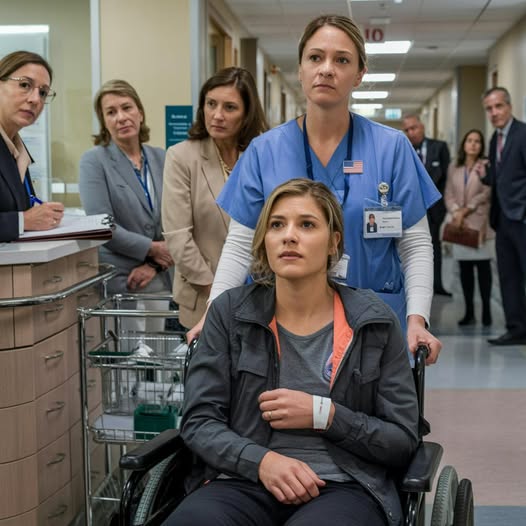
The ER was bright and crowded. A nurse looked up. Her name tag said Brenda.
“What’s going on?” she asked.
Chloe stepped in front of me before I could answer. “She’s just being dramatic. Probably anxiety.”
Brenda looked past her directly at me. Something in her expression changed.
“Can you tell me what you’re feeling?”
“Pain,” I said. “Abdomen. Hard to breathe.”
Her posture shifted instantly. She reached for a wheelchair.
Chloe blocked it.
“Let her wait,” she said flatly. “It’s not urgent.”
“She doesn’t look stable,” Brenda replied.
“She’s fine. She’s just jealous. My wedding is in two days. She always does this right before something important.” She leaned slightly closer. “Trust me. She’s fine.”
Brenda still didn’t move her gaze from me.
Then she guided me to a chair by the wall.
“Sit here,” Chloe said. “Don’t move.”
And then she walked out through the glass doors without looking back.
No hesitation. No second glance. Gone.
I watched the doors close and sat with the silence of someone who has just been left behind by the people who were supposed to stay.
My parents arrived twenty minutes later. Not worried. Annoyed.
Brenda stepped between them and me. “Are you family?”
“Yes,” my father said.
“She needs immediate evaluation. Her vitals are unstable. I’m trying to get imaging.”
My mother waved a hand toward me. “She does this. Every time something important is happening, she suddenly gets sick.”
“She is not stable,” Brenda said, carefully. “I need consent for a CT scan and possible intervention.”
My father crossed his arms. “How much will that cost?”
“That is not the priority.”
“It is for us.”
My mother leaned in. “She’s always been like this. Dramatic. We are not authorizing expensive tests because she wants to ruin her sister’s wedding.”
Brenda turned to me. “Can you consent?”
I tried to speak. Nothing came.
“She is not in a condition to consent,” Brenda said. “Then I need your signature.”
“No,” my father said.
One word. Calm. Final.
“She could be bleeding internally,” Brenda said.
“She isn’t,” my mother replied. “She exaggerates.”
My fingers went numb. I registered it clinically — the body prioritizing core survival.
“Sign the refusal then,” Brenda said. “But understand what you’re signing.”
My father signed immediately. My mother added comments about minimal care, as if ordering something optional.
They didn’t look at me again.
“We’re already late,” my mother said.
“Call us if it’s actually serious,” my father added.
And they left.
Brenda moved fast after that. IV. Fluids. Monitors. She spoke to me steadily, keeping me anchored. The beeping started immediately — wrong spacing, too slow. Pressure dropping. Someone called it out.
“We need imaging,” Brenda said sharply.
“She’s AMA,” someone else replied.
“I know what she is,” Brenda said. “And I know what she looks like.”
The ceiling lights drifted above me like distant waves. The monitor stretched its intervals further apart.
Then darkness came.
And something deeper than thought refused to accept it.
Not hope. Not emotion. Just a reflex — trained, built, automatic.
You are not done.
Not a feeling. A fact.
My right hand moved.
Slowly. Weakly. Toward the inner seam of my jacket.
Inside: a device. Cold. Flat. One-time use.
I pressed it.
It cracked. Not clicked.
A signal sent.
Somewhere far away, a system reacted.
The room shifted instantly into controlled urgency.
“CODE BLUE.”
Compressions started. Voices layered. Orders. Movement.
What followed I later reconstructed — defibrillation, repeated attempts, Brenda refusing to stop.
And then something outside the hospital changed.
People in the parking lot felt it first — a vibration. Then sound. Heavy rotor blades approaching fast.
The entrance doors began to clear as people stepped back.
The Black Hawk set down in the hospital parking lot. Not because it had asked permission, but because clearance had been obtained from somewhere several levels above what the hospital director was accustomed to navigating — and that clearance had been obtained quickly, because that was the kind of clearance it was.
Marcus Thorne came through the ER doors with a team behind him. Not aggressive. Not theatrical. Just purposeful in the way of people who had already made the relevant decisions before arriving. He scanned the room once, located me, and moved toward the bed before anyone had finished processing who he was or why he was there.
Brenda did not step back.
“She’s in cardiac arrest,” she said. “We’re in the middle of—”
“We’re taking over.”
“Not while I’m working,” she said.
A moment passed between them. Two people arriving at the same conclusion from different directions. Brenda looked at him, measuring. He looked at her, not unkindly.
“What’s her status?” he asked.
“Flatline. No response to defib.”
He turned to his team. One word. They moved into the space around my bed with the seamlessness of people who had done this before — not once, but many times. Advanced equipment appeared that the ER did not have. Someone took over compressions without breaking rhythm. Someone else managed the airway. The handover was so smooth it barely registered as a transition.
Brenda did not leave. She stepped back half a pace and watched, because she understood that whatever this was had come from somewhere beyond what the room could contain, and the right thing to do was let it work.
When they moved me to the helicopter, she stood at the entrance.
“Don’t lose her,” she said.
Marcus was already moving.
He did not answer, because he was moving, and because the answer was already in the movement.
I woke in a room that was quiet in the intentional way of secure medical facilities. Steady monitors. Clean bandages. IV lines in both arms. Two men near the door — not for comfort, but for protection.
I did not ask questions. I let memory assemble itself in fragments.
The house. Chloe. The chair by the wall. The signature on the form — my father’s, placed with the calm of someone approving a routine expense.
Not grief. Not rage. Those burn out. What remained in me was colder, more durable. Clarity.
A week later Marcus entered and placed a folder beside my bed.
“Surgery went clean,” he said. “No permanent damage.”
“Tell me the rest,” I said.
He opened the folder.
Four years of financial records. Accounts opened in my name without consent. Military compensation. Injury benefits. Retirement contributions. Drained in careful increments — consistent enough to form a system, small enough to avoid detection. My name on signatures that were not mine.
“Your sister initiated most of the transactions,” he said. “Your parents authorized the rest.”
I studied the dates. They aligned precisely with deployments — times I was off-grid, unable to check statements. Four years of a life funded by what had been taken from me. Dresses. Venues. The image of a family that functioned properly.
“They knew that if you were treated properly,” Marcus said, “you would recover. You would regain access. You would see the accounts.”
I said nothing.
“If you died,” he added, “everything stays buried.”
The room held that sentence.
Not shock. Not even betrayal — betrayal requires surprise. This was confirmation. Clean. Final. Something I had circled for years without looking at directly.
“What are my options?” I asked.
“Federal prosecution. Full charges. Asset recovery.”
“And the other kind?”
He understood immediately. Not revenge. Structure.
“They built everything on what they took from me,” I said. “Their image. Their connections. That wedding. I want the truth delivered in front of the people whose respect they borrowed against my name. Where it cannot be managed.”
Marcus gave a small nod. “Understood.”
Planning is not the same as revenge. Revenge is reactive. It follows someone else’s timing. What I did over the next two weeks was structural.
Julian’s company was the first target. Debt layered under debt, carefully hidden but not invisible. Investors being managed while the numbers deteriorated. We acquired liabilities through clean entities. By the time it closed, every major debt answered to me. No one in his family knew. They were preparing a celebration.
Civil coordination ran through Marcus. No alerts. No warnings. Everything timed precisely. The goal was not to stop the ceremony — it was to let it proceed far enough that everyone Chloe relied on believing her version of reality was already seated and watching.
Two weeks after I woke, I adjusted my dress uniform cuff in the back of an SUV two blocks from the church.
The building was designed to impress: high ceilings, stone façade, architecture that made events feel significant regardless of what they were.
Every seat was filled.
My parents sat in the front row — calm, confident, as if the matter had already been settled.
At 2:45, the processional began.
Chloe appeared at the back of the church. Perfect dress. Controlled smile. Every step designed to project exactly what she wanted. She moved as she always had — as if the room existed to frame her.
Halfway down the aisle, her eyes scanned quickly. She noticed exits. Men positioned at each one — not her security. Not familiar. Something she could not immediately categorize.
Her steps slowed.
Then she corrected herself. Lifted her chin. Reframed the situation. High security at a wedding meant importance. Status. Validation.
That assumption would not survive much longer.
I entered through the back doors while the music was still playing.
Footsteps echoed across stone. Heads turned. The music stopped mid-phrase.
Chloe turned — and the moment she saw me, her composure fractured. Not slightly. Completely.
“No,” she said. Then louder: “Security!”
No one moved. The men at the exits did not belong to her.
I walked to the sound system and plugged in the USB without ceremony.
Her voice filled the church.
Clear. Unedited.
Let her wait. It’s not urgent.
A ripple moved through the pews.
She’s jealous. My wedding is in two days.
Then my mother:
We’re not authorizing anything expensive. She does this for attention.
Silence settled.
I turned to face them.
“Four years of financial records,” I said evenly. “Accounts opened in my name without consent. Military compensation. Injury benefits. Retirement funds.”
I looked at Chloe.
“You forged my signature.”
Her mouth opened. Nothing came.
I turned to Julian. His expression changed instantly — the moment private collapse becomes public exposure.
His father stood. Slowly. Decisively. That single movement ended the illusion. His mother did not even look at Chloe.
“This is over,” she said. They left.
The room began to understand what it was witnessing.
Chloe lunged toward me.
Two military police stepped in. Not aggressively. Just final.
She stopped.
Civil officers arrived. Charges were read:
Federal wire fraud. Identity theft. Unlawful possession of classified government property.
She resisted at first. Then turned to me.
“Elena,” she said, breaking. “I’m your sister.”
I stepped closer.
“You told the nurse to let me wait.”
She flinched.
“Now you can wait for your sentence.”
They took her.
My parents followed. My father stared forward. My mother said something about daughters, as if the word itself meant protection.
It did not.
The doors closed.
I walked out of the church into open air.
Marcus waited at the curb. Brenda stood beside him.
I got in.
The door closed.
I looked out the window as the city moved past.
Same face.
Different position.
No longer the one left waiting.
What I understood was simple:
Titles do not protect you. Family is not behavior. It is not loyalty. It is just proximity without guarantee.
What protects you is action — what people do when it costs them something to stay.
Brenda had stayed.
Marcus had moved an aircraft for someone who might not survive.
Neither of them owed me anything.
That was the point.
For four years my family had taken from me while I was absent, then decided I was inconvenient when I returned injured.
That was the decision.
Not confusion. Not mistake. Calculation.
And once you understand that clearly, you cannot unknow it.
There is no return path through that kind of knowledge.
The road stretched ahead.
Not behind.
Not toward anything I had lost.
What I felt was not triumph.
It was space.
And that, finally, was enough.
Everything else had already been decided.