My father said it the way he might have said, pass the salt.
I had been in their house for eleven minutes. My coat was still on. The pot roast my mother had made for a lunch none of us were eating sat untouched on the stove, filling the kitchen with a warm, heavy smell—food that had been prepared with care and no longer had an audience. It lingered in the air like something unfinished.
He sat across from me at the table. My mother sat at the end, closer to him than to me, her hands folded in her lap. I watched her hands more than her face. I always did that when something felt wrong. I noted them. Stored them away.
“Your sister owes two hundred and forty thousand dollars,” he said. “And you’re going to pay it.”
Not a question. Not a discussion. A conclusion already reached, spoken aloud so I could catch up.
He laid it out—failed business, creditors, accounts, my name on some of the paperwork from a co-sign years ago. He called it a family matter, something families handle together. He said if I paid it, it would all be over.
He spoke like someone reading from notes prepared long before I walked in.
I asked my mother how long she had known.
My father cut in immediately: that wasn’t the point.
I asked again.
She started to speak. Stopped. Looked at him instead.
That was enough.
I’ve been in rooms like this before—workrooms, emergency rooms, meetings where people decide things about you while pretending they haven’t. You learn to recognize when a conversation is no longer a conversation. This wasn’t one. This was an outcome being delivered.
Then my father said it clearly: pay it, or you’re no longer our child.
I had thought about that sentence before, in abstract ways. What it would feel like. I had imagined anger, or pleading, or shock.
None of that came.
“Then I’m not,” I said.
Even my own voice surprised me. Not emotional. Not raised. Just final.
I stood, took my keys from the table, picked up my coat—the same coat I had never taken off—and walked out. No argument followed me. No one stopped me. I didn’t slam the door. I didn’t need the sound.
The drive home was quiet. Fourteen minutes through gray January streets that felt like they had already decided not to care about anything. My hands stayed steady on the wheel.
When I got home, I stood in my kitchen for a moment before turning on the light. Then I sat on the floor with my back against the cabinet and cried for twelve minutes. I know it was twelve because I checked the microwave clock like I needed proof that it ended.
When it passed, I washed my face, made coffee I didn’t want, and sat at my own table. Not theirs. A place where nothing could be decided about me without my knowledge.
Then I opened my laptop and checked my credit report.
I already had monitoring. I always had. I was the one who paid attention to details, who tracked things, who followed through. The kind of person my father used to describe as reliable, like it was only a compliment.
The number at the top stopped me.
My credit score had dropped 193 points in three months.
That isn’t a mistake you scroll past. That’s structural.
I went through the report slowly.
My mortgage. My old car loan, clean and closed. Two credit cards I managed carefully, always paid on time, always under control.
And then—things I didn’t recognize.
A business line of credit. An institution I had never heard of. My Social Security number listed as the borrower. Not co-signer. Borrower.
Balance: eighty-seven thousand dollars.
I stared at it without moving.
Four years earlier came back to me in fragments. My sister Kayla in my parents’ living room. Her voice bright, rehearsed, full of optimism. A spa business plan in a spiral binder. A logo. A future she was presenting like it was already real.
She didn’t have the credit for a loan.
My father did what he always did. He solved it quickly.
“Just co-sign,” he said. “It’s a formality. She’ll pay it back. You’ll barely notice.”
I said yes.
I remember signing. I remember asking for copies.
I never received them.
I told myself I would follow up. I didn’t. Because I trusted them. Because that’s what family was supposed to mean.
Now I was looking at eighty-seven thousand dollars that had never been part of the agreement I thought I had made.
I scrolled further.
Another account.
Another line of credit.
Sixty-one thousand dollars.
Same story. Same pattern. My name where it should not have been. My identity tied to debt I had never agreed to carry alone.
And only then did I start to understand that what had happened in that kitchen wasn’t just a demand.
It was a continuation of something that had started years earlier.
My father said it the way he used to say “pass the salt.”
I had been in their house for eleven minutes. My coat was still on. The pot roast my mother had made for a lunch none of us had touched sat untouched on the stove, filling the kitchen with a warm, slightly mournful smell—like effort that had already passed its moment of purpose.
He sat across from me at the table. My mother sat at the end, closer to him than to me, her hands folded in her lap. I noticed her hands. I stored that detail away.
“Your sister owes two hundred and forty thousand dollars,” he said. “And you’re going to pay it.”
Not a question. Not even something open for discussion. It was a conclusion already reached, delivered as if I were simply being informed of my role in it.
He explained it: a failed spa business, creditors, accounts tied to my name through a co-sign four years earlier. He said it was a family matter, that families dealt with things together, and that if I paid it, everything would be settled and we could move on.
He spoke with the calm certainty of someone reading from a plan he had already written.
I asked my mother how long she had known.
My father said that wasn’t the point.
I asked again.
She opened her mouth, then closed it. Looked at him instead of me.
That was enough.
I had been in difficult conversations before—the kind where bad news arrives fully formed and all you can do is absorb it. I could tell this wasn’t a conversation. It was a decision made without me, now being delivered to me.
My father said, “Pay it, or you are no longer our child.”
I had imagined this moment before, in abstract ways. I thought I might cry, argue, break down.
None of that happened.
“Then I’m not,” I said.
Even I was surprised by how steady my voice was. Not shaking. Not emotional. Just final.
I stood up, took my keys, and put on my coat. I left the kitchen, walked through the house past the family photos I had seen my entire life, and stepped outside. I didn’t slam the door. I didn’t need to.
The drive home took fourteen minutes. My hands stayed steady on the wheel. The radio was off. Outside, Indianapolis in January felt gray, flat, and indifferent.
At home, I stood in my kitchen for a moment in silence, then slid down against the cabinet and cried for twelve minutes. I don’t know why I timed it. I think I needed something to mark the ending.
When it stopped, I washed my face, made coffee I didn’t want, and sat at my own table. A place where no one could hand me a verdict.
Then I opened my laptop and checked my credit report.
I had always monitored it. I was careful with money. Responsible. The kind of person who pays attention to details.
The number at the top stopped me.
My score had dropped 193 points in three months.
Not a normal decline. Not missed payments or small mistakes. Something structural had gone wrong.
I scrolled.
My mortgage. My paid-off car loan. Two credit cards I knew and managed carefully.
Then accounts I didn’t recognize.
A business line of credit. Balance: eighty-seven thousand dollars. My Social Security number listed as primary borrower. Opened three years ago.
I sat still.
My mind went back four years—to my parents’ living room, to Kayla’s pitch, her business plan, her energy, the optimism of it. She had a space. A contractor. What she didn’t have was credit.
My father had said it was simple. Just co-sign. A formality. It would never be a problem.
I had said yes.
And I never received the documents I asked for.
Now I saw what had actually happened.
I added the numbers.
Then I added them again.
The total did not change.
I called Diane.
She arrived forty minutes later with food neither of us touched. She went through everything calmly, page by page.
When she finished, she looked at me.
“This isn’t just co-signing,” she said. “Someone had full access to your identity. Your Social Security number, your personal details. After the first loan, that information was used to open additional accounts without your consent.”
She paused.
“This is identity fraud.”
I didn’t answer. I didn’t need to.
She stayed late that night. We organized everything by date and institution. When she left, she told me to call her the next day.
In the morning, I went to work anyway. Meetings. Emails. Normal life continuing as if nothing had changed. I was good at looking normal.
But nothing felt normal anymore.
Later, I met with a fraud attorney. He reviewed everything carefully, then set his hands on the desk.
“Some of these signatures are forged,” he said. “That’s not speculation. That’s forgery.”
He told me we could file a criminal complaint.
“And once we do,” he added, “we can’t undo it.”
I said, “File it.”
Three days later, I received a call.
The case had been flagged. Referred to federal authorities. The FBI Financial Crimes Division.
Once that happens, my attorney said, it doesn’t belong to me anymore.
I sat in my car in the parking garage for a long time after the call ended.
Because now it was real.
Not a family argument. Not a misunderstanding.
An investigation.
My phone rang repeatedly afterward. My father. My sister. Messages. Silence. Pressure.
Then my mother came to my apartment.
She stood in my hallway and said what I expected her to say—family, mistakes, fear, trying to fix it.
She wasn’t lying. That was the difficult part. She believed it.
I asked her one question.
“How long have you known?”
She hesitated.
“Two years,” she said.
And just like that, everything became clear.
“I need you to leave,” I said.
She cried in the hallway after the door closed. I stayed on my side and listened until the sound stopped.
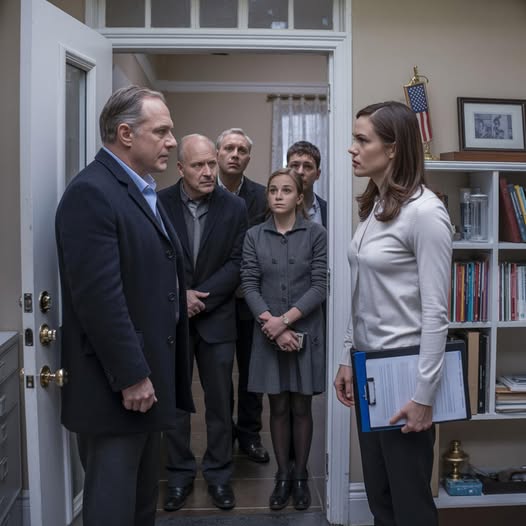
Days later, they all came.
My father. My mother. My sister. Her husband. An aunt.
Five people standing in my hallway.
They tried to explain. Fix. Reframe. Appeal.
I let them speak.
Then I told them the truth:
“This is no longer personal. It’s a federal investigation. I cannot stop it even if I wanted to. And I don’t want to.”
Silence followed.
Then one by one, the weight of it hit them.
My sister collapsed first. My father slid down the wall. My mother stayed standing, but barely.
And I stood there watching, finally understanding something I had spent my whole life avoiding:
This time, I wasn’t the one being decided for.
I was the one who had already decided.
Just me.
“I should have told you,” she said again, her voice very quiet. “Two years ago, when I knew. I should have told you. I’m sorry.”
I believed her again. The same way I had the first time. The apology was real. It was the most genuine “sorry” I had ever heard from her, and it still wasn’t enough to change anything. Both things were true at once, and that is one of the hardest truths about people you love.
“I know,” I said.
Then I added: I need you all to leave now.
No one argued.
That was what I hadn’t expected—that when the moment finally came, with the case number, the federal referral, and the folder Barrett had built, there would be nothing left for anyone to argue against.
Patricia helped Kayla up. Derek kept a hand on her back. My father rose slowly, as if his body had become heavier in the last twenty minutes. My mother looked at me once more, briefly, then away.
They moved into the hallway.
I waited until all of them were through the door.
Then I closed it.
After that, I slid down until I was sitting on the floor, my back against the door—the same position I had been in seven days earlier, after driving home from their house with steady hands and a mind that hadn’t yet caught up to what had happened.
Seven days ago, I had sat on the kitchen floor and cried for twelve minutes, watching the microwave clock because I needed something to measure the ending.
This time, I didn’t cry.
I just sat in the quiet and breathed.
It was the same quiet that had filled my apartment all week—the kind of quiet where the only person you are responsible for is yourself.
Eventually, I stood up.
Six months later, I can tell you how it ended. Or more accurately, how it has ended so far, because some stories don’t really conclude—they just reach a point where you stop checking them every day, and they become part of the background of your life.
Kayla pled guilty to two federal fraud charges. The original case had included five. A plea agreement reduced it to two, which is how these things often work—something Barrett had explained early so I wouldn’t mistake it for loss. It wasn’t a loss. It was the system doing what it does: not satisfying anyone fully, but allowing closure to exist in a workable form.
The fraudulent accounts were removed from my name over the next four months. It required more documentation than I thought possible—letters, affidavits, certified mail to seven institutions, notarized forms sent across agencies. Barrett handled it all with steady, methodical patience.
When it was finished, my credit score was eleven points higher than before any of it began.
I still find that fact almost offensive in its simplicity.
My parents still live in the same house on the same street. I speak to them occasionally. Not often. Not deeply. Not in the way I once imagined would naturally return if enough time passed and I kept showing up as myself. That version of closeness never arrived. I’ve stopped waiting for it.
What we have now is a relationship honest about its limits. Smaller than what I once wanted, but more stable than what we had. And when I look at it closely, I find I prefer it that way.
Kayla and I have not spoken. I don’t know if we ever will. I carry that as an open question—not as something I am avoiding, but as something that belongs to a future version of me. The answer simply isn’t available yet, and forcing it would only create something false.
Diane takes me to brunch on the first Saturday of every month at a place in Fountain Square with good eggs and a server who remembers our order. Diane argues every time about the tip calculation—not because she won’t tip well, but because she believes the suggested percentages are mathematically incorrect, and she considers it her duty to say so out loud. She is exactly who she has always been. I understand now what a gift that is.
Someone asked me recently if I was angry.
They didn’t know all the details—just the outline. They wanted to understand how someone moves through something like this without it defining them completely. I thought about it before answering.
I said I was free.
They looked at me like the answer didn’t fit the question. They said they didn’t understand the difference.
I didn’t explain it. Not because I couldn’t, but because some things don’t survive explanation. You either recognize them or you don’t.
If I had tried, I would have said this: anger keeps you tied to what hurt you. It keeps it in the center of your life, still shaping your attention. Freedom isn’t forgetting. It isn’t forgiving. It isn’t even peace.
It is simply no longer organizing your life around what happened.
I know every detail of what happened—every account, every forged signature, every Sunday afternoon in that kitchen in January—but it is no longer the loudest thing in my life. Not because I minimized it, or overcame it, or turned it into something smaller. But because I finally acted instead of waiting.
I called the bank that night. I called the attorney. I called the agent. I stopped waiting for protection that wasn’t coming.
That is the truth of it.
I had been reliable for thirty-four years. I confused reliability with safety, and safety with love. That confusion cost me more than I understood at the time. And when the cost became undeniable, I got up from the kitchen floor, sat at my own table, and began making calls.
I said “too late” because it was.
Now it is Saturday morning again. January again. The light through the kitchen window is pale and honest—the kind that doesn’t soften anything, just reveals it.
I sit at my kitchen table with coffee. No urgency. No one else’s emotions to track. No one whose presence in another room determines the weather of my day.
Just me. My table. My coffee. The light.
Outside, a car pulls out of a parking space. Somewhere down the hall, a door opens and closes. Ordinary sounds of an ordinary morning in the apartment of a woman who once sat on her kitchen floor for exactly twelve minutes and then got up.
The getting up was the story.
Everything after that was simply what came next.