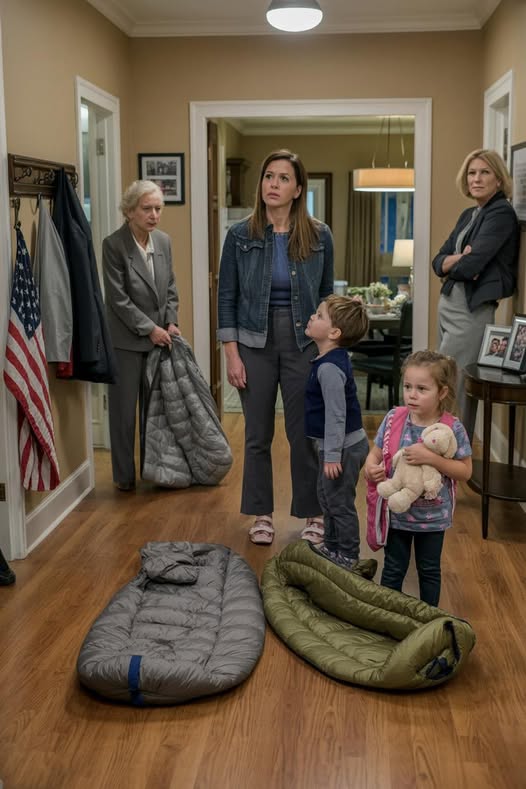
My mother threw two sleeping bags onto the floor for my children, but what broke inside that hallway wasn’t the sleeping arrangements. It was the last justification I had left for staying loyal to a family that only valued me when I was useful.
But I need to go back two hours, because you have to understand what we were walking into.
We left Rochester at three in the afternoon—Ryan and me, Owen in his green turkey sweater, and Ellie holding the stuffed rabbit she never went anywhere without. Two and a half hours on the highway, the sun fading behind the trees, Ellie asking from the back seat if Grandma would have cookies waiting. I had a pie in the trunk. Pumpkin, made from scratch, my father’s recipe—the one with brown butter and an extra pinch of nutmeg he said was a secret only earned after years of standing beside him in the kitchen.
He taught me when I was fourteen, on a step stool because I couldn’t reach the counter. I had made that same pie every Thanksgiving since he died. Four years, four pies, same recipe, same rolling pin, same pinch of nutmeg measured into my palm before it went into the bowl.
I also brought a tablecloth. Ivory linen with scalloped edges—forty-six dollars online, ordered three weeks earlier because my mother had mentioned hers was stained. I didn’t think about the price. I never really thought about money.
Ryan carried the suitcases. I carried the pie. Owen carried the gift bag with the tablecloth. Ellie carried her rabbit. We walked up the porch like a family arriving where they belonged.
The door was unlocked. It always was when Ashley arrived first.
My sister’s red coat hung on the hook inside. Her daughter Mackenzie’s pink jacket. Her son Jordan’s dinosaur hoodie. My mother’s gray cardigan. Five hooks. Five coats. None of them ours. I hung our coats on the banister and tried not to count.
The guest room door was closed, but I could hear Mackenzie and Jordan already inside—laughing, settled since Tuesday, their shoes lined neatly by the bed, suitcases open, Jordan’s tablet charging on the nightstand.
My mother came from the kitchen wiping her hands, smiled, and kissed my cheek.
“There’s my girl. You brought the pie—put it on the counter, honey.”
She lifted Ellie briefly, called her “pumpkin,” set her down, and returned to the stove.
Ashley appeared in the doorway wearing joggers and a sweatshirt that said blessed. No hug. She looked at the pie and said, “You still make Dad’s recipe? I can never get the crust right.”
She had never even tried.
Dinner was fine—pot roast, green beans, bakery rolls, the same table Dad bought in 1994 with a VA loan. My mother said grace, thanking God for family, health, and the meal in front of us. She didn’t mention the tablecloth I had already laid out earlier.
After dinner, I washed the dishes. Ashley dried one plate, placed it on the counter instead of the cabinet, and said her back hurt. My mother called from the living room that I should let her rest—Ashley had been having a rough week.
Ashley had been “having a rough week” since 2019.
By 8:30, the kids were fading. Owen was trying not to show he was tired. Ellie had already curled up on the couch, one shoe off, rabbit pressed to her cheek. I found my mother in the hallway.
“Mom, should I set something up for Owen and Ellie? Maybe blankets in the guest room corner, or I can move their bags—”
She gave me that smile.
The one I had seen my entire life but had never been able to name until that moment. Warm on the surface. Closed underneath. A door painted to look open, but locked from the inside.
“Oh, honey. Ashley’s kids are already in there. You know how Mackenzie gets if we move her—she won’t sleep at all.” Her hand squeezed my arm once. “Your kids are tough. They’ll think it’s fun.”
She opened the hallway closet.
Two sleeping bags fell out—cheap nylon, thin enough to see the floor through them, printed with cartoon dinosaurs, smelling like basement air and things forgotten for years. She didn’t hand them to me.
She tossed them.
One landed at Owen’s feet.
He didn’t pick it up. He just stood there, six years old, hands at his sides, watching my face with the kind of focus children have when they already know their mother’s expression determines everything.
Ellie hugged hers. “Is this for me, Mommy?”
Ashley leaned against the guest room doorframe, arms crossed, wearing that half-smile she saved for moments she knew she had already won.
“You should’ve booked a hotel.”
I counted to three.
I’ve always counted things. Streetlights. Steps. Marshmallows in hot chocolate. I started when I was nine—on a night my father was in the hospital, my mother packed Ashley’s pink backpack, called my aunt, and looked at me in the hallway with my own bag already ready.
“You’re my strong one, Lauren. You can handle it.”
That was the moment I learned the pattern. Ashley got rescued. Lauren handled it.
I walked three blocks that night in November and counted ten steps on the porch before anyone opened the door. Mrs. Peterson gave me hot chocolate with seven marshmallows. I didn’t cry. I counted instead.
Twenty years later, I was still counting. The numbers were just bigger now.
I looked at my mother. At the sleeping bags. At Owen watching me learn the same lesson I had been trying my whole life to make sure he would never have to learn.
I knelt down to his level.
“Pack your things, babies,” I said softly. “We’re going on a real adventure.”
Ryan didn’t ask a single question. He just moved—grabbing suitcases, Ellie’s rabbit, Owen’s coat from the chair where I’d placed it because there were no hooks left.
Four suitcases. One pie carrier. One empty gift bag.
Ryan buckled Ellie into her car seat. I carried Owen, silent now in that way children get when they understand something too early.
My mother stood in the doorway, porch light behind her.
“Lauren, don’t be dramatic. It’s just one night.”
I looked at the windshield, but I spoke loud enough for her to hear.
“I noticed something funny with the bank. They’re saying a payment didn’t go through? I’m sure it’s just some mistake. Call me when you can, sweetheart. Love you.”
Her voice was soft in the way it always got when she wanted something fixed without having to name what was broken. The same tone she used when she handed responsibility to me without ever calling it that. Not an order. Not a demand. Just a gentle expectation that I would step back into place and make the problem disappear.
I stood at the kitchen sink with Owen’s toothbrush still in my hand, watching the foam in the basin thin and collapse.
Ryan was behind me making coffee. The grinder buzzed once, then stopped. No one spoke for a few seconds, just the ordinary morning sounds continuing around a message that wasn’t ordinary at all.
Owen rinsed his mouth and ran off toward the living room, already forgetting the tension. Ellie followed him, rabbit dragging along the floor like a tired shadow.
“She called,” I said finally.
“I figured,” Ryan replied.
There was nothing urgent in his voice. No alarm. Just acknowledgment, like weather you saw coming on the radar hours ago.
I wiped the counter even though it was already clean.
“She sounded… normal,” I added.
“That’s how it usually goes.”
I turned off the tap, watched the last drop fall from the faucet and break into the sink. “She thinks it’s a mistake.”
Ryan leaned against the counter, coffee mug in his hand. “Is it?”
I looked at him.
It wasn’t a question about plumbing or banking systems. We both knew that.
“No,” I said.
He nodded once. That small, final motion of agreement that doesn’t invite follow-up questions.
The silence after that wasn’t heavy. It was clean. The kind of silence that exists when something has already been decided and the world just hasn’t caught up yet.
My phone lit up again a few hours later. Then again. Two missed calls. Three. A text this time.
Mom: Lauren, please call me. This is urgent. Something is wrong with the account. I can’t access the payment for the house.
I stared at the screen for a long moment. The word house did something small and sharp in my chest, but it didn’t take root the way it used to.
There was a time when that word had meant obligation. Now it just meant structure. Wood, brick, mortgage history, a place I had been funding like an invisible tenant for four years without ever being listed on the lease of my own life.
I set the phone face down on the counter.
Ryan watched me. “You going to answer?”
“No.”
“Okay.”
That was it. No argument. No persuasion. No commentary on what a “good daughter” would do. That version of me didn’t live here anymore.
Later that afternoon, while Ellie colored at the table and Owen built something complicated out of cereal boxes and tape, I opened the laptop again. Not out of emotion. Out of routine.
The spreadsheet was still there. Proof folder still labeled exactly the same. Clean lines. Numbers that didn’t lie, even if the stories around them always tried to.
I added one more note at the bottom:
Final payment withdrawn. Dependency cycle ended.
I didn’t hit send on anything. There was nothing to send it to.
The phone rang again that evening while I was cooking dinner. I watched it ring across the counter, lighting up the wood with my mother’s name over and over like a pulse I used to respond to automatically.
Ellie looked up from her plate. “Are you going to answer, Mommy?”
“No,” I said gently.
“Is it Grandma?”
“Yes.”
“Why aren’t you answering?”
I paused long enough to choose a version of the truth she could carry without it cutting her.
“Because sometimes,” I said, “grown-ups have to stop fixing things that other grown-ups keep breaking.”
Ellie accepted that the way children do when they trust your tone more than your explanation. She went back to her food.
The phone stopped ringing.
That night, after the kids were asleep, I stood in the hallway longer than I needed to. Listening to the house. The heating system clicking on. Ryan’s footsteps upstairs. The quiet, steady reality of a life that didn’t require me to earn my place in it every day.
My mother called again at 11:42 p.m.
I let it go to voicemail.
Her voice came through a minute later, thinner this time. Less practiced.
“Lauren, please. The bank says the mortgage hasn’t been paid. I don’t understand what’s going on. Call me back. Please.”
There it was. Not “love you” this time. Not warmth. Just need.
I didn’t move.
For the first time in years, I didn’t feel the reflex to solve it immediately. No internal calculation. No guilt-driven arithmetic. No imagining consequences I would be responsible for preventing.
I just listened to the silence after the message ended.
And in that silence, something finally settled into place—not anger, not even relief.
Clarity.
Whatever happened next, it would not be because I failed to carry it.
It would be because I finally stopped.
Monday felt less like a surprise and more like a delayed reaction finally catching up.
A glitch, my mother called it in her first voicemail.
By Wednesday it had evolved into something else entirely.
Four calls. Seven texts. A voicemail that started calm and ended with the kind of tightening voice she only used when she could feel control slipping but wasn’t ready to admit it out loud.
Lauren, I don’t understand what’s happening. The bank says—please just call me back. This is serious.
Serious. Not I’m sorry. Not I didn’t realize. Just serious, like the situation itself was the problem and not the years behind it.
I listened to it once. Then deleted it without replaying.
By Thursday morning, the story had already started mutating outside of me.
That’s what families do when they don’t want to look directly at the source of something. They spread it out. Thin it. Make it less sharp so it stops cutting.
Aunt Ruth called Ryan first. Not me.
“I’m just worried about your mother,” she said. “She says Lauren’s been… distant. Since Thanksgiving.”
Distant.
Not she stopped paying for everything I’ve been relying on for years. Not I never noticed until it stopped. Just distant, like I had drifted across the room without permission.
Ryan handed me the phone without comment.
I didn’t even put it on speaker. I just listened while I wiped down the counter.
When it ended, he said, “Same script.”
I nodded. “Yeah.”
No one said the obvious thing, because it didn’t need saying anymore.
The version of events that protected my mother required me to be something vague and emotional and unreasonable. A daughter who “misunderstood” love. A woman who “took things too personally.” Anything except what I actually was: the person holding the entire structure up without being acknowledged as part of it.
By Friday, Ashley had entered the situation like she always did—late, loud, and fully convinced she was the center of it.
Ryan answered her call on the second ring while I was folding laundry.
I could hear her before I could hear the words. That sharpened tone she used when reality refused to match her expectations.
Ryan said very little. Just “uh-huh” once. Then, “I’ll talk to her.”
He hung up and looked at me.
“She says Mackenzie’s tuition bounced.”
I didn’t look up from the towel I was folding.
“And?”
A pause.
“And she wants to know if you changed your card.”
There it was again. The assumption embedded so deeply it didn’t even need explanation.
Did you forget?
As if I were still actively participating in something I had quietly dismantled.
Ryan leaned against the counter. “I told her I’d ask you.”
“You always do.”
He didn’t deny it.
There was a time when that would have irritated me. The pass-through. The buffer role I had been assigned in my own family. Messages routed through Ryan like I was a department that required filtering before contact.
Now it just felt accurate.
Wednesday brought the full collapse of plausible deniability.
My mother didn’t say the truth. Of course she didn’t.
She never said: your daughter has been paying my entire life for four years and stopped.
That sentence would have required something she had spent decades avoiding.
Instead, she called it confusion.
Then concern.
Then worry.
By the time Barb from church called, it had become a vague emotional weather system affecting everyone except the person actually making the payments.
“She just misses you,” Barb said gently. “She doesn’t always know how to show it.”
I almost laughed.
Doesn’t know how to show it.
My mother knew exactly how to show things.
She showed appreciation when Ashley posted photos of her life.
She showed pride when Ashley walked into rooms empty-handed and still got the best seat.
She showed gratitude when I filled in the gaps she didn’t want to acknowledge existed.
She just didn’t show it toward me.
Because showing it would have required naming what I was doing.
And naming it would have required responsibility.
By Wednesday evening, the final voicemail arrived.
I was standing in the kitchen rinsing a plate when it came through.
Her voice was thinner now. Less rehearsed.
Lauren, the bank says the mortgage payment didn’t go through. I don’t understand. I don’t understand how this could happen. Your father would be—
She stopped.
That pause said more than anything else she had recorded.
Because I knew what came next.
Not disappointment.
Not confusion.
Shame.
But not of the kind she imagined.
I set the plate down carefully.
Ryan was in the hallway with Owen on his shoulders, both of them laughing at something I hadn’t heard. Ellie was on the floor lining up toy animals in a way that only made sense in her head.
Normal life continued anyway. That was the strange part.
The collapse wasn’t loud. It didn’t interrupt dinner. It just existed alongside everything else, like a parallel track finally becoming visible.
I typed back one message.
Saturday. Caribou Coffee, Plymouth Avenue. 10 a.m.
Nothing else.
Not because I was trying to be dramatic.
Because anything more would have reopened negotiations I was no longer interested in having.
Saturday morning was gray in that flat Minnesota way, snow half-fallen and half-melted into wet pavement.
I arrived early.
Not emotionally early. Just early.
Coffee already in hand. Folder already in my bag.
I had stopped rehearsing conversations years ago. You can’t rehearse with someone who changes the rules mid-sentence and then acts like you misheard them.
At 10:02 she walked in.
Church clothes. Pearl earrings. Lipstick precise enough to suggest effort rather than urgency.
“Hi, honey,” she said immediately. “I’ve been so worried about you.”
Not about this. About you.
I slid the folder onto the table.
No buildup.
No performance.
Just placement.
“Mom,” I said, “do you know what autopay is?”
She smiled slightly, like this was going to be a simple misunderstanding she could fix with tone.
And then I opened it.
Page by page.
Mortgage.
Insurance.
Furnace.
Kitchen.
Gymnastics.
Roof.
The numbers didn’t need emotion to be heavy. They already were.
When I finished, I closed it.
She stared at it like it had changed shape while she wasn’t looking.
“I didn’t know it was that much,” she said finally.
“You didn’t ask.”
That landed harder than anything else.
Because it removed the only comfortable story left.
She tried to recover it. “It was just help. Family helps each other.”
I nodded once.
“Yes. That’s true.”
Then I looked at her.
“But it was always one direction.”
Silence.
The kind that isn’t empty. The kind that is full of everything finally being acknowledged at once.
Her voice came out smaller. “What do you want me to do?”
And there it was.
Not anger. Not denial.
Adaptation.
I realized then that she wasn’t incapable of understanding.
She was just used to understanding only what didn’t require her to change.
“I want you to see it,” I said. “All of it. Not as a glitch. Not as confusion. As four years of me being invisible while keeping your life stable.”
Her fingers tightened around the edge of the table.
“I never meant—”
“I know,” I said quietly.
And I did know.
That was the hardest part.
Intent didn’t change impact.
“I’m not going to let you lose the house,” I continued. “But I’m not doing this silently anymore. Ashley can contribute, or you downsize. Those are your options.”
Her eyes flicked away at that.
Ashley always appeared in the conversation like weather she couldn’t control but also never had to stand in.
She nodded slowly. Not agreement. Processing.
When I stood up, I left the folder there.
She looked at it like it might explain itself if she stared long enough.
Outside, the cold hit my face and I exhaled for what felt like the first time in years without carrying someone else’s breath inside it.
Ryan was waiting in the car.
“How’d it go?” he asked.
“I think she finally heard me.”
He nodded. “Good.”
No celebration. No interrogation. Just alignment.
That evening, I ordered sleeping bags.
Real ones.
Not basement leftovers. Not symbolic punishment. Just equipment.
When they arrived, Owen tore into the box like it was Christmas morning.
“These are ours?”
“Yeah,” I said.
He ran his hand over the fabric. “They don’t smell like Grandma’s house.”
“No,” I said softly. “They don’t.”
Ellie immediately crawled inside hers and declared it a “fort.”
Ryan brought out hot chocolate. Four mugs. Marshmallows counted with serious attention.
Ellie counted hers out loud, delighted.
One. Two. Three. Four.
I watched her, and for the first time I didn’t translate counting into labor or obligation.
Just joy.
Later that night, I stood at the window after the kids were asleep.
The house behind me was not impressive. Not large. Not curated.
But it held us without conditions.
And that was the difference I had spent years trying to name.
My mother had called it a glitch.
But nothing that steady, nothing that structured, nothing that quietly consumes four years of a person’s life is ever a glitch.
It is a system.
And I had finally stepped out of it.