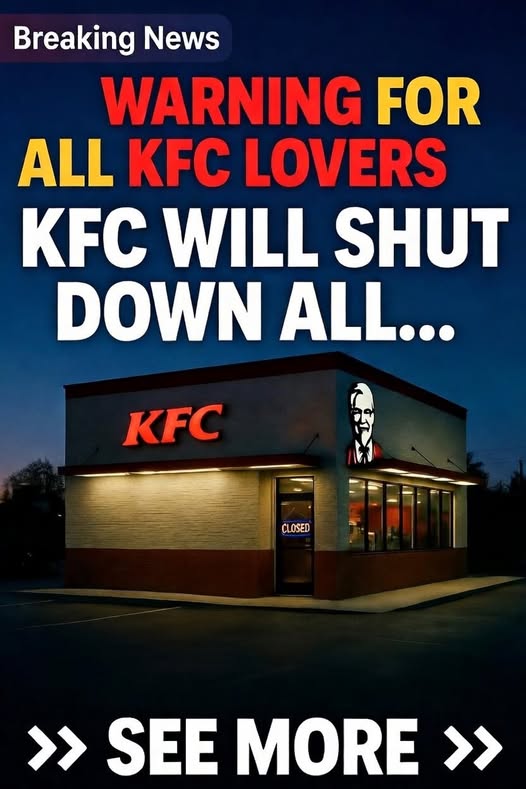
In today’s hyper-saturated advertising landscape, where brands battle for attention with flashing screens, intrusive pop-ups, and relentless digital noise, KFC has taken an audacious step in the opposite direction: they are speaking by saying nothing at all—literally. The centerpiece of their “Out-Door” campaign is simple yet radical: removing the doors from their restaurants. What might appear at first glance as a construction oversight or security blunder is actually a carefully orchestrated strategy that transforms the very architecture of KFC into a bold, unmissable message about availability. By erasing the physical barrier between the kitchen and customers, KFC conveys a powerful, immediate idea: the restaurant is always open.
This is a masterclass in environmental marketing. By stripping away doors, KFC turns its own buildings into a visual statement that demands attention. In a world where audiences are exhausted by slogans, banners, and neon lights, the empty doorframe is jarring, impossible to ignore, and universally understood: no door equals no closure. The communication is instantaneous, visceral, and requires no words—an elegant demonstration of the principle that absence can be louder than presence.
But the ingenuity of “Out-Door” doesn’t stop at the doorframes themselves. The removed doors have been repurposed into mobile, interactive installations scattered across urban centers. These reclaimed doors function as playful signposts, featuring clear, confident messaging and QR codes that guide hungry late-night commuters to the nearest KFC location. At 2:00 A.M., a passerby can scan a door standing in a public plaza and be immediately directed to a hot bucket of chicken—melding real-world experience with seamless digital convenience.
The brilliance of this campaign lies in its power of subtraction. While competitors pile on more lights, more screens, and more noise, KFC demonstrates that doing less can communicate far more. Removing a single, essential element—a door—creates a psychological “pattern interrupt,” forcing the brain to pause and process an anomaly. It’s a subtle form of disruption that respects the intelligence of the consumer, conveying confidence rather than desperation.
Furthermore, “Out-Door” taps into the rhythm of modern, always-on life. In a world where streaming never stops, delivery runs 24/7, and digital marketplaces never sleep, a doorless restaurant visually mirrors this cultural shift. It communicates that KFC is a constant, a dependable presence ready to serve whether it’s a post-concert snack at midnight or a pre-dawn meal before an early shift. The architecture itself embodies the promise of accessibility.
Ultimately, KFC’s campaign proves that innovation doesn’t always demand massive budgets or cutting-edge technology. Sometimes, it’s a matter of reimagining the familiar. By removing a literal barrier, the brand creates a metaphorical connection with its audience that is far more compelling than any conventional commercial. Through clever design and architectural storytelling, KFC sells more than chicken—they sell certainty, reliability, and the comforting assurance that the lights are always on and the doors are always open.