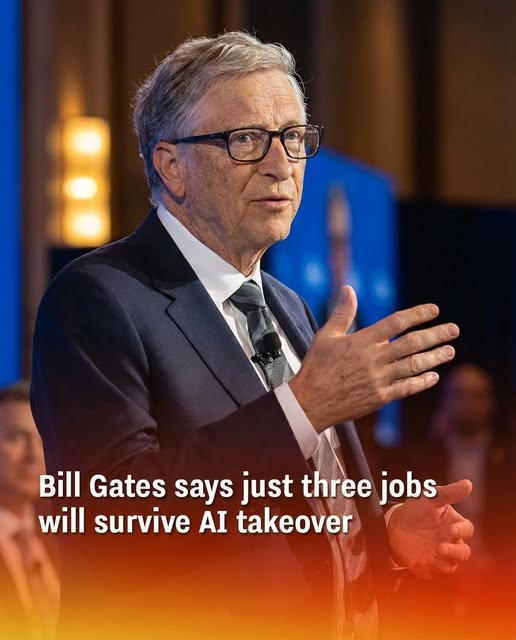
As artificial intelligence accelerates from a futuristic curiosity to a central driver of the global economy, a haunting question is now echoing through boardrooms, breakrooms, and kitchen tables alike: is my job next? In a world where algorithms can draft complex legal briefs, compose intricate musical scores, and diagnose diseases with astonishing precision, the traditional career ladder increasingly feels less like a path forward and more like a disappearing platform. Yet amidst this growing anxiety, tech visionary and Microsoft co-founder Bill Gates has stepped forward with a clear-eyed forecast, identifying three categories of professional work that he believes are fundamentally insulated from the sweeping tide of AI automation. His message offers both a warning and a blueprint for navigating a rapidly shifting labor landscape.
The global workforce’s unease is not unwarranted. By early 2026, generative AI had already permeated routine business operations, transforming how value is created across industries. Tasks that once required meticulous human attention—drafting reports, analyzing data, and performing repetitive cognitive functions—are increasingly handled by systems capable of processing enormous volumes of information in seconds. Yet Gates remains cautiously optimistic, framing the AI era not as a death sentence for human employment, but as a structural reorganization. Central to his argument is the idea that while AI can replicate analytical reasoning, it cannot replicate the “human spark”—the combination of intuition, moral judgment, and real-world accountability that remains uniquely human.
According to Gates, the first category of roles most resistant to automation encompasses those who build and manage the digital infrastructure itself: software developers, AI engineers, and system architects. At first glance, it might seem paradoxical that the creators of AI would be among the safest from its effects. However, Gates emphasizes that AI systems are extraordinarily complex and require ongoing human oversight to function safely and effectively. While an algorithm can optimize code or process information at scale, it lacks the intentionality necessary to innovate its own architecture, anticipate nuanced industry needs, or align technological outcomes with ethical considerations. In this sense, developers are evolving from coders to “conductors,” orchestrating digital ecosystems while ensuring that machines remain aligned with human goals.
The second human stronghold, according to Gates, lies in high-level scientific research, particularly within biology, medicine, and healthcare. AI may accelerate data analysis, quickly cross-referencing millions of chemical compounds or simulating clinical trials. Yet the insight required to connect disparate observations into breakthrough discoveries—the proverbial “Aha!” moments—remains fundamentally human. Complex problem-solving that involves creativity, moral judgment, and nuanced decision-making in life-and-death contexts cannot be outsourced to an algorithm. In essence, the critical thinking and imaginative leaps that define cutting-edge research remain impervious to automation, ensuring that human scientists continue to play an indispensable role.
Finally, Gates points to the energy sector as a domain where human labor is irreplaceable. As the world pivots toward green and renewable energy, managing physical infrastructure—power grids, next-generation nuclear plants, and large-scale solar installations—requires not only technical expertise but also situational judgment, on-site decision-making, and real-world accountability. Unlike tasks confined to digital space, these roles demand a presence in the physical world, where problems cannot be fully anticipated or simulated in advance. Operational responsibility, logistical troubleshooting, and the coordination of complex systems remain inherently human challenges.
Ultimately, Gates’ vision frames the AI revolution not as a confrontation between humans and machines, but as a partnership. The professionals most likely to thrive in the next decade will be those who learn to “speak AI”—leveraging these systems as high-powered tools that amplify human creativity and judgment. While certain roles may fade into history, those that survive will be defined by uniquely human qualities: insight, intuition, ethical reasoning, and the ability to operate in a world that is increasingly digital yet still dependent on human sensibility. For anyone concerned about the future of their career, Gates’ advice is unambiguous: invest in the skills a machine cannot replicate, and position yourself at the intersection of human ingenuity and technological advancement.