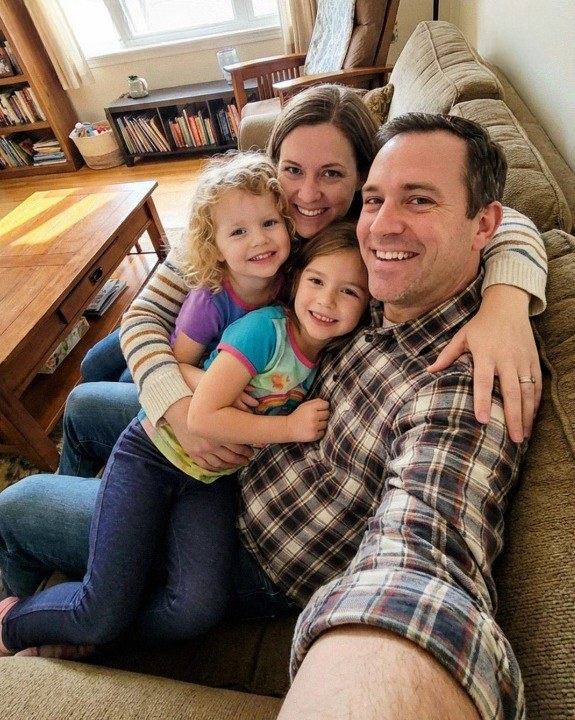
I thought I was stepping into a family that had already weathered its hardest storm. But a single comment from Daniel’s oldest daughter quickly revealed there was something unusual, something secretive, in that house.
When I first started dating Daniel, he had chosen to be upfront about the hardest part, during our second date.
“I have two daughters,” he said. “Grace is six, Emily is four. Their mother passed away three years ago.”
He spoke carefully, his voice steady, as though he had rehearsed this moment, the controlled calm people show when they are holding themselves together in front of the world.
I reached across the table, placing my hand on his.
“Thank you for telling me,” I said.
He offered a small, tired smile. “Some people hear that and decide dinner is over.”
“I’m still here,” I told him. And I meant it.
The girls were incredibly easy to love, even though they couldn’t have been more different. I never tried to replace their mother—that was never my role.
Grace was sharp, serious, and highly observant, often seeing straight through any vague answers. If something didn’t make sense, she would stare until you either explained it properly or admitted you didn’t know.
Emily, on the other hand, was pure energy and light. At first, she would hide behind Daniel’s leg, peeking at me like I might be a strange creature. Within a month, she climbed into my lap with a book, declaring, “I sit here now,” as though the decision had been made officially.
I didn’t try to become their mother, but I wanted them to feel safe. To trust me.
Daniel and I dated for a year before marrying. Our wedding was small, simple, held by a quiet lake—nothing extravagant. Just family, a few friends, and two little girls more interested in dessert than vows. Grace wore a flower crown and kept asking every ten minutes when the cake would arrive. Emily fell asleep halfway through dinner, frosting still on her cheek. Daniel looked happy but cautious, like he didn’t fully trust happiness would last.
After the wedding, I moved in. His house was warm, lived-in, and full of life: a large kitchen, a wraparound porch, drawings on the fridge, shoes by the door, toys tucked everywhere.
But there was one thing that caught my attention immediately: the basement door.
It was always locked.
During my first week, I asked, “Why is that door always locked?”
Daniel didn’t look up from drying dishes. “Storage. Old tools, boxes, paint cans. Nothing important. I just don’t want the girls getting into anything dangerous.”
It sounded reasonable, so I let it go.
Still, small details kept nagging at me. Grace would occasionally glance at the door when she thought no one was watching. Emily would wander near it, then step back quickly, that guilty look children wear when they almost reveal a secret.
One afternoon, I found Grace sitting on the floor, staring at the knob.
“What are you doing?” I asked.
“Thinking,” she replied.
“About what?”
She stood immediately. “Nothing,” and ran off before I could ask more.
I brushed it off—families have quirks, houses have drafts.
Until the day everything changed.
Both girls had mild colds, so I stayed home while Daniel went to work. For an hour, they acted dramatic, claiming they were “fading” and possibly dying. By midday, they were running and playing like children always do.
Then Grace tugged on my sleeve. Her expression was serious.
“What is it?” I asked.
“Do you want to meet my mom?”
My heart stopped.
“What do you mean, sweetheart?”
She repeated slowly, as though I didn’t understand:
“Do you want to meet my mom? She liked hide and seek too.”
A chill ran through me.
“Grace,” I said gently, “what are you talking about?”
She frowned. “Do you want to see where she lives?”
Emily wandered in, holding her stuffed rabbit.
“Mommy is downstairs,” she said.
I froze.
“Downstairs where?” I asked.
Grace took my hand. “The basement. Come on.”
Every awful possibility flashed through my mind—the locked door, the secrecy, a wife’s absence, a basement Daniel never showed me.
Grace pulled me down the hallway, her urgency growing with every step.
When we reached the door, she looked up.
“You just have to open it,” she said.
My throat went dry.
“Does Daddy take you down there?”
She nodded. “Sometimes. When he misses her.”
Emily hugged her rabbit tighter.
I should have stopped. I should have called Daniel. I didn’t.
I knelt in front of the lock, hands shaking, and used two hairpins to open it. Grace bounced with excitement. Emily sniffled quietly.
Click.
I opened the door.
The first thing that hit me was the smell: sharp, damp, that stale basement scent.
Step by step, the room revealed itself.
It wasn’t a crime scene. Not a body.
It was a shrine.
An old couch with a folded blanket. Shelves lined with albums, framed photos, candles, drawings. Labeled boxes, a small tea set on a child-sized table, a cardigan over a chair, a pair of rain boots, and an old TV with stacked DVDs. A dripping pipe left a stain on the wall.
Grace smiled. “This is where Mom lives,” she said.
I swallowed hard. “What do you mean, sweetheart?”
She pointed. “Daddy brings us here so we can be with her.”
Emily hugged her rabbit. “We watch Mommy on TV.”
Grace nodded. “And Daddy talks to her. Sometimes he cries, but she already knows.”
I stepped closer to the TV. One DVD read Zoo Trip, another Grace Birthday. A notebook lay open; one line caught my eye: I wish you were here for this. I closed it immediately.
Then I heard Daniel at the front door.
“Girls?” he called.
“Daddy! I showed her Mommy!” Grace shouted.
He froze at the basement doorway. His color drained.
“What did you do?” he asked, voice sharp, making Grace flinch.
“I’m not your child,” I said calmly. “But your daughters are.”
He pressed his hands to his head. “Why is this open?”
“Because your daughter told me her mother lives down here.”
His face shifted—anger giving way to raw shame.
Grace whispered, “Did I do something wrong?”
“No, baby. No.”
I sent the girls upstairs to cartoons. Emily dragging her rabbit, Grace glancing back twice.
Once alone, I turned to Daniel. “Talk.”
He sat on the steps. “I was going to tell you.”
“When?”
He didn’t answer.
“It’s not what you think.”
I laughed softly. “Exactly.”
“I don’t know what to think either,” he admitted, voice cracking. “It’s all I had left. After she died, everyone told me to be strong, so I was. I worked. Took care of the girls. I felt numb. I kept her things down here because I couldn’t throw them away. The girls asked about her, so sometimes we came here, looked at pictures, watched videos.”
“Grace thinks her mother lives in the basement,” I said.
“I know,” he whispered.
“You knew?”
“Not at first… but she kept saying it, and I didn’t correct her.”
“That’s not a small mistake, Daniel.”
“I know.”
“Why keep it like this?”
“Because down here, she was still part of the house,” he said.
I asked the question I dreaded. “Why did you marry me while living like this?”
“Because I love you,” he said.
I believed him—but it hurt.
“Do you love me, or do you love that I help carry her life?”
He hesitated. “Both.”
“You asked me to build a life while hiding grief,” I said.
“I was ashamed,” he admitted. “I should have been honest.”
“Those girls need memories, not a basement where they think their mother still lives,” I told him.
Over the next week, they spent time together in that room, talking openly. Slowly, Daniel cleared it out. I didn’t interfere, only observed quietly, making sure the old pattern was breaking.
We don’t know yet what that space will become.
But I know this:
We’re no longer living around a locked door.
And we’re learning how to remember her in a way that keeps no one trapped in the past.