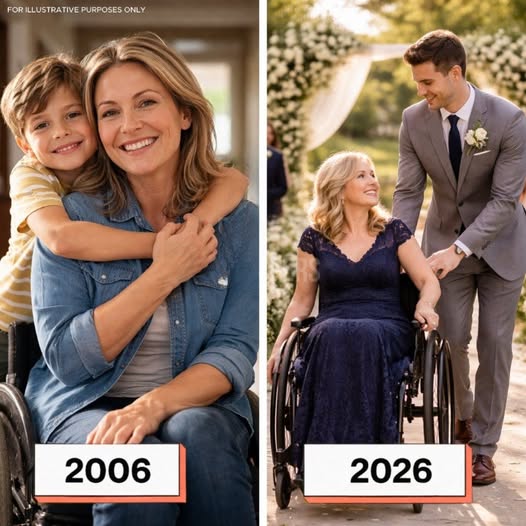
I’m 54 now, and I’ve been a single mother for so long that the life I had before everything changed feels far away—almost like it belonged to someone else.
Before the wheelchair. Before that single moment that divided my life into two parts. There was the life I knew, and the one I had to learn from the beginning.
Nearly twenty years ago, an accident left me paralyzed from the waist down. One day I was rushing through a grocery store while my five-year-old begged me to buy dinosaur-shaped cereal. The next, I found myself in a rehabilitation center, staring up at blank ceiling tiles, trying to understand how my body could still be mine and yet no longer respond the way it once did.
People often assume the hardest part is the physical pain. But it isn’t.
It’s the way your world suddenly becomes smaller.
It’s measuring everything—doorways, ramps, steps. It’s noticing which places you can enter and which ones quietly exclude you. It’s sitting in spaces not designed for you, or being spoken around as if you’re invisible. It’s forcing a polite smile when someone calls you “inspiring,” simply because you’re existing.
But in those early years, I had Liam.
And Liam—strong-willed, funny, and full of kindness—made our world feel complete, even when everything else felt uncertain.
He was only five when I came home in the wheelchair. I was afraid he might be scared, that he would look at me differently and never be able to unsee it. But instead, he walked straight up to me, placed his hands on the armrests as if examining something fascinating, and said, “So… this is your new car.”
I laughed until I cried.
From that moment on, it was always the two of us.
He would bring me juice boxes and call them “emergency supplies.” He opened doors with a sense of duty far bigger than his size. When I struggled, he would gently hold my wrist, as if he could pass some of his strength into me.
Some evenings, when my arms were exhausted from pushing myself around all day, he would stand behind my chair and push me down the hallway, making exaggerated superhero noises.
“We’ve got you, Mom,” he’d say. “Always.”
Those words stayed with me through everything.
I worked hard—more than one job at times. I adapted to cooking while seated, learned how to fix small problems around the house, and showed up for every school event, even when space wasn’t made for me. I clapped the loudest, cheered the hardest, and made sure he always felt supported.
And Liam grew up.
He became thoughtful, dependable, and caring—the kind of man who never forgot to call, no matter how busy life became.
So when he met Jessica, I chose to be happy for him rather than cautious.
Jessica seemed put together, always polished, the kind of person whose life appeared carefully arranged. The first time she came over, I noticed how she looked around my apartment, as if taking everything in with quiet judgment. Still, she smiled, complimented my cooking, and hugged me warmly.
I wanted to trust that version of her.
When Liam proposed, I was overjoyed. I cried, then immediately began preparing in my own way—searching for a dress that would look elegant while seated, practicing moving more efficiently, and making sure I could manage everything smoothly. I imagined the ceremony, sitting proudly in the front row as he said his vows.
Most of all, I thought about the mother-son dance—something he had talked about since he was little.
So when he came to visit me alone a week before the wedding, I felt uneasy, but I didn’t expect what was coming.
He seemed tense, avoiding eye contact.
“Mom, we need to talk about the wedding,” he said.
I smiled, trying to keep things light. “Of course. Is everything okay?”
He hesitated before answering. “The venue… it’s a historic chapel on a cliff.”
I felt a quiet concern settle in. “Is it accessible?”
The silence that followed told me everything.
Finally, he said, “Jessica and the planner think adding a ramp would ruin the look. They want everything to be… perfect in the photos.”
My stomach sank.
“I can come early,” I said quickly. “Someone can help me in. It doesn’t have to be noticeable.”
He shook his head.
“It’s not just that,” he added.
I went still. “What do you mean?”
He looked down. “The chair… Jessica thinks it will stand out too much. That it might distract from everything.”
For a moment, I couldn’t even process the words.
“So you don’t want me there,” I said quietly.
“Mom, please don’t turn this into a disability issue.”
I let out a hollow laugh. “That’s exactly what it is.”
“It’s just one day,” he insisted. “Our day. Can’t it be perfect? We’ll send you pictures. We can video call you.”
A video call.
And then came the part that hurt the most.
“The dance… Jessica’s mom is going to do it instead. It just fits better.”
Something inside me broke.
“Alright,” I said softly.
He looked relieved—and that hurt more than anything else.
After he left, I sat there for a long time in silence, trying to absorb everything that had just happened.
Then I remembered something.
Not the wedding gifts or anything like that—but something older, something that mattered more.
In my dresser, I kept a small wooden box. Inside was a piece of folded construction paper Liam had made when he was six. It had stick figures drawn in crayon—one of them in a wheelchair—and a heart above us.
At the top, it said: TEAM LIAM + MOM.
Below that, in uneven handwriting, he had written a promise: that when he grew up, he would take me everywhere, help me, and never feel ashamed of me.
I added a short letter to it, along with a simple silver tie clip engraved with the words: “We’ve got you.”
I asked my brother to deliver it on the wedding day.
That morning, I stayed home.
About an hour later, my phone rang.
It was Liam.
When I answered, he was crying.
“Mom… I read it. I remembered everything. I stopped the wedding. I couldn’t go through with it—not without you.”
Fifteen minutes later, he was at my door, still in his suit, holding that old drawing in his hands.
“I’m so sorry,” he said, his voice breaking as he dropped to his knees. “I let myself believe it didn’t matter. I tried to ignore the hard parts instead of respecting them. But you’re not something to hide. You’re my mother.”
I told him the truth—that I was hurt, deeply. Angry, too.
But he had made a choice.
He had stopped the wedding.
And that mattered.
He promised he would fix things, that he would do better.
Later, Jessica came as well. She looked shaken, apologetic. She admitted she hadn’t fully understood what she was asking—that she had been focused on appearances instead of people.
They didn’t get married that day.
A month later, Liam planned a new ceremony.
This time, it was in a garden, with paths that welcomed everyone, with space that didn’t exclude anyone.
And that day, he didn’t hide me.
He walked beside me—guiding my wheelchair down the aisle himself.
Halfway through, he leaned down and whispered, “We’ve got you, Mom.”
At the reception, he asked me to dance.
We laughed as we moved carefully together, adjusting to the rhythm in our own way.
The pain from before didn’t disappear completely.
But I saw the decision he made after his mistake.
And sometimes, that’s where forgiveness truly begins.