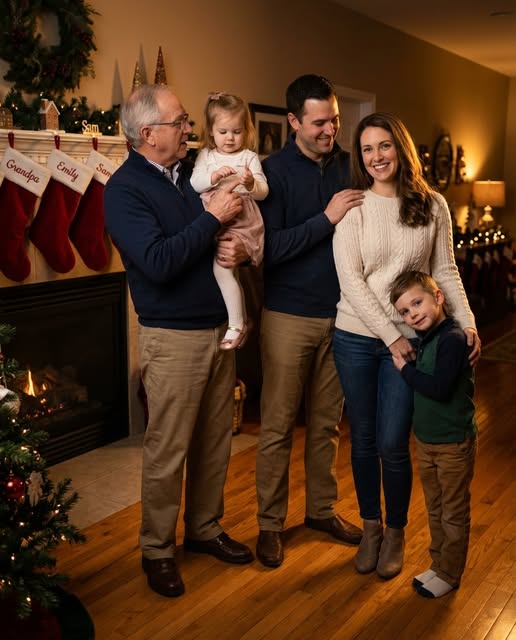
For twenty years, I truly believed I had made peace with the worst night of my life. It wasn’t a peace that came easily, nor one that ever felt complete, but it was enough to let me move forward and keep going each day. A sudden snowstorm had taken my son, his wife, and my grandson in a devastating crash, leaving behind a silence that could never truly be filled. In the aftermath of that night, everything changed in an instant, and the only light left in that darkness was my five-year-old granddaughter, who had somehow survived.
I devoted myself entirely to raising her—protecting her, guiding her, and trying to give her a sense of safety in a world that had already taken so much from her. Over the years, I held tightly to the explanation we had all been given: that it was a terrible, unavoidable accident caused by harsh weather conditions. It was a painful truth, but it was one I could accept. However, just days before the anniversary of that night, something happened that shook that belief to its core. She came home quietly, her expression more serious than I had ever seen it, placed a folded note in front of me, and said in a calm but heavy voice, “You need to read this.
” The moment felt different, as if something important was about to surface. And when I unfolded the paper and read the words inside, everything I thought I knew began to unravel.
Back then, the storm had arrived suddenly, far worse than anyone had predicted. It wasn’t just snow—it was blinding, relentless, and dangerous in a way that made even familiar roads feel unfamiliar. I still remember standing at the door that evening, watching them leave, trusting that they would make it home safely despite the weather. There had been no reason to think otherwise at the time. That moment stayed with me—the last wave goodbye, the last glimpse of their car disappearing into the growing storm. Hours later, the sound of a knock on my door broke through the quiet of the night, and with it came news that no parent should ever have to hear.
In a single instant, my world shifted completely. I was no longer just a father grieving unimaginable loss; I had become a guardian, responsible for a child who now depended on me for everything. My granddaughter had survived, but not without injuries and not without scars that went far beyond the physical. Her memories of that night were fragmented, incomplete, and fragile. The doctors had been clear in their advice: don’t push her, don’t force her to remember, let her mind heal at its own pace.
So I followed that guidance carefully. I told her what I had been told—that it was an accident, something no one could have prevented—and together, we slowly learned how to live with that version of the truth, even if it never fully eased the pain.
As the years passed, she grew into a thoughtful, observant, and somewhat quiet young woman. There was a depth to her, shaped by everything she had been through, even if she didn’t always speak about it. Our life together found its rhythm—simple routines, shared meals, quiet evenings, and an understanding of loss that didn’t always need words. There were things we didn’t talk about often, but they were always present in the background, shaping who we were. She rarely asked about the crash, and over time, I came to believe that some of her memories from that night had simply faded away or disappeared entirely. It seemed easier that way, for both of us. But recently, something had begun to shift in her.
I noticed it in small ways at first—how she became more focused, more curious, asking careful and specific questions about that night. She wanted to know details I hadn’t revisited in years, things I had almost trained myself to stop thinking about. At the time, I assumed she was searching for closure, trying to better understand what had happened so she could move forward more fully. What I didn’t realize was that she had already begun uncovering something much deeper, something far more unsettling than either of us had expected.
When she finally handed me the note, I could see that her hands were trembling slightly, even though she tried to remain composed. There was a seriousness in her expression that made it clear this was not just a passing thought or a simple question. I unfolded the paper slowly, unsure of what I was about to read, and the words immediately caught my attention: “It wasn’t an accident.” For a moment, I couldn’t fully process what I was seeing. Those words directly challenged everything we had believed for so many years.
She began to explain, her voice steady but filled with emotion, that pieces of her memory had started returning—small fragments at first, then clearer images that refused to fade. Alongside that, her own research had led her to old records, archived reports, and pieces of evidence that had been overlooked or never fully examined. What she found didn’t provide a simple or complete answer, but it raised serious and troubling questions. According to what she had uncovered, the road conditions that night might not have been exactly as we were told. There were indications that certain safety measures may not have been properly in place, and that key details had either been omitted or downplayed in the original report. It wasn’t a clear accusation, nor was it a fully formed conclusion, but it was enough to challenge the story we had lived with for two decades.
As I sat there, holding the note and listening to her, I felt something inside me shift. The grief that had once felt so heavy and fixed began to take on a different shape. It wasn’t replaced by anger, and it wasn’t softened into relief—it became something closer to clarity. For years, we had accepted a version of events that gave us a way to cope, even if it left questions unanswered. Now, those questions were no longer buried. We couldn’t change what had happened, and we understood that not every truth would lead to justice or action. Some answers might remain incomplete, and some details might never be fully known.
But even a partial understanding brought a sense of form to something that had always felt unfinished, like a story missing its final chapter. That night, as we sat together remembering our family—the laughter, the love, the life we had lost—the weight we carried felt different. It wasn’t lighter, and it didn’t disappear, but it felt clearer, more defined. And for the first time in many years, it felt like we were no longer just living alongside the past, trying to endure it—we were finally beginning to understand it, piece by piece.