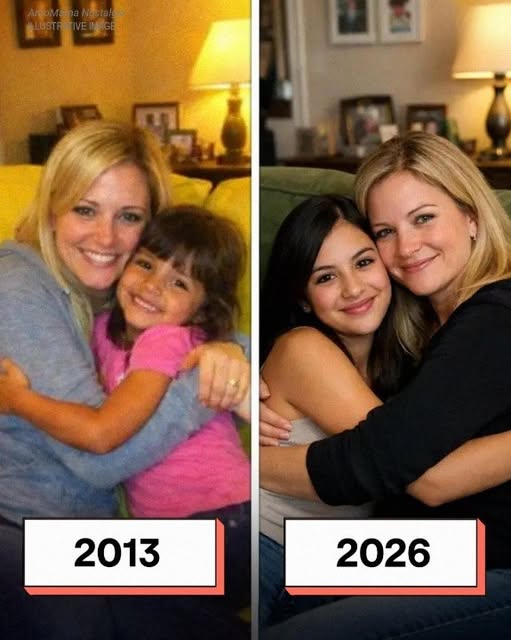
I took in my best friend’s daughter after she died in a tragic accident. For thirteen years, I poured every ounce of love, energy, and sacrifice into raising her. Every day, every sleepless night, every scraped knee, every scraped heart—I gave my all. I made sure she felt chosen, protected, and deeply wanted, even though she had lost the person who brought her into this world. But on her eighteenth birthday, the girl I loved more than my own life did something that made me break down in tears in a way I never had before—a way that left me both proud and utterly undone.
My name is Anna. I grew up in an orphanage, sharing a room with seven other girls. Some were adopted, some aged out, some left in silence and sadness. But Lila and I remained. We didn’t become best friends because life was easy. We became best friends because we survived the same loneliness, the same hunger for belonging, the same aching need for someone to see us. We used to promise each other that one day we’d build the kind of family we’d only ever seen in movies—full of laughter, warmth, and choices made out of love rather than necessity. We swore that even if the world tried to take us down, we would hold on to each other.
When we turned eighteen, we aged out together. The system that had kept us “safe” until then no longer had a plan for us. Lila found work at a call center, answering questions for people she didn’t know. I started waitressing the night shift at a diner, serving food to strangers who barely looked up. We shared a tiny studio apartment filled with yard-sale furniture that squeaked under our weight and a bathroom so cramped you had to sit sideways on the toilet. It wasn’t glamorous. It wasn’t perfect. But it was ours. No one could tell us to leave. No one could dictate how we lived or loved. It was freedom, bittersweet and raw.
Three years later, Lila walked in from a party looking pale, shaken, and fragile in a way I hadn’t seen before.
“I’m pregnant,” she said, voice trembling, at two in the morning. “And Jake’s not answering my calls.”
Jake, the man she’d been seeing for a few months, had blocked her the very next day. No family. No parents. No one to fall back on except me.
I stayed awake with her that night. We talked for hours, pacing the apartment, weighing impossible choices, and trying to figure out a way forward. I held her when she cried, rubbed her back when she shook, whispered words of hope into a room that felt too small for our fears. And when the day came, and Miranda was born, I was in the delivery room, witnessing Lila transform into a mother in the span of hours.
“She’s perfect,” Lila whispered, holding her tiny daughter. “Look at her, Anna. She’s beautiful.”
And she was. Miranda had dark hair, Lila’s exact nose, tiny fingers that curled around ours, and a voice that could already demand the world. Wrinkled and screaming, yet breathtaking all the same.
For five years, we carved out a life from the scraps the world offered us. Lila moved into medical billing, climbing a quiet ladder of independence. I took extra shifts to cover daycare, shoes, birthdays, and school trips. We were a team of three against a world that had never promised us anything. Miranda called me “Aunt Anna,” and sometimes, as she curled into my lap during movie nights, I would feel the weight of her trust like gravity, holding me steady. Carrying her to bed felt like holding every ounce of happiness I’d ever known, and I swore I’d never let it slip.
Then everything shattered in an instant. Lila was driving to work when a delivery truck ran a red light. She died instantly. The officer tried to soften the blow with his words: “She didn’t suffer.” As if that could undo the devastation, as if anyone’s soul could be reassured by the clinical language of a stranger.
Miranda was five. Five years old, and already forced to confront mortality in a way no child should. She kept asking when her mommy was coming back, her voice a haunting echo through the empty apartment.
Social services showed up three days after the funeral.
“There’s no one able to take custody,” the caseworker said, eyes flicking over the papers.
“What happens to her?”
“She’ll enter foster care.”
“No,” I said immediately, my voice trembling but firm. “She’s not going into the system.”
“Are you related?”
“I’m her godmother.”
“That’s not legal.”
“Then make it legal. I’ll adopt her.”
The process was exhausting, painstaking, and relentless. Six months of home checks, parenting classes, mountains of paperwork, and endless meetings. Every day, Miranda asked if I was going to leave her too, every night she curled up close, seeking reassurance in the shadow of a life-altering loss.
“I’m not going anywhere,” I promised. “You’re stuck with me.”
When the adoption was finally finalized, I sat her down in our small living room, filled with the furniture of survival and love.
“I’m not your birth mom,” I told her gently, “but I’m your mom now. Forever, if that’s okay.”
“Forever?” she asked, wide-eyed, uncertain.
“Forever.”
She threw her arms around me. “Can I call you Mommy then?”
I cried when I said yes. Not tears of sorrow, but tears of relief, of triumph, of love solidified into something tangible.
Raising her wasn’t perfect. We argued. She grieved. I made mistakes. There were nights when she cried for Lila and I couldn’t fix the pain. Mornings I was so exhausted I accidentally poured orange juice on her cereal, or forgot to sign permission slips. But through it all, we grew together. I cheered at every school play. Helped her practice lines. Cried when she sang on stage. Sat through heartbreaks, friend drama, and even speeding tickets. I was present. I was her anchor, and she became mine.
By the time she turned seventeen, she was taller than me, with a voice confident enough to call me Mom without hesitation. One quiet night, while washing dishes together in our tiny kitchen, she said softly, “You know I love you, right?”
I smiled. “Of course I do.”
I thought we were solid. I thought we had survived every storm the world had thrown at us. I thought nothing could shake the trust and love we had built.
Her eighteenth birthday came on a bright Saturday. We threw a party in our apartment with friends, laughter spilling into the narrow streets outside. She laughed, made a secret wish, and looked happier than I had ever seen her. Later that night, she stood quietly in my doorway.
“Mom? Can we talk?”
Something in her tone made my stomach drop.
“I’m eighteen now,” she said.
“I know,” I smiled, expecting her to continue casually.
She didn’t smile back. Her eyes were steady, intense.
“I got access to the money this week. From my mom. The insurance. Her savings.”
I nodded. I’d protected that money in a trust for her entire childhood, a buffer for the future I hoped she would never have to navigate alone.
“That’s yours,” I said. “Do whatever you want with it.”
Her gaze held mine. A seriousness far beyond her years settled over the room.
“I know what I want to do.”
“Okay.”
She inhaled shakily, and the next words hit me like a wave.
“You need to pack your things.”
The words didn’t make sense. My legs went weak.
“What?”
“You need to pack your things. I’m serious.”
“You want me to leave?”
“Just… read this first.”
She handed me an envelope. Inside was a letter, her handwriting messy, rushed, yet precise in its emotion. She wrote about watching me give up promotions, relationships, dreams, travel. She wrote about every sacrifice I had made to raise her, every tiny invisible choice I had taken so she could thrive. Then came the words that broke me completely:
“I used some of Mom Lila’s money. I booked us two months in Mexico and Brazil. Every place you ever said you wanted to see. That’s why you need to pack. We leave in nine days. Now let me choose you back.”
I looked up. She was filming me, crying and smiling at the same time.
“Surprise.”
I collapsed into tears. She ran to hold me.
“You scared me,” I sobbed.
“I wanted it to be dramatic,” she said, laughing through tears.
“So… will you come?”
I held her face gently. “I’d follow you anywhere.”
The trip was everything I had buried for years—markets in Mexico, hidden cenotes, sunrise walks in Rio, dancing clumsily under the stars, getting lost and finding our way back together. Each moment felt like reclamation of joy, love, and freedom.
One night, while lying on a Brazilian beach listening to waves crash, she asked quietly, “Do you think my mom would be happy? With how things turned out?”
I squeezed her hand. “She’d be proud of both of us. Proud that we built a life from love, that we chose each other every day.”
We sat under the stars, two people who had built a family from nothing, who had stitched together pieces of loss, hope, and persistence into something real.
I’m forty now. I spent most of my life bracing for abandonment, for people to leave, for love to be conditional. But Miranda taught me something different:
Family isn’t who stays because they have to. Family is who stays because they choose to. Every day. In the little acts of care, in the sleepless nights, in the sacrifices that go unnoticed, and in the laughter shared after tears.
And to anyone who has ever loved and raised a child who didn’t come from them… thank you. You prove that the strongest families aren’t born. They’re built. One choice at a time.