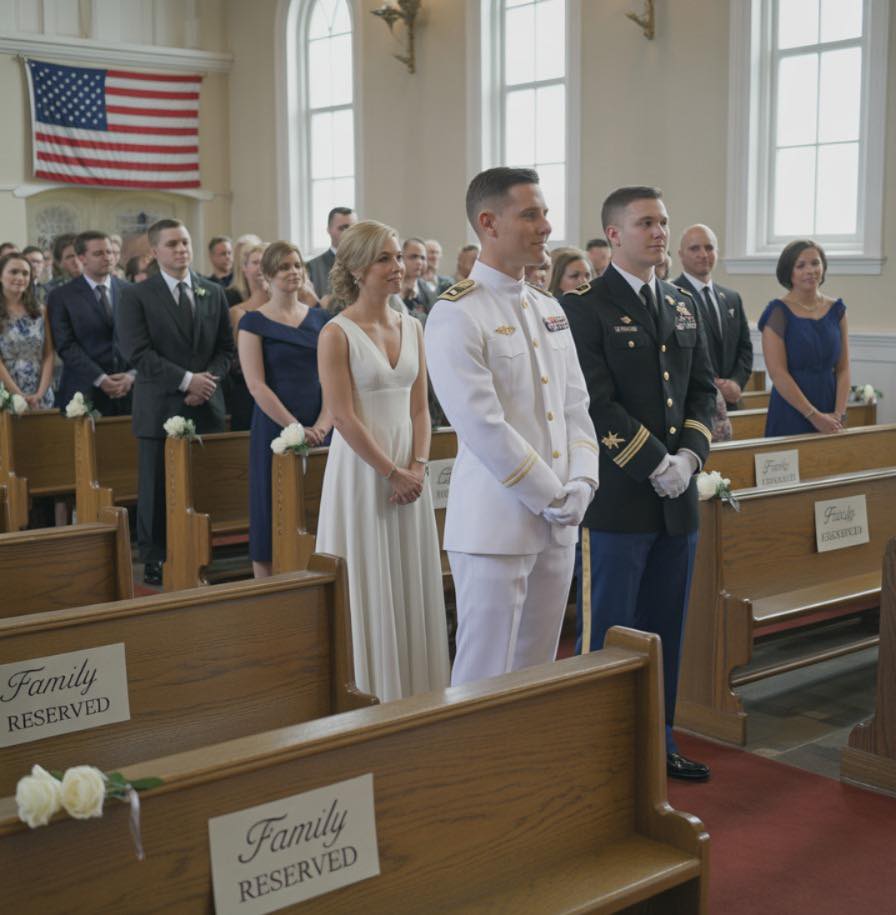
I’m Captain Elena Ward, and for eight years I proudly wore a Navy uniform that my family never truly respected. I showed up for every milestone they chose to miss, responded to every dismissive remark with patience, and kept holding on to the hope that one day they might finally see me for who I was. But when my parents and my sister decided to fly to London instead of attending my engagement ceremony—sharing champagne photos online with the caption “some celebrations actually matter”—something inside me finally shifted.
This isn’t a story about revenge. It’s about the moment you realize who truly shows up when it matters most—and what unfolded when my family ended up seeing my wedding broadcast on the evening news.
The first fractures in our relationship appeared long before any wedding plans were ever made. They started with subtle remarks that felt like constant paper cuts—my sister Lydia joking during family dinners that I’d probably end up marrying “some sergeant with a jeep,” or my mother Caroline gently correcting my posture whenever I wore my uniform to a dinner party, as if the confidence of military bearing were something awkward rather than something earned.
They never said it directly, but the message was obvious: my career was merely tolerated, not celebrated. What truly mattered in our household was that Lydia had recently been promoted to senior marketing director at a tech company—a role my mother could easily describe to her book club friends without uncomfortable pauses or patriotic clichés.
I had served on three deployments, received commendations for tactical analysis, and built a reputation as someone who remained steady under pressure. I had briefed admirals, managed classified intelligence operations, and guided teams through complex strategic missions. Yet none of that ever seemed to register at family dinners. The conversation always drifted back to Lydia’s newest client victory or my father Richard’s billable hours at his corporate law firm.
When I got engaged, their reaction was lukewarm at best. Polite smiles. Thin congratulations that felt rehearsed rather than heartfelt. My father shook Mark’s hand with the sort of grip that suggested he was doing me a favor simply by acknowledging the relationship. Later that night, I overheard him whisper to my mother—his voice just loud enough for me to catch the words: “She’s always been desperate to prove something.”
I didn’t tell them much about Mark because they never showed any interest. To them, he was simply “someone I met through work,” which was technically true. What I left out was that Mark held a rank most officers spend their entire careers striving to achieve, or that part of his work involved briefing members of Congress and the Joint Chiefs of Staff. I never mentioned it because it wasn’t important to me—and I knew it wouldn’t matter to them either. They had already decided who I was: the daughter who chose camouflage instead of cocktail dresses, duty instead of dinner parties.
Then Lydia announced that she and my parents had finally booked the dream trip to London—scheduled during the exact same week as my engagement ceremony. It wasn’t the wedding itself, just the formal ceremony where we would sign paperwork, make everything official in front of our command, and celebrate with the people who truly knew us.
When I asked why they had chosen that exact week, Lydia gave me the same polished smile she used during client presentations.
“To celebrate something worthwhile,” she said, letting the words linger in the room like smoke.
My mother avoided my eyes. My father cleared his throat and abruptly changed the topic to airline miles and hotel points. The implication couldn’t have been clearer: your engagement simply wasn’t important enough to postpone a vacation.
It hurt—but I didn’t argue. The military teaches you composure under pressure. You learn to keep your face neutral when someone is shouting orders inches from your face. You learn to function on little sleep and terrible coffee. And you learn that some battles aren’t worth fighting because the other side was never interested in peace to begin with.
So I didn’t argue or plead for them to reconsider. I simply said, “Have a good trip,” and continued planning an event they had made it very clear they would not attend.
Mark noticed immediately. He has the kind of quiet awareness that comes from years of studying satellite intelligence and threat reports. One evening while we were reviewing the guest list, he set down his pen and looked directly at me.
“They’re really not coming.”
It wasn’t phrased as a question, but I answered anyway.
“No. They’re really not.”
“Is it because they disapprove of the military,” he asked calmly, “or because they disapprove of you?”
I thought about that carefully before answering.
“I think they’re embarrassed that I didn’t become what they expected. The military was supposed to be temporary—something I’d grow out of after a year or two. Instead, I built my life around it.”
He nodded slowly, absorbing the information like strategic data.
“Their loss.”
After that conversation, I tried not to dwell on it. I focused on work, on the details of the ceremony, on making sure everything was organized properly. I told myself it didn’t matter—that I had built a life outside their approval, surrounded by people who understood duty, service, and the importance of showing up when it counts.
But the night before the engagement ceremony, I sat alone in my quarters staring at three empty RSVP cards I had printed for them—three empty seats reserved in the front row labeled “family of the bride.” I considered throwing the cards away, but something stubborn inside me stopped me.
I wanted those empty seats to remain visible. I wanted everyone to see exactly who hadn’t shown up.
The engagement ceremony itself was modest but formal—folded flags on the tables, a toast from my commanding officer Colonel James Harper, and official documents signed in triplicate. The room filled with Navy uniforms, perfectly pressed and starched, ribbons and medals reflecting the afternoon sunlight. Several senior officers attended—people who had supervised my work, written my evaluations, and seen both my best and worst moments before deciding I was worth investing in.
My friends were there too. Lieutenant Commander Sarah Chin, my roommate during officer training. Petty Officer First Class Mike Rodriguez, who once saved my life during a training accident in Guam. Commander Patricia Oay, who had mentored me during my first deployment. These were my people—the ones who understood service, sacrifice, and loyalty.
Colonel Harper pulled me aside before the ceremony began.
“Your family couldn’t make it,” he said carefully, studying my expression. “They had other plans.”
“That’s right.”
He watched me for a moment and then nodded slowly.
“Their loss. You’re doing a good thing here, Ward. Hall is a solid officer. The two of you are going to accomplish great things together.”
The ceremony unfolded with military precision. Mark stood beside me in his dress uniform, and when he slid the ring onto my finger, I felt something settle deep inside my chest. It wasn’t quite happiness—more like certainty.
These were my people. This was my family—the one I had chosen, and the one that had chosen me.
Still, my parents’ absence lingered in the room like smoke. People noticed the empty seats. A few quietly asked where my family was, and I gave the same neutral answer each time:
“They had other plans.”
No one pushed further. Military communities understand loyalty—but they also recognize when it isn’t returned.
Later that night, after the ceremony ended, I checked my phone out of habit.
Lydia had posted photos from London—champagne glasses raised against the Thames skyline, a rooftop dinner overlooking the glittering city lights, her arm wrapped around my mother as both of them laughed into the camera.
The caption read:
“Some celebrations actually matter. ✨”
I stared at those words for a long time, rereading them again and again until they stopped feeling like a caption and started feeling like a judgment.
Eventually I placed the phone face-down on my nightstand and tried to sleep.
By the next morning, the photo had spread everywhere. Someone had tagged me in it. Others had reshared it. By noon, half my unit had seen it. By evening, Mark had seen it too.
At first he didn’t say much. He looked at the screen, then at me, then back at the screen again. Finally, he set the phone aside and gently took my hand.
“Now I understand,” he said quietly.
“Understand what?”
“Why you never talk about them. Why you tense up every time someone mentions family leave.” He squeezed my hand softly. “They don’t really see you, do they?”
I wanted to defend them—to explain it away as misunderstandings or different priorities. But I was tired of pretending, especially with him.
“No,” I admitted softly. “They don’t.”
He sat silently for a moment, thinking.
“Then do you still want to keep the wedding quiet?”
I had told him before that I wanted something small and private—just a handful of witnesses in the base chapel. Nothing extravagant.
“Yes,” I said firmly. “I don’t need anything big.”
He nodded slowly, but there was a look in his eyes I didn’t fully recognize—something that looked like determination mixed with quiet protectiveness.
“Okay,” he said. “Small and private. Just us.”
I believed him.
In hindsight, I should have known better.
Mark never lies—but his idea of “small” is very different from most people’s.