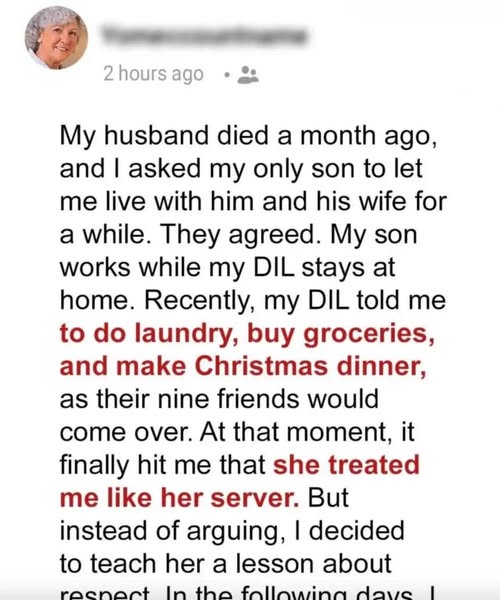
The transition into widowhood often feels like a series of quiet subtractions. After my husband, Ron, passed away, the silence in our home became a physical weight, pressing into every corner of the house we had shared for forty years. Every creak of the floorboards echoed with a loneliness I wasn’t prepared for, and Ron’s empty armchair was a constant, painful reminder of the life that had been severed. Within a month, I realized that living alone in that vast space was slowly eroding me. I called my son, Connor, and his immediate, unhesitating invitation to move in felt like a lifeline. I rented out my old house—a symbolic closing of one chapter—and moved into their guest room, determined to contribute to their household rather than be a burden.
At first, everything went smoothly. Connor and his wife, Eve, were exceptionally attentive. Eve, in particular, personified kindness, making sure I was comfortable and encouraging me to rest. She brought me tea and handled the cooking, always saying I had “been through enough.” It was a period of healing, where I felt seen and embraced by family. But as the weeks turned into months, the social dynamics of the household subtly began to shift.
The transition from “honored guest” to “unpaid domestic” didn’t happen overnight—it was gradual. It started with the dishwasher, then the laundry, and eventually included cleaning the entire house. Slowly, Eve’s “requests” became “assignments.” I found myself cooking every meal, scrubbing bathrooms, and organizing their busy schedules. The kindness that had characterized our early days was replaced by quiet entitlement. I realized I was no longer being cared for; I was being used. My grief hadn’t disappeared, but it was being buried under the daily labor of maintaining a household that wasn’t mine.
The breaking point came a few days before Christmas. While folding a mountain of towels, Eve casually told me to handle groceries and prepare Christmas dinner for nine people. There was no discussion or collaboration—just a task list for a holiday marathon. Something inside me tightened. I had spent my life as a mother and wife, but I had never been anyone’s servant. I didn’t want a family conflict, but I knew that staying silent would cost me the last pieces of my identity.
I decided to let my competence speak. If I was to host dinner for nine, I would do it with the legendary precision and flair that had made my holiday gatherings famous. On Christmas Eve, I rose before dawn and transformed the kitchen into a theater of culinary excellence. I prepared a roast turkey with fresh herbs, garlic-roasted mashed potatoes, and my signature pecan pie. By the time the guests arrived, the house was alive with the smells and warmth of the holidays.
The dinner was a success. As guests marveled at the feast, the reality of what had happened began to sink in. When Connor’s friends asked if I had done it all myself, my simple “I did” wasn’t just a statement of fact—it was a reclamation of my status. Eve’s polite smile faltered as she realized she hadn’t contributed a single spoonful. The contrast between her leisure and my labor was finally undeniable.
After the guests left and the house fell quiet, Eve approached me. To her credit, she had learned the lesson. She admitted she had let me do too much and apologized for treating me like an extension of the house rather than a person. I responded firmly but gently: “I don’t mind helping, but I’m not twenty-five anymore. I need partnership, not assignments.” It was a boundary set not with anger but with the grace of someone who knows her worth.
Since that Christmas in 2026, our household dynamic has changed fundamentally. We now operate as a team, sharing tasks and checking in on each other’s well-being. I am no longer “live-in help”; I am family. The silence I feared after Ron’s death has been replaced by the vibrant noise of a home where everyone is seen. I learned that even later in life, it’s never too late to teach people how to treat you. Boundaries don’t have to be walls—they can be what makes a shared life possible.
Moving in with adult children is emotionally complex, especially for widows navigating the shift from shared life to solitude. Studies on intergenerational living show that “role ambiguity” often causes friction. Without clearly defined roles, elder family members may fall into traditional labor roles to “earn” their place. By setting a boundary through action, I avoided the resentment that usually poisons these arrangements.
Today, I feel lighter. I arrived grieving and unsure of my place, but I found it by refusing to be invisible. I am Lucy—a mother, mother-in-law, and a woman who still has much to give, but on my terms. My story is a reminder that we are the authors of our own lives, and sometimes the most powerful thing we can do is remind the world who we are without saying a word.