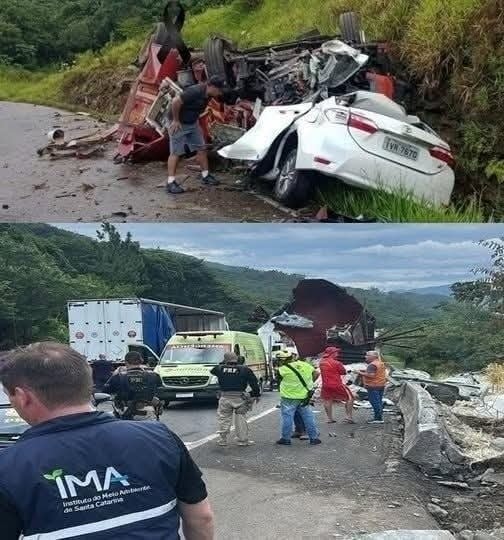
The quiet of a Tuesday night on the BR-251 highway near Grão Mogol was violently broken by the thunder of engines and the shriek of ripping metal, ushering in one of the darkest tragedies Northern Minas Gerais has seen in recent years. What should have been an ordinary drive through rural Brazil turned into a nightmare when a cargo truck collided head-on with a passenger van. Nine lives were lost instantly, and twelve others were left critically injured, fighting to survive. Among those killed was a deeply loved regional singer, whose sudden death has left a lasting emptiness in the cultural soul of the community.
The crash took place on a notoriously dangerous stretch of road, known for its challenging terrain and heavy industrial traffic. The van was transporting workers returning to Ceará after completing a period of labor. They were traveling home with hopes of reunion, carrying the fruits of their hard work to support their families. That journey ended abruptly due to a failure that investigators are now carefully examining.
Emergency responders described a horrifying scene upon arrival. Mangled metal, scattered debris, and shattered silence filled the roadway as sirens cut through the night. Firefighters and paramedics worked tirelessly through the early morning hours, using heavy equipment to free survivors trapped in the wreckage. The scale of the disaster required a coordinated response involving military police, forensic specialists, and medical teams from surrounding towns, all racing against time to save lives.
The Civil Police of Minas Gerais (PCMG) immediately launched a detailed investigation into the cause of the crash. Forensic expert Hugo Leonardo identified a crucial factor that likely determined the tragic outcome. Early evidence collected from the roadway indicates that the truck crossed into the opposite lane, directly into the path of the van.
Marks left on the asphalt paint a grim picture of the final moments before impact. Investigators found deep gouges and long drag marks showing the truck’s momentum as it crossed the center line. Tire evidence suggests the van’s driver had virtually no opportunity to react or avoid the collision. The force of the impact was so severe that both vehicles were almost unrecognizable, highlighting the devastating energy released when a heavy truck collides with a smaller vehicle at highway speed.
As the news spread, grief quickly became deeply personal. Confirmation that a well-known local singer was among the victims transformed the tragedy from a statistic into a shared loss. The artist was not just an entertainer, but a voice of the people—someone whose music accompanied daily life, celebrations, and local traditions. Tributes poured in from across Minas Gerais, honoring a musician who gave meaning and comfort to a hardworking community.
The disaster has reignited urgent discussions about safety on the BR-251, a critical yet perilous route for regional commerce. Residents and transportation experts are calling for structural reforms, not just answers. Narrow lanes, poor lighting, and driver exhaustion have long made this road hazardous. In such conditions, a single mistake can lead to irreversible consequences.
Beyond infrastructure concerns, the human cost is overwhelming. The twelve survivors remain hospitalized, many in critical condition, facing long physical and emotional recoveries. For families in Ceará, the tragedy replaced what should have been a joyful return with unimaginable grief. The loss of nine workers and a cultural figure will be felt not only emotionally, but economically, in homes now missing providers and loved ones.
Authorities continue to investigate whether mechanical failure, driver fatigue, or road conditions played a role in the truck’s lane invasion. If the truck driver survived, they are now under serious legal scrutiny as investigators determine responsibility. Expert Hugo Leonardo stated that the forensic reconstruction is nearing completion and will be used both to seek justice and to provide the public with a clear explanation of how the tragedy unfolded.
In the days since the crash, the people of Grão Mogol have come together in solidarity. Candlelight vigils have been held near the site, and churches have opened their doors to grieving families. The late singer’s music still echoes from cars and storefronts—a powerful reminder that while a life can be taken, its impact cannot be erased.
This tragedy stands as a sobering reminder of life’s fragility and the immense responsibility carried by those who travel and work on the nation’s highways. Though the wreckage will be cleared and the scars on the road will fade, the memory of that night—the bravery of rescuers, the sorrow of families, and the silenced voice of a beloved artist—will remain forever etched in the heart of Minas Gerais. For this community, the demand for safer roads is no longer political or procedural; it is a moral duty born from loss.