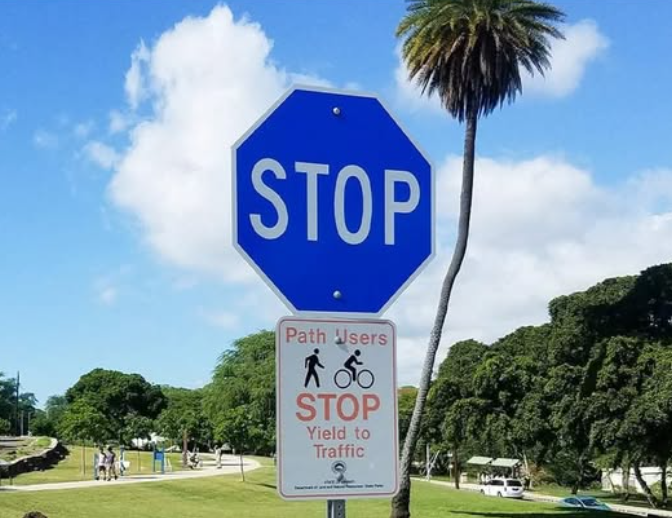
The first time you see it, your brain freezes for a split second, a momentary glitch in the rhythm of perception. There it is—a stop sign, familiar in shape and purpose, yet completely unfamiliar in color. Bright blue, almost startling in its unexpectedness. You blink, unsure if reality has momentarily shifted, or if someone is playing a practical joke. Was it painted wrong? Is it a prank, a mistake, or some kind of clever trap designed to catch inattentive drivers off guard? You hesitate, your foot hovering over the brake, and in that brief moment, the ordinary intersection becomes a test you were never prepared to take. Because if a stop sign—the universal symbol of caution and authority—can change color without warning, then what else on the road might not be what it seems? Traffic rules, lane markings, pedestrian signals, even other drivers’ intentions suddenly feel a little less predictable.
That blue stop sign isn’t a glitch in reality. It exists intentionally, purposefully, though not without legal and cultural nuance. In the United States, stop signs on public roads are required by federal law to be red with white letters, a color scheme recognized instantly by drivers nationwide. Red conveys urgency, command, and universal recognition. Blue, on the other hand, lives almost entirely in the private sector. You’ll encounter it in business parks, gated communities, long private driveways, or private campuses where property owners have the freedom to bend or reinterpret the visual rules of traffic signage. These are spaces where legal requirements for color often do not apply, where aesthetics, local identity, or personal preference can outweigh national standards. Yet just because it is blue does not mean it lacks authority in context: on private roads, it is still a command to halt, a marker of intersections that carry the same potential for accidents, collisions, and misunderstandings as their red counterparts.
Despite its unusual hue, the responsibility on the driver does not change. A blue stop sign is not a suggestion or decoration. It represents a real intersection, with real drivers, pedestrians, cyclists, and blind spots, all of whom depend on others to respect the rules of stopping and yielding. Even in places where the color might be intentionally different, such as certain areas in Hawaii where blue signs distinguish private property from government roads, the message remains: you must stop. It is a small but vital reminder that compliance and awareness cannot depend solely on habit or expectation. The simplest and safest rule is also the oldest: regardless of appearance, when a stop sign is present, you stop. Ignoring it, whether out of confusion, dismissal, or inattention, can carry consequences as severe as any public road violation, from near-misses to collisions that change lives.
The blue stop sign is also a lesson in perception, trust, and attentiveness. It challenges the automaticity of driving—the unconscious patterns we rely on—and forces a pause, a moment to process, observe, and respond consciously. It reminds us that color, while a powerful visual cue, is not infallible, and that judgment, caution, and responsibility are ultimately human choices, not automatic responses. The sign exists as a small disruption to our expectations, a nudge toward mindfulness, reminding drivers that their decisions carry weight even when visual signals are unfamiliar.
In essence, the blue stop sign embodies the tension between convention and variation, law and local freedom, predictability and surprise. It reminds drivers that the road is a dynamic environment where rules, appearances, and assumptions must be continually interpreted. And most importantly, it teaches a simple but enduring lesson: no matter the color, shape, or context, a stop sign is a stop sign. Respect it, slow down, and recognize that every intersection—red, blue, or otherwise—is a space where your attentiveness and judgment truly matter.