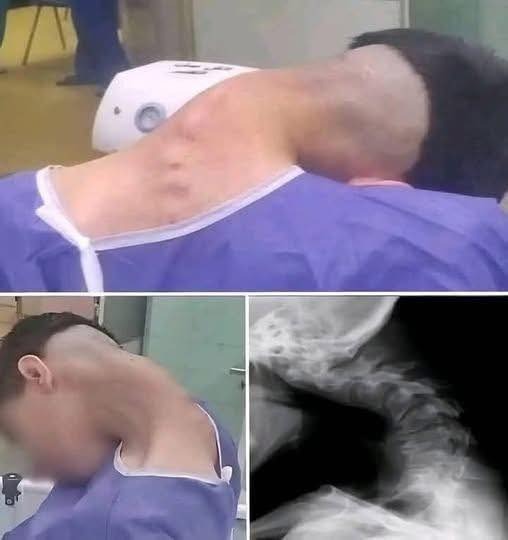
In September 2022, the Journal of Orthopaedic Case Reports detailed a devastating and fatal workplace accident involving an 18-year-old laborer in India, whose life tragically ended just two days after sustaining a catastrophic cervical spine injury. The incident occurred when a heavy metallic object fell directly onto the front of his head while he was performing routine work duties, generating an intense axial force that crushed part of his cervical spine. The resulting fracture pattern was so unusual and severe that it did not conform to any established spinal injury classification system, leaving medical professionals both puzzled and profoundly concerned.
According to eyewitness accounts, the young man was standing at his designated worksite when a large metal pipe or structural beam dislodged from an overhead support and struck him squarely on the frontal region of his skull. Observers reported that he collapsed instantly, losing consciousness while showing immediate signs of acute respiratory distress and entering shock within seconds. Emergency medical personnel were dispatched rapidly and acted with urgency. They intubated him to secure his airway, applied a rigid cervical collar to immobilize the spine, and transported him to a hospital equipped with advanced trauma care, understanding the gravity of the injury and the limited window for intervention.
Upon arrival at the emergency department, physicians performed a non-contrast computed tomography (CT) scan of the cervical spine. Imaging revealed a rare and highly dangerous injury pattern. The C5 vertebral body had fractured and been forced posteriorly into the spinal canal — a mechanism known as retropulsion — directly compressing the spinal cord. In addition, the postero-superior portion of the adjacent C6 vertebral body was fractured, further complicating the clinical picture. What made this injury particularly remarkable was the absence of displacement in the facet joints or fractures of the pedicles, which are typically involved in severe cervical trauma. Instead, the impact appeared to have compressed the vertebral body in a direct axial flexion-compression mechanism, creating what clinicians described as a “nutcracker-like” effect: the vertebra was crushed between adjacent segments and driven backward into the spinal canal without producing the usual structural disruptions that spinal classification systems are designed to detect.
Despite immediate stabilization and intensive supportive care, the patient’s condition remained critical. Upon arrival, he was in hemodynamic compromise with significant respiratory insufficiency, requiring mechanical ventilation and continuous monitoring in an intensive care unit. Cervical traction was applied to attempt decompression of the spinal canal and stabilize the injured segment, but the severity of the canal compromise and the patient’s physiological instability severely limited surgical options. Tragically, within 48 hours of the accident, the young man succumbed to his injuries.
Medical experts highlighted the case not only due to its devastating outcome but also because of its rarity. The injury did not correspond with widely used classification frameworks such as Allen and Ferguson, the Subaxial Injury Classification System (SLIC), or the AO Spine classification. These systems categorize cervical spine injuries based on features such as facet dislocation, burst fractures, pedicle involvement, ligamentous disruption, and neurologic status. In this instance, the isolated retropulsion of C5 with intact facet joints and pedicles defied conventional categories, challenging clinicians to rely on imaging, experience, and expert judgment rather than established algorithms.
The subaxial cervical spine, which spans vertebrae C3 through C7, is highly mobile and supports the majority of neck motion. That mobility also renders it particularly susceptible to axial compressive forces. When a heavy object impacts the head directly, the force travels downward through the skull into the vertebral column. In this case, the concentrated axial load crushed C5 and displaced it posteriorly into the spinal canal, while simultaneously fracturing the upper posterior edge of C6. Retropulsion injuries are particularly dangerous because the spinal cord runs directly behind the vertebral bodies; displacement of bone fragments into the canal can compress or sever neural tissue, resulting in immediate paralysis, respiratory failure, and cardiovascular instability.
Management of such injuries requires a multifaceted approach. Rapid immobilization is critical to prevent secondary spinal cord damage, while airway protection and circulatory stabilization address life-threatening complications. Urgent surgical decompression may be required, though outcomes heavily depend on the extent of initial cord injury and patient stability. In this case, the severity of trauma, combined with rapid deterioration, made recovery impossible despite optimal interventions.
Beyond its clinical uniqueness, the case underscores the immense force that even a single falling object can generate. An impact delivered along the cranial-vertebral axis, even from a seemingly modest height, can produce enough compression to collapse a vertebral body and compromise the spinal canal within seconds, leaving little room for error or delay in emergency response.
The case also illuminates limitations in existing injury classification systems. These frameworks are essential for diagnosis, interdisciplinary communication, and surgical planning. When injuries do not fit predefined categories, clinicians must rely on high-resolution imaging, detailed case analysis, and specialist judgment to guide management. Rare patterns like this highlight the need for evolving systems capable of accounting for atypical or previously unrecorded injury mechanisms.
From a prevention standpoint, the incident offers stark lessons in occupational safety. Work environments where heavy materials are stored or transported overhead inherently carry risk. Certified protective helmets, strict adherence to material-handling protocols, secure suspension systems for beams and pipes, and proper employee training in hazard identification are mandatory. Employers must enforce stringent measures to prevent unsecured loads from becoming life-threatening projectiles.
The importance of preventive strategies extends beyond formal work sites. In homes, workshops, and informal labor environments, heavy objects placed on high shelves or unstable structures can pose comparable hazards. Securing furniture, anchoring tall storage units, and avoiding precarious stacking of heavy materials can reduce the risk of similar catastrophic injuries.
Immediate and appropriate response to suspected neck trauma is critical. The injured person’s head and neck should remain immobilized, preferably in the position found, with application of rigid cervical support if available. Rapid activation of emergency medical services, careful monitoring, and avoidance of unnecessary movement are essential to prevent exacerbating spinal cord damage.
For medical teams, this case reinforces the importance of comprehensive imaging and vigilance. Even in the absence of hallmark signs such as facet displacement, severe canal compromise can exist. Non-contrast CT scans remain vital for detecting bony injury and vertebral displacement, while MRI is invaluable for assessing spinal cord involvement and soft tissue damage when feasible.
Ultimately, this tragic event serves as a sobering reminder of how quickly a routine workday can turn fatal. An 18-year-old laborer lost his life to a catastrophic cervical injury from a single falling object, producing a fracture morphology previously unrecorded and defying conventional classification. The case highlights lessons spanning from occupational safety to hospital preparedness: rigorous safety standards, immediate and careful emergency response, meticulous imaging, and continuous evolution of classification systems are all essential to prevent similar tragedies.
In conclusion, this case represents both a clinical milestone and a human cautionary tale. It demonstrates the extreme vulnerability of the cervical spine to axial forces, exposes the limits of existing spinal injury frameworks, and emphasizes the irreplaceable importance of prevention, preparedness, and prompt intervention in mitigating workplace and traumatic injuries. The story leaves a lasting impact on both medical practice and occupational safety, reminding all stakeholders of the fragile line between daily routine and catastrophic consequence.