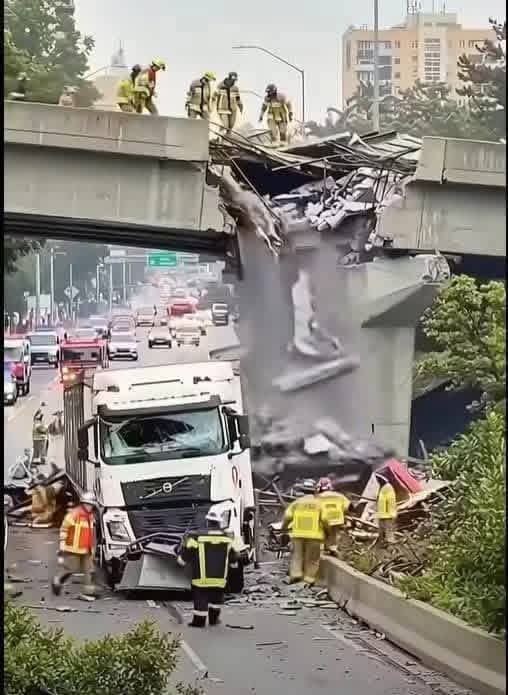
Richmond, British Columbia, started what seemed like a normal Friday morning, only to be jolted into chaos at 7:15 a.m. The calm of early daylight was shattered when a commercial truck collided violently with the Cambie Road overpass along Knight Street. The truck, pulling a dump trailer in a raised position, failed to clear the bridge span, striking the structure with enough force to leave the trailer precariously lodged against it. The impact was so severe that the cab of the truck separated from the trailer, skidding across the roadway. Miraculously, no one was physically injured, yet the incident immediately raised serious concerns about the overpass’s structural integrity and led to the closure of all southbound lanes.
City officials quickly coordinated with provincial engineers to assess the situation. Their mission was clear: ensure that the bridge could safely support traffic before reopening. Although the highway falls under provincial jurisdiction, Richmond’s municipal engineers provided essential support in the investigation. Crews worked tirelessly to remove debris and stabilize the area, leaving the trailer still pressed against the bridge well into the morning. Police immediately advised drivers to seek alternate routes, anticipating severe congestion throughout the city.
The Richmond Road Safety Unit has assumed control of the investigation, working closely with the Ministry of Transportation and Infrastructure. Structural engineers conducted meticulous inspections, checking for cracks, joint misalignment, and weakened support beams. Even when a bridge appears intact, unseen internal damage can compromise long-term safety, making these checks critical.
Truck-overpass collisions are not new to British Columbia. Over the past few years, incidents across the Lower Mainland and Fraser Valley have increased due to raised truck beds, mismeasured loads, and drivers’ unfamiliarity with height restrictions. Last year, a similar collision in Langley marked the eighth such event on provincial highways within a single year. While driver error plays a significant role, other factors—aging infrastructure, inconsistent signage, and resurfacing projects that reduce vertical clearance—also contribute to these risks.
Industry groups have been vocal about preventing such accidents. The British Columbia Trucking Association has advocated for over-height detection systems, which use lasers or infrared sensors to alert drivers approaching low-clearance structures. They stress the importance of rigorous driver training, ensuring that operators check trailer heights and secure hydraulic mechanisms before heading out. GPS-based fleet monitoring and data analysis of overpass incidents can also help identify recurring problem areas and guide future infrastructure investments.
Engineers note that impacts can strain internal bridge reinforcements and loosen joints. Every collision requires a careful assessment and, in some cases, temporary reinforcement before the road can safely reopen. The team investigating the Knight Street overpass emphasized that their work is not only vital for immediate public safety but also critical to preventing more costly structural failures in the future.
The closure of Knight Street Bridge sent shockwaves through the region’s transportation network. Richmond serves as a hub for commercial trucking connecting Vancouver, Delta, and the Fraser Valley. The shutdown disrupted delivery schedules, increased fuel costs, and created logistical headaches for businesses. Residents faced longer commutes, rerouted through secondary roads, while companies relying on daily shipments experienced temporary supply challenges. The incident highlighted how a single overpass collision can cascade into economic and logistical disruption across a wider region.
Experts continue to advocate for a comprehensive approach combining technology, training, and regular infrastructure audits to prevent future incidents. Over-height detection systems, real-time GPS monitoring, driver education, and routine inspections all form part of a proactive safety strategy. Dr. Steven Fong of the University of British Columbia notes that these tools must function within a broader “safety ecosystem,” where accountability is shared among drivers, fleet operators, and authorities.
Policy discussions have intensified following the Richmond incident. Canada’s infrastructure is aging, and freight volumes are rising, making the modernization of bridges and overpasses increasingly urgent. Proposed solutions include mandating over-height detection equipment on major commercial corridors and integrating clearance data into GPS navigation systems for trucks. Public safety advocates also emphasize the need for transparent reporting on collisions and clear timelines for reopening affected routes, which helps maintain public trust in transportation networks.
The Knight Street collision serves as a stark reminder of how a single miscalculation or oversight can disrupt an entire region. The financial, logistical, and administrative costs are considerable, with repair estimates often reaching millions of dollars. For city and provincial authorities, proactive prevention is far more cost-effective than responding after a crisis. For the trucking industry, the event underscores the importance of driver training, equipment checks, and investment in safety technologies.
Ultimately, the safety of vital transportation routes like Knight Street Bridge depends on collaboration between drivers, companies, engineers, and government agencies. While this incident was contained without injury, the lessons extend far beyond Richmond. Vigilant inspection, modern detection systems, and ongoing education are crucial to preventing future accidents, safeguarding both lives and livelihoods, and maintaining the integrity of essential infrastructure. The event is a wake-up call: while heavy-haul vehicles are indispensable to commerce, their interaction with aging bridges requires systematic attention, coordinated measures, and a shared commitment to safety at every level.