The end of a marriage is almost never a single, clean break. It happens through small ruptures that widen over time until the shared life collapses completely. When my husband left years ago, his departure was total. He didn’t just walk away from me—he vanished from the everyday lives of our children. Overnight, I was left to carry everything alone, learning how to survive the exhausting, frightening, yet deeply meaningful reality of single motherhood in complete silence. I became the sole provider, protector, and builder of our home, creating stability from the ashes he abandoned. Slowly, the pain hardened into resilience. I found peace, independence, and a sense of self I guarded fiercely.
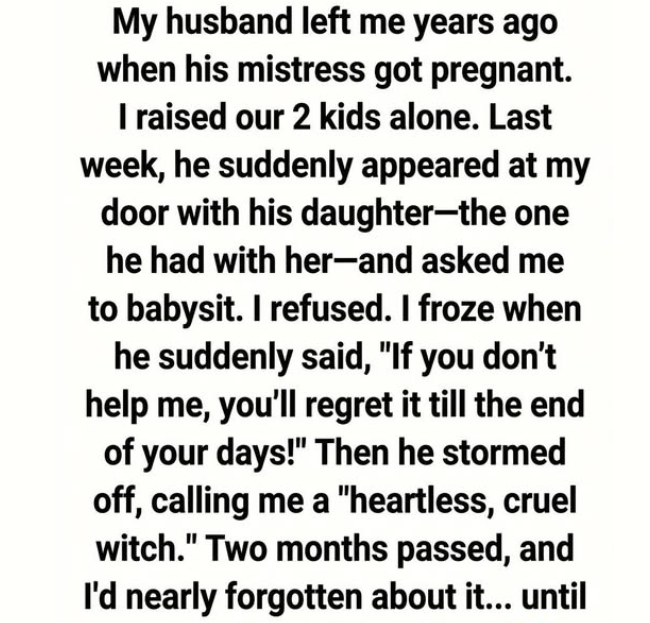
That hard-earned peace was shattered one Tuesday afternoon by an unexpected knock at my door—like a ghost returning to a place it no longer belonged. When I opened it, there was no apology, no awkward attempt at reconciliation. Instead, my ex-husband stood there with the relaxed assurance of someone who believed time had wiped his slate clean. Standing beside him was a small girl, maybe four years old, a living reminder of the life he had created while I rebuilt ours alone.
He didn’t acknowledge the years he had missed or the weight I had carried. There was no concern for our children, no remorse. He simply asked me to babysit his daughter. He mentioned a scheduling issue and a last-minute problem, speaking as though I were still available for his convenience—less a person he had hurt and more a service he assumed he could still access.
I looked at the child and felt compassion for her innocence, but that feeling was quickly overtaken by something stronger: self-respect. I met his eyes and calmly said no. I told him I was not a backup plan for his new life and that our past did not give him any claim on my time or energy.
His response was immediate and explosive. The calm façade vanished, revealing the same entitlement that had destroyed our marriage. He lashed out, calling me cruel, selfish, and heartless. He accused me of taking my resentment out on a child and painted my refusal as bitterness. As I listened, I understood something clearly: his anger had nothing to do with the child. It was about control. He was furious because the version of me who always gave in no longer existed.
I closed the door while he was still shouting, my hands trembling—not from fear, but from the shock of seeing how little he had changed. For the next hour, I sat alone in my living room, his words echoing in my head. Old conditioning crept in, whispering doubts. Was I too harsh? Was I failing to be the “bigger person”? Society’s expectation that women must always nurture, forgive, and accommodate pressed heavily on me.
But as the evening settled, clarity followed. I realized that “being the bigger person” had often meant erasing myself. I remembered the nights I cried over unpaid bills and the moments I held my children while pretending everything would be okay. No one had rescued me then. I had done that myself. I had fought my way to stability, and I was not obligated to let the person who caused the damage benefit from my healing.
Weeks later, my phone rang. I expected more hostility, but instead, it was his new wife. Her voice was cautious, sincere. She didn’t defend him or make excuses. She apologized. She acknowledged that his request—and his reaction—had been wrong. She made it clear that I owed them nothing.
That conversation completed something inside me. It validated what I already knew: my boundaries weren’t cruel—they were necessary. I could feel empathy without sacrificing myself. Strength didn’t require self-betrayal.
I learned then that real strength is quiet. It doesn’t scream or seek revenge. Sometimes it’s simply the ability to say “no” without guilt. It’s protecting the peace you fought to build and refusing to apologize for it. I no longer needed anyone’s permission to decide who had access to my life.
Today, my home is peaceful. The children I raised on my own are thriving. The man who once believed he could still demand from me has faded into irrelevance. I don’t replay that day with doubt anymore. I see it as the moment I finally stopped sacrificing myself. Not because I lacked compassion—but because I finally learned to give myself the same care I had always given others. The past no longer knocks at my door, and the silence inside my life is no longer empty. It is full of peace.