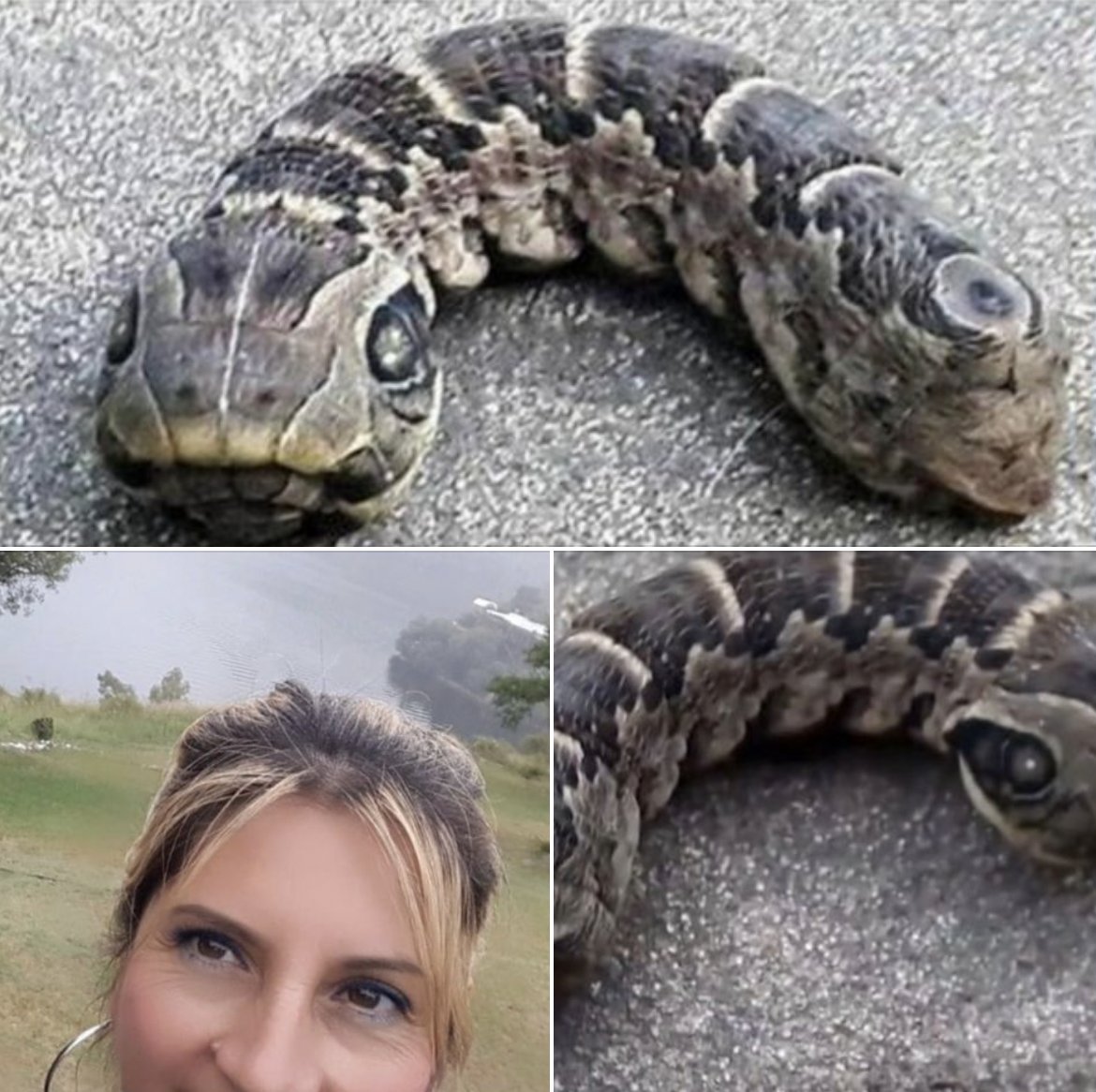
When a regular stroll through an Argentinean backyard transformed into a time of true dread, surprise, and scientific inquiry, the backyard became the focus of worldwide intrigue. Lujan Eroles, 46, discovered what she thought was a tiny snake curled amid the bushes in the town of Santa Fe. She shrieked and took a step back, certain that she had come upon something terrible, because of the creature’s stance, markings, and eerie eyes.
The fear seemed to make perfect sense at first. The animal had a robust body, was about ten centimeters long, and handled itself in a manner that strongly resembled a young snake getting ready to defend itself. Its body was patterned, its head seemed broad, and most frightening of all were what appeared to be big, glaring eyes. The conclusion was clear to anyone without specialized knowledge of evolutionary biology or insect behavior: avoid this.
Attracted by the disturbance, neighbors hurried over. Confusion and worry were common among the tiny group. It was unlike anything anyone had ever seen. In equal measure, tension and intrigue were heightened by the rapidly spreading suspicion that it might be poisonous. Smartphones were introduced. Videos were captured. There was a lot of speculation.
Eroles then said, “I looked down and encountered the strange animal, and fear struck me knowing it could have been poisonous.” “The eyes were really weird, but it looked exactly like a snake.” Some neighbors questioned whether pollution or environmental changes had created a mutant species because of how convincing the likeness appeared.
Instead of trying to touch or get rid of the creature, Eroles made a choice that would soon transform a local fright into a global educational opportunity. In a video that she posted online, she asked viewers to identify the enigmatic animal. The video went viral within hours, drawing comments from professional scientists, wildlife enthusiasts, and amateur naturalists alike.
What came next was a classic illustration of how the internet may occasionally be useful.
Experts soon realized that this was a caterpillar using mimicry, one of the best survival techniques found in nature, rather than a snake. In particular, it was discovered to be a rare species of hawk-moth caterpillar that is renowned for its remarkable capacity to mimic the appearance of a tiny snake when it feels threatened.
It’s no coincidence that the illusion exists. This caterpillar has no physical defenses, speed, venom, or fangs. Rather, it was given deceit by evolution. When disturbed, it shows enormous eye-like markings that instantly mimic reptilian features, retracts its head, and inflates the front of its body. As a result, predators including birds, rodents, and small mammals become frightened by the visual warning.
This is brilliance from an evolutionary perspective.
To live, predators must make snap decisions. The prey may be saved by pause alone if something appears threatening. This impulse is expertly exploited by the caterpillar’s snake-like display. It just has to be believed; it doesn’t have to struggle or run.
This phenomenon, which occurs when a harmless species evolves to replicate the warning signals of a hazardous one, is known to biologists as Batesian mimicry. People whose patterns most closely mirrored those of snakes had a higher chance of surviving and procreating across thousands of generations. The end effect is a caterpillar that is so realistic that it may deceive both people and animals.
Because sightings like these are rather uncommon, particularly in domestic settings, the discovery captivated experts. Although hawk-moth caterpillars are indigenous to some regions of Central and South America, only skilled observers can typically witness their defensive displays in their natural environments. Witnessing one in a backyard garden, flawlessly carrying out its survival pattern, was a unique opportunity to observe evolutionary strategy in action.
The experience served as a potent reminder of the biodiversity that is right outside our doors, even beyond the shock value. Complex ecosystems continue to flourish, frequently undetected, even in urban or semi-urban settings. Among the planet’s most varied and adaptable life forms are insects, which are crucial to food chains, pollination, and soil health.
A more general fact about nature is also brought to light by the caterpillar’s actions: danger is frequently felt rather than actual. Although many snakes are harmless and completely shun human contact, snakes themselves are often misunderstood and feared. In this instance, a creature that had perfected the art of appearing deadly without actually being so heightened the terror.
Eroles’s feelings of anxiety rapidly gave way to amazement. When she discovered what she had truly seen, her initial feelings of dread gave way to appreciation. She stated, “We believed it to be something out of the ordinary.” “However, it turned out to be something extremely intelligent in its own way.”
Teachers, wildlife organizations, and science communicators continue to utilize her movie as a teaching tool to demonstrate mimicry, adaptation, and the value of showing respect to strange animals rather than reacting violently.
This narrative is noteworthy for a different reason in a time when violence and spectacle are frequently the focal points of viral material. It demonstrates how a single experience may ignite a global interest in the natural sciences and how curiosity can triumph over fear. It also emphasizes how important it is to observe rather than make assumptions, particularly when working with wildlife.
The caterpillar, which resembled a snake, carried out its evolutionary purpose. It fended against imagined dangers, made it through the meeting, and carried on with its life cycle. In the meantime, humans were reminded that the natural world is full with tactics that are far more complex than they first seem.
What appeared to be a monster was actually a masterful adaption. And one tiny caterpillar in a peaceful Argentinean garden served as a reminder to everyone that nature’s strongest defenses are frequently delusions that have been refined over time.