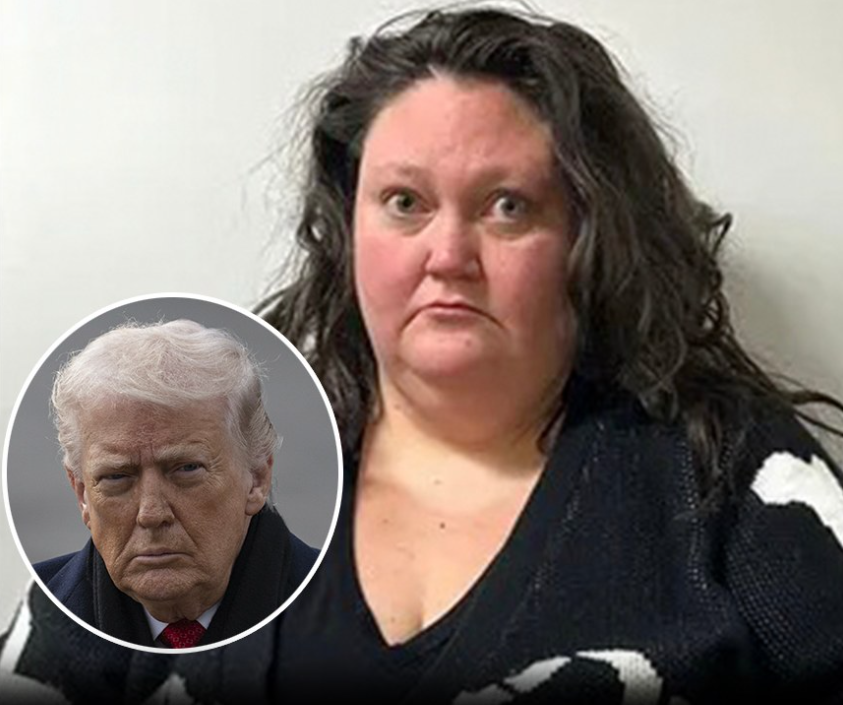
A quiet jail cell in Ripley, West Virginia, became the center of national attention this week after authorities arrested a local librarian for what they described as a dangerous online threat against former President Donald Trump. Investigators said the case was not about heated political opinions but about words they believe crossed into a credible call for violence—words posted publicly, widely shared, and amplified during a tense moment in the country.
The librarian, identified as Morgan L. Morrow, was well known in Ripley for checking out books, organizing shelves, and helping children with homework. That image changed overnight when authorities announced her arrest on charges related to making a terroristic threat.
The case began with a single social media post. Officials said the caption, shared publicly on Instagram, went beyond criticism or satire and was interpreted as a direct call for lethal action against a specific political figure. Screenshots circulated quickly, tips came in, and law enforcement acted fast, citing concerns that even a brief delay could be dangerous.
Authorities emphasized that the issue was not whether Morrow had weapons or a detailed plan. They inferred intent from the wording and context. Prosecutors argue that targeting public figures online, especially during politically volatile times, can make even one statement spark real-world violence.
Investigators said the situation worsened with comments from strangers who glorified violence or echoed threats. This showed how quickly online posts can escalate, creating broader public safety risks.
Authorities acted within hours of the post being flagged, securing warrants, collecting digital evidence, and taking Morrow into custody without incident. She faces serious charges that could lead to significant prison time. Her legal team plans to challenge whether her words were truly a threat.
The library where Morrow worked placed her on leave and issued a statement emphasizing that it does not condone threats or violence. Staff and patrons expressed disbelief, struggling to reconcile the allegations with someone they knew in a quiet role.
For Ripley residents, the arrest was shocking. Federal vehicles and news crews appeared on familiar streets, creating an intense spotlight in a town unused to national attention.
Legal experts say the case highlights a growing tension in American law: the boundary between free speech and criminal threats online. Political speech is protected, even when offensive, but prosecutors argue that protection ends when words are interpreted as encouraging or enabling violence. Civil liberties advocates caution that aggressive prosecutions could chill legitimate speech, while supporters stress that public safety demands action.
The arrest has reignited debates about online platforms and accountability. Social media companies face renewed scrutiny over moderation and reporting. Cooperation from the platform helped investigators preserve evidence, though details remain sealed.
Morrow remains in custody awaiting further hearings. Prosecutors plan to rely heavily on digital evidence, including the original post, comments, and related messages. Her defense is expected to argue that her language was exaggerated, metaphorical, or taken out of context.
Beyond the legal case, the situation highlights how a single online post can have consequences far beyond its audience. In today’s digital world, political anger spreads fast and anonymously, narrowing the margin for error.
For Ripley, this is no longer just about a librarian. It shows how quickly ordinary lives can become part of national crises, and how online words can carry real-world consequences. The case is a stark reminder: in today’s climate, words posted online do not stay online, and the line between speech and threat is one the justice system is increasingly ready to enforce.