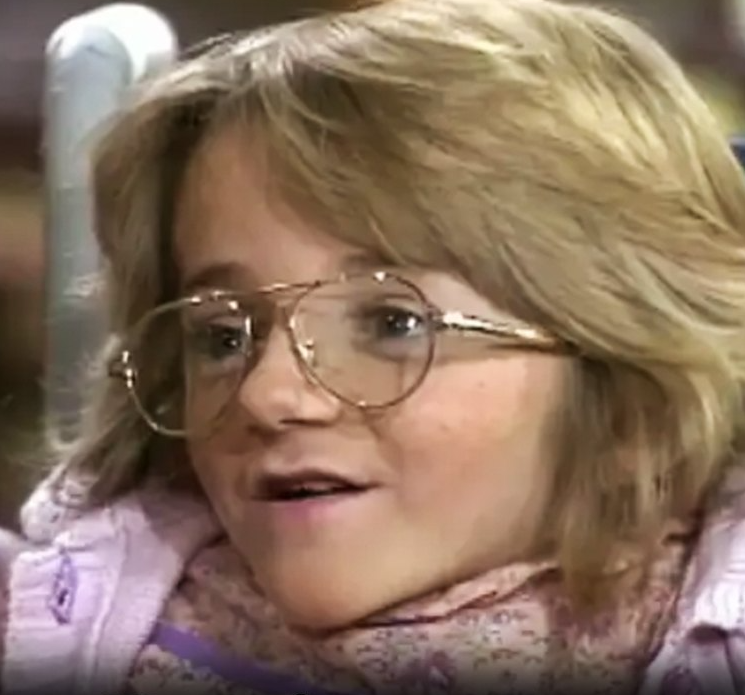
With profound sadness, the television community mourns the loss of a woman whose influence extended far beyond her limited time on screen. Melanie Watson, remembered most for her role as Kathy Gordon on the beloved sitcom Diff’rent Strokes, has died at the age of 57. Her brother, Robert Watson, confirmed that she passed away following hospitalization in Colorado Springs, Colorado. Though the news arrived quietly, its impact has been deeply felt by those who understand what her presence represented during a time when television rarely made room for stories like hers.
Melanie Watson was born in July 1968 in Dana Point, California, into circumstances marked early on by significant challenges. At birth, she was diagnosed with osteogenesis imperfecta, commonly known as brittle bone disease—a genetic condition that causes bones to fracture easily and is often accompanied by short stature, skeletal fragility, and chronic pain. For Watson, this meant growing up with constant physical limitations and risks that shaped every aspect of daily life. Ordinary childhood activities carried serious consequences, and the threat of injury was never distant—it was constant.
Even so, Watson never allowed her condition to define the boundaries of her dreams. From a young age, she was drawn to acting and storytelling—not to escape her disability, but to be recognized as more than it. Performance gave her visibility, agency, and a sense of control in a world that frequently underestimated people like her. At a time when Hollywood offered little inclusion for visibly disabled performers, Watson pursued acting anyway, determined to claim space in an industry that had long overlooked voices like hers.
Her most notable opportunity came when she was cast as Kathy Gordon on Diff’rent Strokes, one of the most influential sitcoms of its era. The show was known for blending humor with social commentary and had become a staple in American households. Between 1981 and 1984, Watson appeared in four episodes, sharing scenes with cast members including Todd Bridges and the late Gary Coleman. Though her appearances were brief, they left a lasting impression.
The character of Kathy Gordon was written specifically for Watson. Like her, Kathy used a wheelchair, reflecting Watson’s real-life mobility needs. At the time, it was extraordinarily rare for a network television series to feature a disabled character portrayed by an actor who actually lived with that disability. Conversations about representation, as they exist today, were virtually nonexistent. Yet Watson appeared on screen as herself—visible, genuine, and unapologetic.
That visibility, however, was not without difficulty. In one episode, Kathy was scripted to walk with crutches. Watson was deeply uneasy with the scene. She had previously experienced a serious fall, and the physical danger was real. She expressed her concerns, explaining that using crutches was unsafe for her. Still, the moment was framed as an emotional breakthrough within the story, and she was told it was necessary.
In a candid interview years later, Watson reflected honestly on that experience. She described feeling as though she was being asked to fulfill “someone else’s dream,” rather than having her own reality respected. Despite her fear, she ultimately agreed to perform the scene, influenced by the adults around her, including her mother. She was young, navigating professional expectations, health risks, and unequal power dynamics all at once.
In hindsight, Watson held complicated feelings about that moment. The fear and discomfort never fully disappeared, but over time, she came to recognize that the episode had resonated with audiences. What once felt overwhelming eventually revealed its impact. She understood that her role—imperfect and challenging as it was—had mattered.
Watson later spoke with appreciation about Norman Lear, the legendary producer behind Diff’rent Strokes. Known for pushing boundaries and addressing topics mainstream television often avoided, Lear took a risk by casting a young actress with a visible disability and weaving her character naturally into the show. Watson credited him with opening a door that had long been closed.
At the time, she didn’t fully grasp the significance of what she was doing. She was a child managing work, health issues, and the pressures of being different in a very public space. It wasn’t until much later that she realized how many people had seen themselves reflected in her. For children with disabilities—and for their families—Kathy Gordon was more than a character. She was proof of existence, visibility, and belonging on television.
Looking back, Watson acknowledged that she might have stayed in the entertainment industry longer if circumstances had been different. Her acting career was brief, and she eventually stepped away from the spotlight as life, health, and personal priorities took her elsewhere. Still, her limited time on screen left a lasting mark. Representation does not always require longevity—sometimes it only takes one honest presence at the right moment.
Melanie Watson’s legacy is not measured in awards or an extensive list of credits. It lives in something quieter but more enduring. She helped normalize disability on television when it was largely invisible. She showed that a character using a wheelchair didn’t have to be a lesson or a symbol—she could simply be a kid, living her life, part of the story.
Her passing reminds us that progress often comes not from grand gestures, but from individuals who move forward despite fear, limitations, and uncertainty. Watson did exactly that, without fully realizing the weight of what she carried. The impact came later, rippling outward, touching lives she would never know.
Melanie Watson will be remembered not only for who she was, but for what she stood for: quiet courage, authentic visibility, and honesty in a medium that often avoided all three. She helped open doors softly—and once opened, those doors were never completely closed again.
May she rest in peace, remembered for her strength, her truth, and the lasting imprint she left on television history.