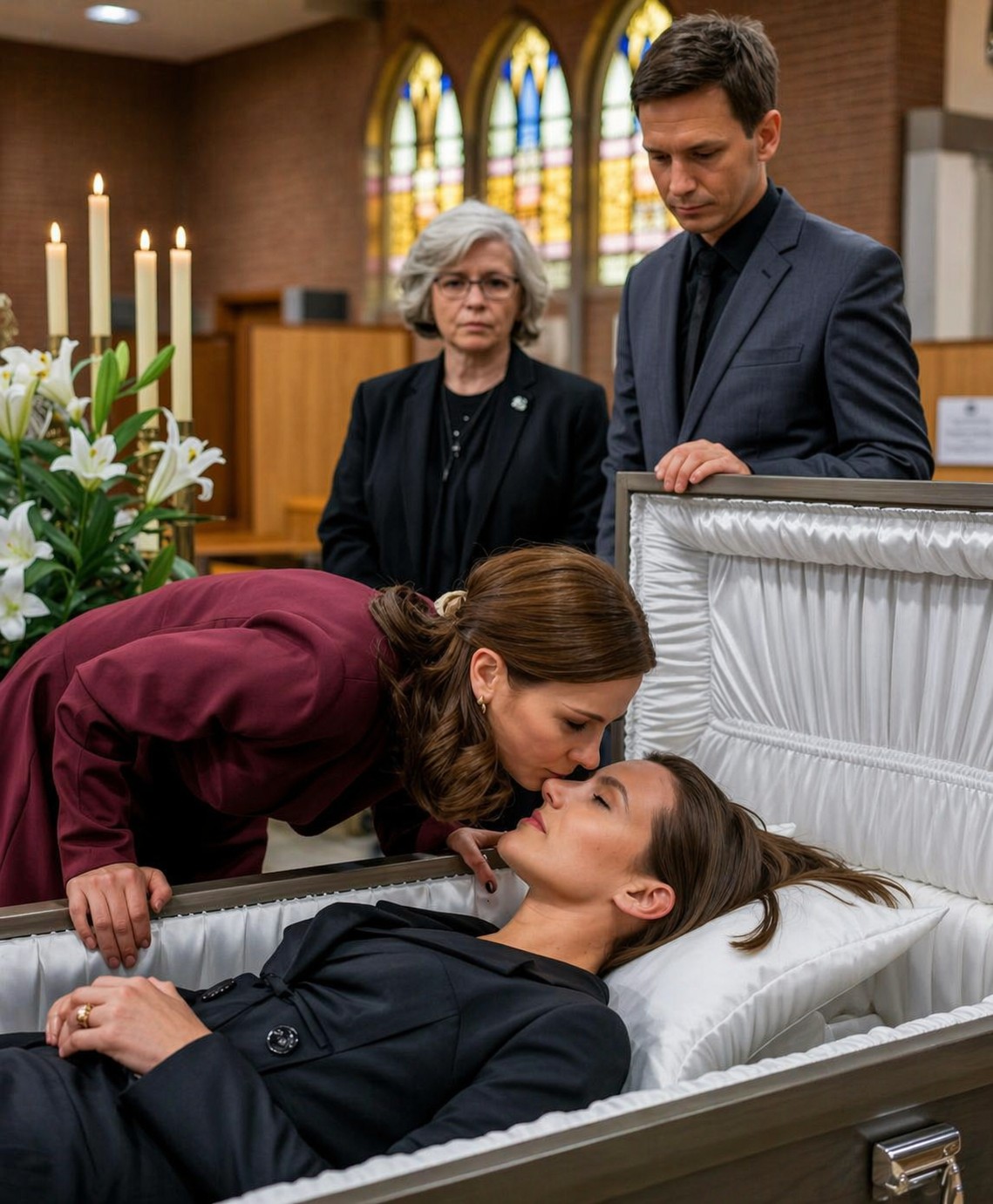
The thick humidity inside the chapel seemed to cling to everything that afternoon — the velvet pews, the black clothing of the mourners, even the heavy silence hanging over the room. I sat motionless in the very first row, gripping a delicate lace handkerchief that once belonged to my daughter Clara so tightly my fingers had turned white. She was only thirty-two years old when cancer stole her from us, taking a bright, ambitious life far too early. Since the moment she died, my chest had felt hollow, as if grief itself had carved out everything inside me and left behind only silence.
Then that silence was shattered.
The sharp metallic clicking of high heels echoed through the chapel like gunshots against marble.
Every person in the sanctuary turned toward the back doors just as they swung open dramatically. The reaction from the mourners came instantly — quiet gasps rippling through the room in waves of disbelief.
Julian, my late daughter’s husband, did not enter like a grieving widower attending his wife’s funeral.
He walked in like a man arriving at a business meeting.
His posture was rigid with arrogance, chin tilted upward confidently beneath the dim church lights. He wore a sharply tailored charcoal-gray suit that looked more appropriate for a corporate negotiation than a funeral service.
And hanging proudly from his arm was another woman.
She couldn’t have been older than twenty-five.
Her dress was blood red — tight, short, and impossibly inappropriate for a church funeral. The color alone felt offensive against the soft white flowers surrounding Clara’s casket.
The room practically stopped breathing.
They didn’t quietly sit near the back to avoid attention either. Julian calmly guided the woman down the aisle toward the front rows, forcing distant relatives to awkwardly shift aside so they could sit together in the third pew as if nothing about the situation was shameful.
He never looked at Clara’s casket once.
Not once.
Instead, he leaned toward the young woman and whispered something into her ear that made her laugh softly — a delicate little giggle that sliced through the church organ music like broken glass.
Even the priest faltered mid-sentence.
I watched his eyes flick toward them briefly before he struggled to continue the service.
Beside me, my husband’s hand tightened painfully around mine. His breathing had become uneven, barely restrained rage trembling beneath every inhale.
We already knew about the affair.
Clara had told me near the end, during one of the final nights in hospice while machines hummed softly around her hospital bed. Her voice had been weak, barely louder than a whisper, but the heartbreak behind it nearly destroyed me.
“He’s waiting for me to die,” she admitted quietly. “Then he won’t have to hide her anymore.”
Even then, lying in pain while cancer consumed her body, Clara never sounded angry. Just exhausted.
But nothing could have prepared me for the cruelty of watching him bring that woman to her funeral.
As the service continued and eventually moved toward the cemetery, the tension only became heavier.
The afternoon sun burned overhead while mourners gathered around the open grave. Flowers already began wilting beneath the heat.
I stood only a few feet away from Julian and his mistress during the final prayers.
Then it happened.
As the priest finished speaking and Clara’s casket slowly lowered into the earth, the young woman leaned closer to Julian before subtly turning her head toward me.
Her eyes gleamed with victory.
She smiled.
And then, quietly enough that only I could hear, she whispered:
“I won.”
The words slid into my chest like a knife.
Her breath smelled faintly of expensive perfume, champagne, and mint. To her, my daughter’s funeral wasn’t a tragedy.
It was a promotion.
She had already moved into Clara’s home.
Already started wearing Clara’s jewelry.
And now she believed she was about to inherit the fortune Clara spent years building through relentless work as a tech executive.
Julian barely acknowledged me afterward. He gave a short dismissive nod while people slowly drifted away toward the reception hall.
He looked confident.
Satisfied.
Like a man mentally spending inherited money before paperwork was even signed.
What he didn’t know was that Clara had already prepared for all of this.
The next morning we gathered at the office of Clara’s longtime attorney, Mr. Sterling.
The room itself felt cold and severe — dark mahogany walls, polished furniture, quiet air-conditioning humming in the background. Julian arrived late, naturally, with the mistress still glued to his side.
This time she wore an expensive white silk suit that screamed wealth and entitlement.
Julian leaned casually back in his chair and checked his gold watch impatiently.
“I’ve got lunch reservations at one,” he said arrogantly. “Can we make this quick? I assume everything’s straightforward.”
Mr. Sterling barely reacted.
He calmly adjusted his glasses and folded his hands atop a thick stack of legal documents.
“Your wife was indeed extremely organized,” he replied evenly. “Which is why she made several major revisions to her will fourteen days before her death.”
That was the first moment Julian’s confidence cracked.
Only slightly.
“What revisions?” he asked cautiously.
The mistress shifted uncomfortably beside him.
Mr. Sterling finally looked up, his expression icy and unreadable.
“The prenuptial agreement guaranteeing assets to the surviving spouse remained valid only under the condition of marital good faith,” he explained. “Before her death, Clara provided extensive evidence documenting your affair and your use of marital funds to financially support your companion over the last eighteen months.”
Silence slammed into the room.
Complete silence.
I could actually hear the mistress breathing faster.
Mr. Sterling continued.
“As a result, Clara amended her will. The family estate, penthouse property, and all investment portfolios have been transferred into a permanent charitable trust managed by her parents.”
Julian shot to his feet instantly.
“That’s insane!” he shouted. “I’m her husband! She can’t cut me out completely!”
Mr. Sterling calmly closed the folder in front of him with a quiet but final thud.
“She already did.”
Julian’s face turned dark red with fury.
“What about the house?” he demanded.
“The house now belongs to the trust,” Sterling replied. “You have forty-eight hours to vacate the property.”
The mistress suddenly leaned forward in panic, all traces of confidence disappearing from her face.
“What does he get?” she asked quickly.
Mr. Sterling slowly reached into his desk drawer and removed a single envelope.
He slid it across the table.
Julian tore it open immediately.
Inside wasn’t a check.
It was a receipt for a storage unit outside town.
Mr. Sterling spoke carefully.
“Clara left you the contents of your personal closet… and one dollar.”
The room went completely still again.
“She also included a note,” he added.
Julian unfolded the paper with trembling hands.
I already knew what it said because Mr. Sterling had shown me a draft days earlier.
The message was only one sentence long:
“You told me you loved me for who I was, not what I had. Now you get to prove it.”
The mistress stood up so quickly her chair nearly toppled backward.
For the first time since I’d seen her, the smugness was gone completely.
Now she looked at Julian differently.
Not with affection.
Not with loyalty.
With calculation.
She no longer saw a wealthy executive’s husband living in luxury.
She saw a man stripped of status, money, and usefulness.
Without saying a single word, she grabbed her designer handbag — the same one I recognized as a gift Clara once bought herself — and walked out of the office.
This time, the sound of her heels against the hallway floor no longer sounded triumphant.
It sounded desperate.
Like someone fleeing a sinking ship.
Julian slowly collapsed back into his chair, shoulders sagging beneath the weight of everything he had destroyed.
For a brief second, he looked at me as if hoping I might offer sympathy.
Mercy.
Understanding.
Instead, I gave him exactly what my daughter would have wanted him to see:
Nothing.
Only quiet certainty.
Because Clara may have lost her battle with cancer, but she never stopped fighting for herself.
Even in her final days, she protected her legacy.
Protected her dignity.
Protected everything they tried to take from her.
And in the end, the woman who whispered “I won” beside my daughter’s grave learned the truth far too late:
The only thing she and Julian truly inherited was the emptiness they created with their own betrayal.