Tattoos have long existed at the crossroads of personal identity and institutional authority. For Kay’Ana Adams, that intersection became the point where her career abruptly ended. While her termination from the Mobile Fire Department was formally attributed to policy violations, the broader story reveals how inflexible rules, evolving standards, and internal power dynamics can collide with devastating consequences.
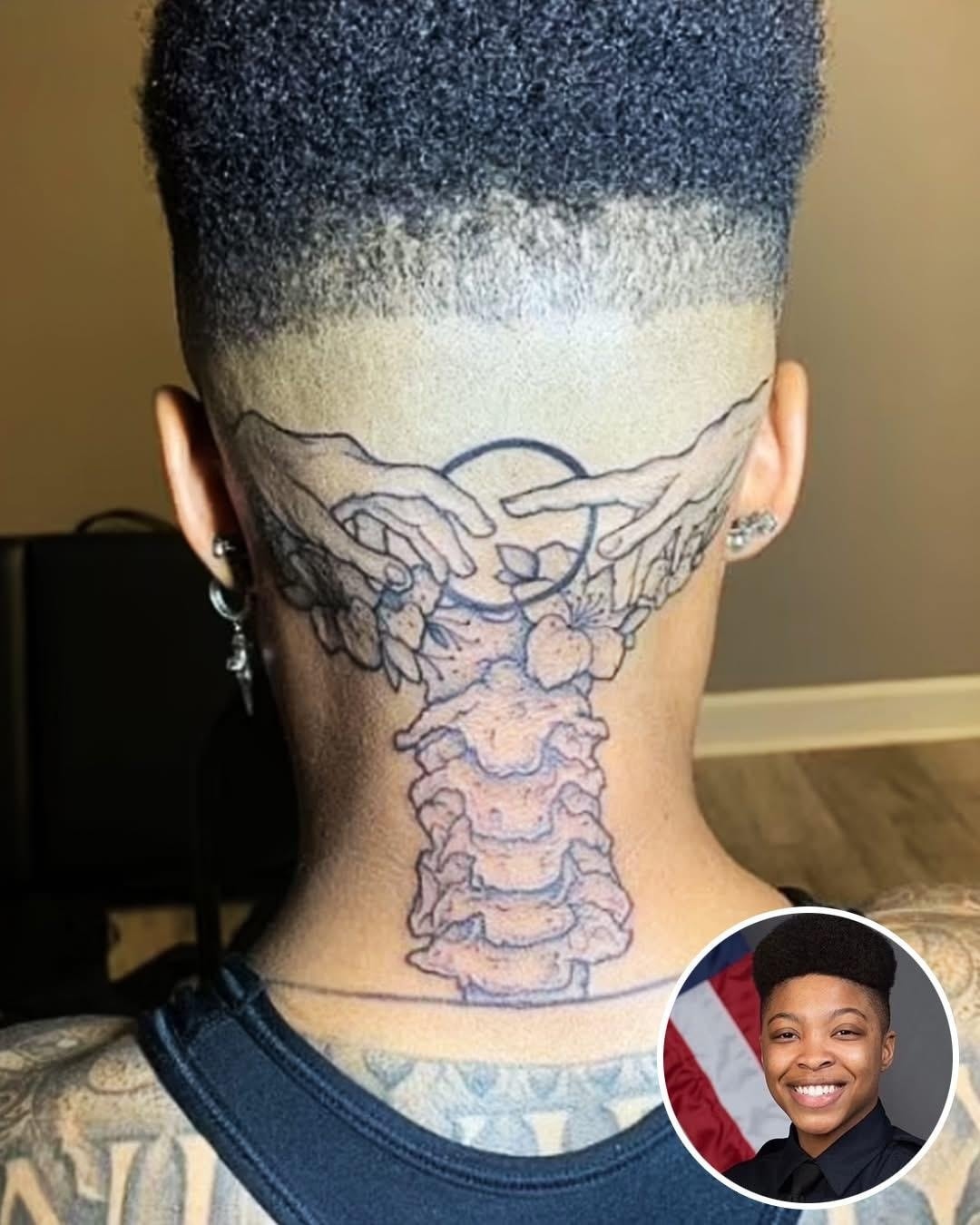
Adams joined the department in early 2023, fully aware that firefighting is a profession rooted in tradition and strict expectations. Nine months into her role, her career unraveled over a tattoo she had received in June 2022—well before her dismissal and before any explicit rule prohibited it. The tattoo was located on the back of her head, a placement she intentionally chose because it could be concealed by her hair. At the time, department policy banned tattoos on the face and neck, but made no mention of head tattoos.
Relying on the policy as written, Adams believed she was in compliance. She did not attempt to hide the tattoo’s existence or skirt the rules. Instead, she followed them, ensuring the tattoo remained covered while on duty. She later explained that she made deliberate choices to align with what the department defined as professionalism and order.
That confidence was shaken when a complaint was filed regarding her appearance. An internal investigation followed, and Adams was instructed to grow out her hair to ensure the tattoo stayed hidden. She complied. But rather than settling the matter, the situation escalated. Her hair texture and growth became points of scrutiny, highlighting how appearance standards—when applied uniformly—can disproportionately affect Black women whose hair does not behave the same way as others’.
While Adams was still navigating these demands, the department revised its tattoo policy. The updated rules banned head tattoos entirely. The change occurred months after Adams had gotten her tattoo and after she had already been working under the previous guidelines. Even so, she continued covering the tattoo and believed she was complying with both the letter and intent of the new policy.
Then, on November 10, 2023, everything ended.
A captain photographed Adams while her tattoo was fully covered. Later that same day, she was fired.
Adams described the termination as sudden and devastating. There was no clear escalation or final warning that her job was at risk. One moment she was a firefighter attempting to meet shifting expectations; the next, she was unemployed. Department leadership later confirmed her dismissal, citing failure to meet standards. Adams strongly disagreed, stating that compliance had never been the issue.
For her, the tattoo was deeply personal. Adams has scoliosis, a condition that can cause chronic pain and physical limitations. Becoming a firefighter despite that diagnosis was a significant challenge. The tattoo symbolized strength, endurance, and perseverance—a reminder that her body’s limitations would not define her future.
She has consistently emphasized that her tattoos were expressions of identity, not rebellion. They marked survival, not defiance. That distinction reframes the issue from one of appearance to one of dignity and self-determination.
As attention grew around her firing, Adams suggested the tattoo was not the sole factor. She had previously raised concerns about the department’s workplace culture, including sexist remarks and troubling comments made during training. In one instance, she objected to jokes involving nooses, which she found offensive and inappropriate. Speaking out placed her at odds with colleagues and supervisors in an environment not known for welcoming criticism.
Two captains who supported Adams—Jason Craig and Rodrick Shoots—also faced consequences. Craig was suspended for 30 days, while Shoots was fired on allegations of obstructing orders. Department leaders, including Public Safety Director Lawrence Battiste, insisted these actions were unrelated to Adams’ complaints and instead stemmed from insubordination and policy violations.
To many observers, the timing raised concerns. When an employee speaks up and those who support her are punished shortly afterward, questions naturally arise about whether rules are being enforced fairly or used to silence dissent.
Adams’ case has since become a focal point in broader discussions about workplace conformity and inclusion. Fire departments, like many uniformed institutions, emphasize hierarchy, tradition, and appearance. Supporters argue that strict standards promote discipline and public trust. Critics counter that such policies often fail to reflect modern realities and disproportionately impact women and people of color.
Her experience also underscores how policy changes can become tools of harm when applied retroactively or selectively. Shifting rules without clear transition periods leave employees vulnerable, especially when enforcement relies on subjective judgments rather than job performance.
What remains undisputed is Adams’ commitment to the job. She trained, complied with instructions, and sought no special treatment. She did not pursue attention—yet it found her.
Since her dismissal, Adams has spoken candidly about the emotional toll of losing a career she worked hard to achieve. She has also become an unintended symbol in conversations about employee rights, inclusion, and institutional accountability. Her story resonates because it extends beyond tattoos—it raises questions about who defines professionalism and whose bodies are most closely policed.
At its core, the case demands a difficult reckoning. When policies clash with identity and speaking up carries consequences, the issue is not whether rules exist, but whether they are fair, consistently applied, and capable of evolving.
Kay’Ana Adams did not lose her job for failing to serve. She lost it at the intersection of expression, authority, and an institution unwilling to adapt. Whether her story leads to reform remains uncertain, but it has already made one truth clear: professionalism is not neutral, and enforcing it without context can exact a heavy cost.