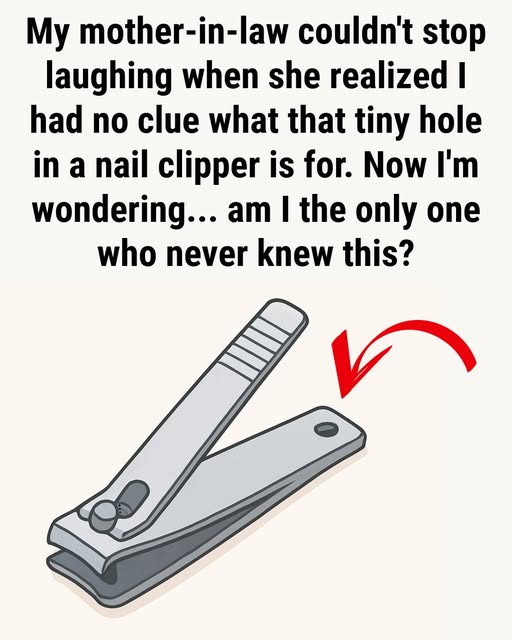
We navigate our daily lives surrounded by countless marvels of industrial design, yet we rarely pause to consider the thoughtfulness embedded in the objects we use every day. From the tiny coin pocket tucked into a pair of denim jeans to the serrated edge on a humble tape dispenser, our household tools are packed with subtle features that are often dismissed as purely decorative or incidental. Among these understated yet ingeniously designed objects, one of the most ubiquitous—and easily overlooked—is the small, round hole located at the end of the lever on a standard pair of nail clippers. At first glance, it might appear to be a trivial artifact of the manufacturing process, a purely aesthetic flourish, or even a leftover from metal stamping. However, this modest aperture is far from accidental; it is a deliberate design choice with a rich history and a practical purpose that has endured for more than a century.
The primary role of this hole is rooted in portability and organization. In the terminology of today’s “everyday carry” enthusiasts, the hole functions as a dedicated attachment point. By threading a small split ring, chain, or lanyard through it, a nail clipper can be secured to a keychain, a grooming kit, or a hook inside a medicine cabinet. This simple yet thoughtful design effectively eliminates one of the most common minor frustrations in households: misplacing the clipper amidst the clutter of drawers, counters, or bathroom shelves. By allowing the clipper to be hung or tethered, designers transformed a simple piece of hardware into a more integrated, organized component of a personal care routine. In doing so, the hole elevates the clipper from a utilitarian tool into an object designed to seamlessly fit into daily life.
Beyond its primary purpose as a mounting point, the hole provides a range of secondary utilities that most users never consciously notice. For those with limited dexterity, arthritis, or weaker grip strength, the hole can act as a point of leverage, allowing for a more controlled and secure clipping motion. When trimming especially thick toenails, looping a finger through the hole can prevent the clipper from slipping mid-cut, reducing the risk of injury. Furthermore, households that maintain separate clippers for fingernails and toenails—a common hygienic practice—can use the hole to group the tools together on a single ring or hook, ensuring that the set remains complete and easy to locate at a glance. In these small ways, a feature often overlooked quietly enhances convenience and safety.
The origins of this seemingly minor feature stretch back to the late 19th century, when personal grooming tools were transitioning from luxury items to everyday household necessities. Before the rise of expansive master bathrooms and comprehensive vanity sets, grooming tools needed to be portable, practical, and durable. Much like pocket watches, penknives, and chatelaines, nail clippers were designed to be carried on the person, ensuring that one could maintain personal appearance while traveling. The hole allowed the clipper to be attached to a watch chain, a keyring, or a chatelaine, effectively preventing loss and ensuring accessibility. It is a testament to the cleverness of Victorian-era design that this feature has persisted virtually unchanged into the 21st century, outlasting many other design experiments and trends.
As manufacturing technology advanced, the nail clipper evolved into a multi-functional tool, incorporating swing-out files, built-in cleaners, and even small bottle openers. Yet, despite these additional features, the simple hole remained constant, a subtle reminder that thoughtful design is not always flashy or complex. It represents a philosophy in which the user’s long-term experience and convenience take precedence over temporary aesthetic trends. The hole demonstrates that small design elements, when intentionally implemented, can have an outsized impact on usability, reducing minor daily frustrations and subtly enhancing everyday life.
Next time you reach for your nail clippers, pause for a moment and consider that tiny, circular gap at the end of the lever. It is far more than an empty space; it is a carefully considered piece of engineering, designed to make your grooming routine smoother, your tools easier to manage, and your daily life just a little more organized. It stands as a perfect example of how some of the most thoughtful, effective design exists not in what shouts for attention, but in what quietly solves a problem, anticipating human needs in ways we often take for granted. In a world overflowing with gadgets and technology, the nail clipper’s small hole is a quiet reminder that even the simplest features can be profoundly ingenious.