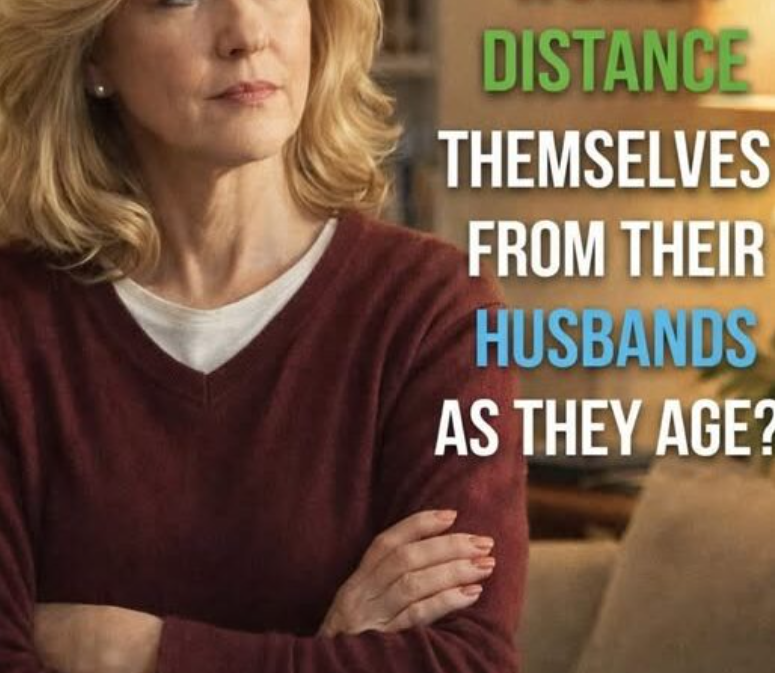
Marriage is often imagined as a fixed destination—a safe harbor reached once vows are exchanged and the celebration ends. In reality, it is a living, evolving entity that must adapt to the passage of decades. As couples move from the passionate idealism of their twenties into the complex terrain of midlife and beyond, the structure of their intimacy inevitably shifts. One commonly observed pattern in modern sociology is that women, in particular, tend to gradually distance themselves from their husbands as they age. This drift rarely results from a single event; instead, it emerges over years of emotional labor, changing biological priorities, and the natural evolution of personal identity.
A strong marriage is founded on shared dreams and youthful optimism. At the start, couples envision a unity that feels unbreakable. Yet the reality of long-term marriage encompasses far more than milestones and celebrations. It demands constant adaptability and emotional maturity, especially during the “middle years”—a period defined by career peaks, parenting pressures, and the responsibilities of aging parents. Research consistently shows that stable, supportive marriages boost both physical and emotional well-being, serving as a buffer against life’s stresses. But the same research reveals a sobering truth: unmet emotional needs, when accumulated over decades, lead not to sudden breaks, but to a quiet, steady distancing.
A major driver of this distancing is the unequal distribution of emotional labor. In many households, women often take on the role of Chief Emotional Officer—managing schedules, anticipating children’s needs, bridging family communication, and providing primary psychological support to their spouses. Over time, this cumulative effort can result in “compassion fatigue.” As women enter their fifties or sixties, sometimes coinciding with menopause, they often shift their focus back to themselves. If a husband has relied on consuming this emotional labor without actively reciprocating, the wife may naturally withdraw it as a form of self-preservation.
Career trajectories and financial pressures also contribute to this divergence. Take Alex and Taylor, a couple married for over twenty-five years. Outwardly, their life is a portrait of stability—they have raised children, managed finances, and built strong professional reputations. Alex devoted decades to teaching and coaching, pouring himself into his students and community. Taylor climbed the ranks at a demanding law firm while balancing the household.
Yet as they enter their mid-fifties, their paths begin to diverge. Alex seeks a slower pace, envisioning a quieter life with fewer responsibilities. Taylor, at the peak of her career, feels a surge of ambition and wants to embrace leadership opportunities she once deferred. This “ambition gap” often fuels distancing. If Alex expects Taylor to slow down, she may feel constrained. If Taylor expects Alex to maintain his former level of support, he may feel abandoned. Without deliberate, open communication, these natural shifts are interpreted as personal rejection. The distancing that occurs is often a protective measure—a way for each partner to preserve their evolving identity within the relationship.
The “empty nest” phase further highlights this shift. For decades, couples often communicate primarily through their children—discussions revolve around schedules, tuition, or discipline. When the children leave, couples face each other without this buffer. Women may suddenly realize that their spouse has become a stranger or someone they no longer feel responsible to manage. Distancing in this stage can be a quest for autonomy. After years of being defined as “wife” and “mother,” a woman may seek space not out of dislike, but to rediscover herself.
Bridging this distance requires moving beyond the “autopilot” approach of younger years. Lasting marital strength comes from treating individual change as a collaborative process rather than a threat. This demands empathy that reaches beyond basic kindness—a curiosity about who your partner is today, not who they were on your wedding day. Flexibility is the antidote to rigidity. If Alex supports Taylor’s professional drive and Taylor honors Alex’s need for a slower pace, they can forge a “third way” that respects both evolving needs.
Ultimately, a woman’s distancing with age can signal an opportunity for the marriage to evolve. It reflects that the old “contract”—written in their twenties—is no longer suitable for the adults they have become. Honest dialogue is the tool needed to cut through decades of accumulated misunderstandings. By acknowledging domestic burdens, rebalancing emotional responsibilities, and validating each other’s changing ambitions, couples can transform this tension into a new chapter of deeper connection. Distancing need not mark the end; it can create the space necessary for a more mature, authentic love to flourish.