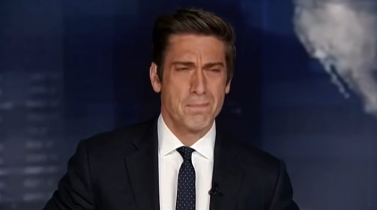
David Muir has earned his place as one of the most respected figures in American journalism not through spectacle or self-promotion, but through consistency, discipline, and a deep respect for the audience he serves. In a time when trust in the media is often fragile and news moves at a relentless pace, Muir represents something increasingly rare: a steady presence that viewers trust to tell them what matters, without exaggeration or personal agenda.
As anchor and managing editor of World News Tonight on ABC News, Muir sits at the center of the national conversation almost every night. This role carries immense responsibility. Millions rely on him not just for headlines, but for context, clarity, and careful judgment. What sets him apart is the seriousness with which he approaches this responsibility. His delivery is measured, calm without being detached, authoritative without sounding arrogant. He doesn’t rush the facts or dramatize events. He lets the information speak for itself, guiding viewers through complexity rather than overwhelming them with noise.
Muir’s credibility is built on years of reporting far beyond the anchor desk. Long before he became a familiar face in American homes, he reported firsthand from some of the world’s most dangerous and consequential stories. From war zones to natural disasters, refugee camps to communities torn apart by violence, he has consistently been where the story is happening. This on-the-ground experience informs the way he anchors. When he speaks about crises, he does so not as a distant narrator, but as someone who has stood in the rubble, spoken to survivors, and witnessed the human cost up close.
One of Muir’s defining strengths is his ability to focus on people rather than abstractions. When covering hurricanes, he doesn’t just report wind speeds or damage estimates; he introduces viewers to families waiting to rebuild. When reporting on global displacement, he gives voice to refugees who are often reduced to statistics in other broadcasts. These choices are not sentimental flourishes—they are editorial decisions rooted in the belief that understanding begins with empathy. By grounding major events in real human experiences, Muir makes complex issues accessible without oversimplifying.
His interviewing style reflects the same philosophy. Muir asks direct questions, but rarely aggressive ones for performance. He listens. He allows silence when needed. He presses for clarity without turning conversations into confrontations. This approach has earned him respect from sources across the political and social spectrum. Viewers sense that he isn’t trying to “win” interviews or dominate the exchange. His goal is to extract truth and present it fairly, even when the answers are incomplete or uncomfortable.
Over the course of his career, Muir has received numerous awards recognizing both his international reporting and domestic coverage. These accolades are less about prestige than about validating a work ethic rooted in accuracy and depth. His reporting often requires long hours, difficult travel, and emotional resilience, yet his on-air presence remains composed. That composure is not accidental. It reflects preparation, discipline, and a strong editorial compass that prioritizes facts over theatrics.
Another factor contributing to Muir’s reputation is restraint. In an industry where personalities often become the story, he has deliberately chosen to stay in the background. He keeps his personal life private, rarely addressing it publicly and never using it as a branding tool. This discretion reinforces the idea that his work, not his image, matters most. Viewers tune in for the news, not the anchor’s life or opinions, and Muir respects that boundary.
Colleagues often describe him as meticulous and deeply committed to the craft. Scripts are reviewed carefully. Words are chosen intentionally. Sources are vetted. These behind-the-scenes habits may not be visible to the audience, but they are felt in the final product. The result is a broadcast that feels reliable even in chaos, reassuring even when the news itself is unsettling.
In a media environment shaped by speed, outrage, and fragmentation, David Muir represents continuity. He bridges traditional journalism with modern storytelling without sacrificing standards. He understands that trust is built slowly and lost quickly, and he treats it accordingly. Night after night, he shows up prepared, focused, and respectful of the audience’s intelligence.
That is why so many Americans see him not just as an anchor, but as a trusted guide in uncertain times. Not because he is loud. Not because he seeks attention. But because he has consistently shown that journalism, when practiced with integrity and care, still matters.