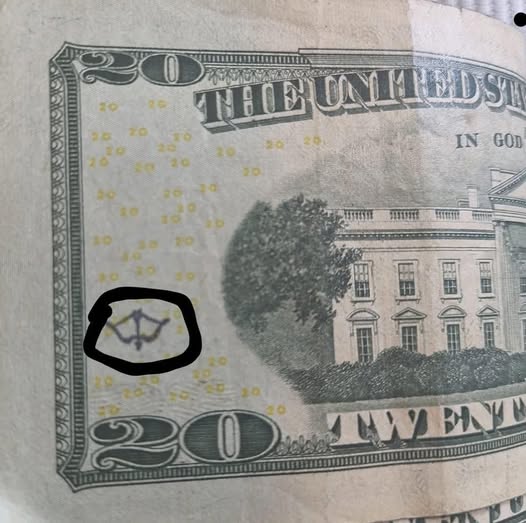
The US dollar is a worldwide traveler that bears the physical wounds of its travels as well as the invisible weight of international trade. It is more than just a piece of legal coin. Small, seemingly mysterious symbols, like a bow and arrow, a geometric form, or a small character, stamped in colorful inks are among the most fascinating elements on legal tender. These can seem like random graffiti or the product of a child’s stamp set to an untrained observer in a grocery store line. These markings, referred to as “chop marks,” are a quiet evidence to a bill’s validity and its lengthy journey through the hands of international merchants, though, for those who are familiar with the complexities of global banking.
No official characteristic of the U.S. Bureau of Engraving and Printing is a chop mark. Rather, it is a private mark of verification that is added by independent dealers, banks, and money changers, mostly outside of the US. These emblems have their origins in a centuries-old commercial custom that existed before paper money. To confirm the purity of the metal during the silver trade era, East Asian traders would “chop” or punch a tiny mark into silver pieces like the American Trade Dollar or the Spanish Eight Real.One A merchant would leave their distinctive stamp as a guarantee to the next recipient if they inspected a coin and determined it to be authentic. Physical punches in metal gave way to inked stamps on banknote edges when the globe switched from heavy silver to lightweight paper.
The note has passed through an area where the U.S. dollar is utilized as secondary or even principal currency when a chop mark appears, such as the fine shape of a bow and arrow. The dollar is valued for its stability in many regions of Latin America, Africa, and Asia.Two Trust becomes the main currency because these areas frequently lack the advanced electronic verification methods present in Western banks. A hundred-dollar bill is examined by a professional money changer in a busy market in Hong Kong or a trade post in Lagos. They check the paper’s texture and the ink’s clarity. They use their “chop” after they are confident the note is authentic. By notifying the local community, “I have checked this money, and it is good,” this mark acts as a personal recommendation.
Chop marks simplify the cash flow from a functional standpoint. Re-verifying each note in a stack of thousands can be a laborious job in high-volume trading scenarios. A banknote with many unique chop marks indicates that it has been authenticated by multiple professional hands and tells a story of successful transactions. It creates a decentralized network of trust and lessens market friction. It’s interesting to note that these markers are nearly always made precisely. Money changers take care to avoid hiding the bill’s security threads, serial numbers, or portrait of the person on it. They insert their emblems into the white areas or the elaborate borders of the design since they know that tarnishing the security measures would make the bill useless.
These symbols are incredibly diverse. Beyond the bow and arrow, there might be basic alphanumeric codes, animal silhouettes like dolphins or eagles, or Chinese symbols that stand for luck or prosperity. Every stamp is a distinct hallmark of a certain exchange company or well-known broker. A single bill with five distinct chop marks is a data point for a global economist; it is a map that demonstrates how this particular piece of paper might have gone from a New York bank to a Singaporean merchant, then possibly to a textile trader in Jakarta, before eventually making its way back to the United States in a traveler’s wallet.
The legality of these marked bills is frequently a persistent concern. It is against the law in the United States to “mutilate, cut, deface, disfigure, or perforate” currency with the intention of making it unfit for reissue, as stated in 18 U.S.C. § 333.3. Nonetheless, the Federal Reserve and the Treasury Department typically consider chop marks to be “incidental wear” as opposed to deliberate defacement. A chop-marked bill is still legal tender, much as a bill that has had a little corner pulled off or wrinkled in a pocket. These bills are typically accepted by banks in the US without being issued, but as they go through the Federal Reserve’s sorting machines, they might eventually be removed from circulation and replaced with “clean” notes.
Chop marks give a contemporary currency collector, or “numismatist,” a level of historical and cultural significance that is absent from a perfect, uncirculated bill. A growing number of collectors specifically search for “world-traveled” dollars, although some prefer perfect notes. These marks are “passport stamps” to them rather than flaws. Every bow and arrow or starburst represents a physical link to a human connection—a time when two individuals, possibly speaking different languages and residing thousands of miles away from Washington, D.C., came to an agreement regarding the worth and legitimacy of a piece of American paper.
The survival of the physical chop mark is an intriguing oddity in a time when cryptocurrency and digital transactions are increasingly commonplace. It stands for the “human element” of finance, which includes the significance of a personal guarantee and the requirement for physical verification. It serves as a reminder that money is really a social compact. Six months ago, a little exchange shop in a foreign hemisphere may have stamped the bow and arrow emblem that appears on a twenty-dollar bill in your pocket. It serves as a reminder that the dollar is an international instrument that supports people’s aspirations and means of subsistence everywhere.
The next time you come across a bill with an odd inked sign, pay great attention to it. You are in possession of a 21st-century version of the “Silk Road” type of business. That little bow and arrow, which has actually landed in your palm, is a symbol of trust, a journey marker, and a tiny fragment of world economic history that has withstood the trials of international trade. It is evidence of the dollar’s ongoing strength and the demand for verification, trust, and commerce shared by all people.