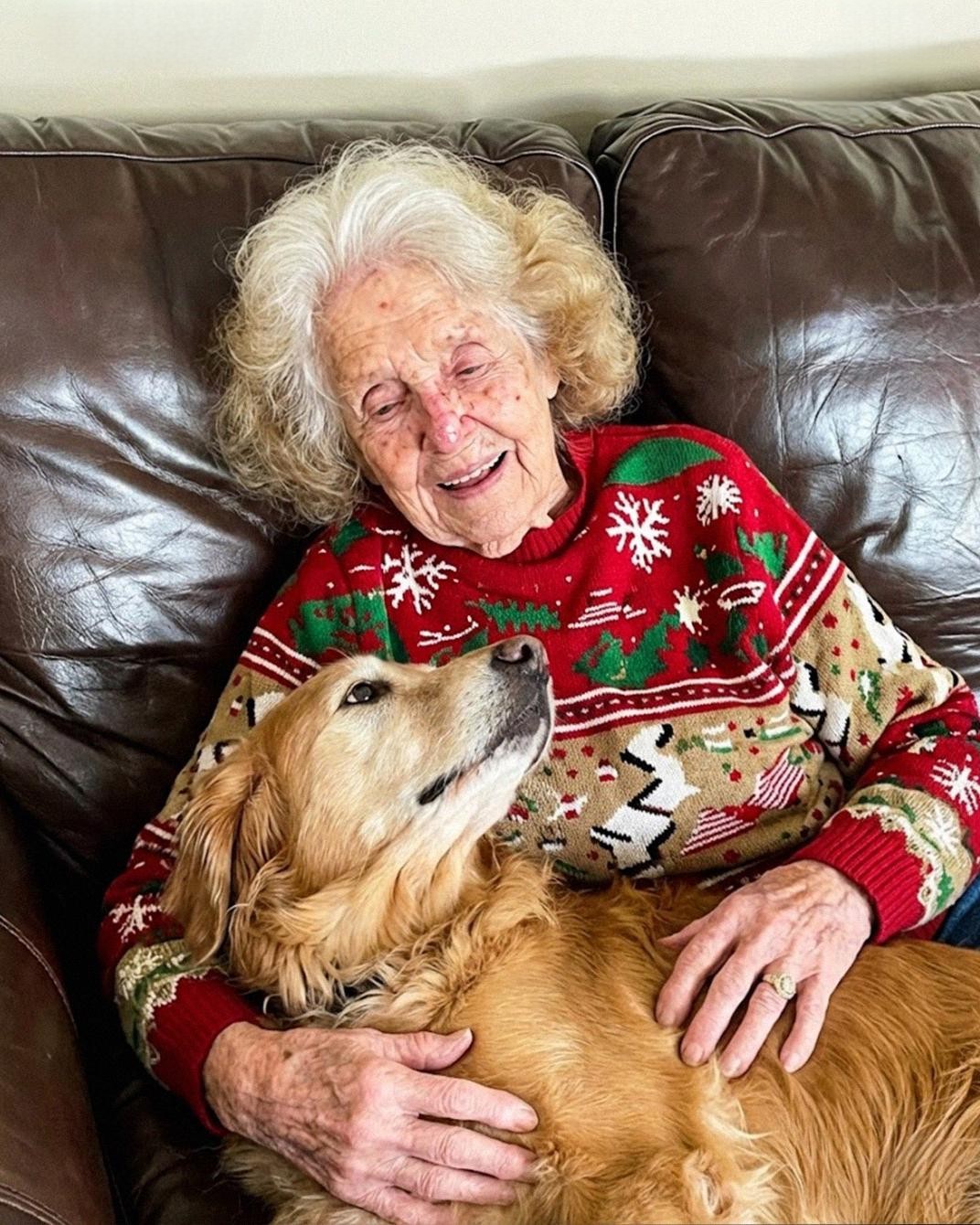
The graveyard was a stage for unspoken resentment, where the air didn’t hum with grief, but with quiet calculation. As Grandma Cassandra was lowered into the earth, I stood apart from the rest of the family, my fingers gripping the worn leather of Berta’s leash. Berta, a golden retriever with a muzzle as white as winter frost, whimpered softly. She had been Grandma’s constant companion for over a decade—the only one, Grandma often joked, who didn’t have a price tag.
Grandma was a woman of immense wealth and even greater principles. She had built a textile empire from the ground up, and she expected nothing less from her descendants. She would pay for an Ivy League education, but she wouldn’t buy you a car. She’d fund a startup, but she wouldn’t pay your rent. This philosophy had earned her a family who didn’t see her as a matriarch but rather as a complex, frustrating vault of wealth.
During the last six months of her life, as cancer slowly robbed her of strength, the house on Willow Lane grew quieter. My mother, Aunt Florence, and Uncle Jack hadn’t visited in years, citing her “emotional coldness.” I was the only one who stayed behind. Balancing my demanding nursing shifts with Grandma’s palliative care was exhausting, but it felt right. In those quiet nights, we didn’t discuss money. We spoke of my patients and the books she loved. Even when my car needed expensive repairs, she simply patted my hand and said, “You’re a nurse, Meredith. You know how to fix things. You’ll figure it out.”
Now, the funeral was over, and the “vultures,” as Grandma had called them, circled the living room. My mother paced the hardwood floor, her eyes scanning the paintings on the wall, no doubt mentally assigning price tags to the frames. Uncle Jack checked his gold watch every few minutes, while my cousins, Tom and Alice, sat with their chins tilted upward, already spending an inheritance that hadn’t yet been granted.
“Remind me, Meredith,” Aunt Florence said with a sugary tone, “are you still doing that… nursing thing?”
“I am,” I answered, sitting on the edge of a chair with Berta’s heavy head resting on my knee.
“You really should’ve listened to your father,” Uncle Jack chimed in. “Tom’s car dealership is expanding, and Alice’s salons are the talk of the town. You’ve settled for so little.”
“I help people,” I said quietly. “That’s enough.”
My mother sighed dramatically. “I honestly don’t know where I went wrong with her.”
The tension broke with the arrival of Mr. Johnson, a man whose briefcase seemed to carry the weight of the world. He entered the room and declined a seat, standing with a posture that suggested he was eager to leave.
“I’ll be brief,” Mr. Johnson said flatly. “Cassandra was very specific. None of the biological children or grandchildren here will receive a direct cash inheritance or the title to this estate.”
A collective gasp of outrage swept through the room. “That’s impossible!” my mother shrieked. “We are her flesh and blood! Who gets the house? Who gets the holdings?”
“I am not at liberty to disclose the beneficiary at this time,” Mr. Johnson said, his gaze moving around the room. “However, I must ask you all to vacate the premises by sundown. The locks will be changed.”
The room erupted in anger. Uncle Jack called his mother a “bitter old witch,” while Aunt Florence began weeping—not for her mother, but for the vacation home she’d already set her eyes on in Tuscany. Amid the chaos, Berta let out a sharp, mournful bark.
“And what about that?” Aunt Florence pointed at the dog. “That animal is twelve years old and half-blind. What happens to her?”
“Put her down,” my mother said coldly. “She’s a reminder of a woman who clearly hated us. It’s the most humane thing.”
“You can’t be serious,” I whispered, my heart pounding. “Grandma loved her. Berta’s family.”
“Then you take her, Meredith,” Uncle Jack sneered. “Add a geriatric dog to your list of burdens. It fits your ‘saintly’ lifestyle perfectly.”
“I can’t,” I said, voice trembling. “My apartment has a strict no-pet policy. I’d lose my lease.”
“Then she goes to the shelter,” Alice said, checking her reflection in a compact mirror. “Or the vet. It’s not our problem.”
I looked down at Berta. She met my gaze with cloudy, trusting eyes, her tail giving a faint, weak thump against the floor. I thought of Grandma’s voice, telling me I was strong enough to manage.
“Fine,” I said, my voice hardening. “I’ll take her. I’ll find a way.”
The family filed out, throwing final insults at the house and the woman who had built it. I packed Berta’s bed, her favorite squeaky duck, and her medications into my car. My landlord, a man usually moved only by late fees, saw the look on my face and agreed to let Berta stay for an extra three hundred dollars a month. It was a king’s ransom on a nurse’s salary, but it was the only choice I could live with.
Life became a blur of double shifts and long walks with a dog that moved at the speed of a tectonic plate. A week later, my mother appeared at my door, her face twisted with rage. She accused me of hiding a secret will, of “manipulating the old woman” during her final days. When I showed her my empty bank account and the bag of cheap dog food in the corner, she spat on the floor and called me a liar.
After she slammed the door, I sank to the floor, pulling Berta into my lap. As I stroked her neck, I noticed the metal tag on her collar was slightly askew. I turned it over. Engraved on the back was an address along with the number 153. Intrigued, I unscrewed the small locket attached to her collar—a piece I had always thought was decorative. A small, silver key tumbled into my palm.
The address led me to a row of lockers at the central train station. My hands shook as I inserted the key into locker 153. Inside, I found a leather-bound folder. The first page was a handwritten letter.
My Dearest Meredith,
If you are reading this, it means you chose a living soul over a bank account. I knew my children would see Berta as a ‘flea-ridden’ reminder of a woman they only tolerated for her gold. I needed to ensure my life’s work went to someone who understood that the most valuable things in this world cannot be liquidated. Everything—the estates, the trust funds, the textile holdings—is now yours. You are the only one who showed decency when there was nothing to gain. Use it to heal more people, Meredith. You were always my favorite.
As I clutched the documents, a shadow fell over me. My mother and Uncle Jack stood a few feet away. Jack had hired a private investigator to follow me, convinced I was hiding their “stashed millions.”
“Hand it over, Meredith,” Jack demanded, stepping forward. “That’s family money. It doesn’t belong to a nurse.”
“It belongs to the person who took the dog,” a voice rang out. Mr. Johnson stepped from behind a pillar, phone in hand. “A digital sensor alerted me the moment this locker was opened. The condition of the will was ‘blind compassion.’ Meredith took Berta, believing it would cost her her home and savings. That act of selfless love triggered the transfer of assets.”
My mother lunged for the folder, but Mr. Johnson stepped between us. “If either of you touches her, I will have the police here in minutes. You were given your education and your start in life; you will receive nothing more.”
They left, defeated by their own greed, leaving me standing alone in the cold station, clutching a folder that had changed my life—and a dog that had saved it.
I didn’t buy a mansion or a fleet of cars. I kept my job at the hospital, but I donated enough to build a new pediatric wing. I bought a house with a massive, fenced-in yard where Berta could spend her final years napping in the sun. Grandma was right—I was a nurse, and I knew how to fix things. And with her help, I fixed everything I could.