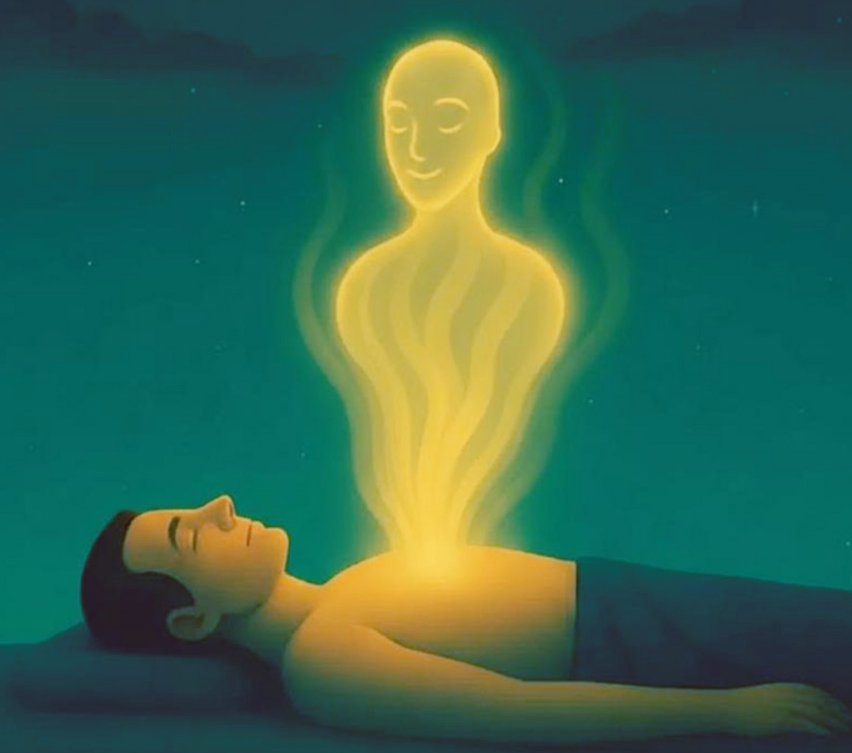
The room was quiet—so quiet, in fact, that the silence itself seemed to hold its breath. In that small stillness, surrounded by soft light and the faint scent of flowers, a question often whispered through history arose again:
What happens in the moments right after we die?
For thousands of years, across continents and cultures, people have believed that the soul does not simply vanish the moment the heart stops. Instead, it lingers—watching, remembering, adjusting. Some traditions say it takes three days before the soul finally moves on.
But why three days? And could science, with all its instruments and measurements, have anything to say about such a profound mystery?
To answer that, we must walk between two worlds: the world of faith, and the world of modern discovery.
The Ancient Belief: A Soul in Transition
Long before machines could measure brain activity, humans relied on intuition, ritual, and their deep sense of the sacred. In many places, death was not considered a single moment, but a journey—a threshold that took time to cross.
In Tibetan Temples
Monks speak of the bardo, a realm between life and rebirth. They describe it as a kind of spiritual twilight, where the soul wanders, confused at first, gradually understanding that the body it once inhabited is no longer its home. The first days are said to be the most delicate, like learning to walk again but in reverse—learning to float, to release, to let go. The soul, they say, is not quick to part from the body it once inhabited, for it holds on to the memories, the emotions, and the life it lived.
This phase is thought to last for days, as the soul makes its transition, learning to detach from the physical and embrace the invisible realms of existence. This transitional period is said to be essential, as it marks the soul’s journey toward liberation and eventual rebirth.
In Jewish Tradition
It is said that the soul stays close to the body for three days, hovering gently, reluctant to leave entirely. This is why ancient mourning rituals are especially tender during this time: a recognition that something sacred is still nearby. The mourners sit vigil, reciting prayers, offering comfort, and lighting candles to help guide the soul’s path. The three-day period is viewed as a time for the soul to reflect on the life it just left behind and slowly prepare to move on.
In some interpretations, the third day represents the soul’s final release from earthly attachments, when it is free to ascend to the afterlife or move on to its next journey.
In Villages Across Latin America
People whisper that a soul, especially one taken suddenly, needs time to understand what has happened. They light candles, keep vigil, and speak softly, believing their words can still reach the one who has passed. The belief is that the soul is still in transition, neither fully departed nor fully present. It is a time of mourning, yes, but also of honoring the process of the soul’s departure.
The rituals performed during these three days help ease the transition of the soul, guiding it gently towards peace. The living do not simply mourn; they assist in the process of letting go, believing that their love and remembrance can provide solace to the soul as it embarks on its next phase.
These stories—from Himalayan peaks to Middle Eastern deserts to small towns wrapped in folklore—all circle around the same idea:
Death isn’t immediate. It’s a transition. A passage. A fading of one reality before another fully forms. Whether through ritual, prayers, or simple presence, humans have sought to honor this transition in ways that span across cultures and generations.
What Science Finds in the Silence of Death
Science does not speak of souls. It cannot measure them, label them, or place electrodes upon them. But it can study consciousness, and in recent years, researchers have begun noticing something startling.
1. The Brain Does Not Stay Silent After the Heart Stops
In hospitals around the world, patients who were clinically dead—without a heartbeat, without breath—were brought back minutes later. And when they woke, many described astonishingly similar experiences:
A sense of floating above their body
Watching medical teams work on them
Hearing conversations word for word
Feeling peace, warmth, or an overwhelming sense of clarity
These are known as near-death experiences (NDEs), and they appear across cultures, ages, and languages. What is extraordinary is that these reports come from moments when the brain should have been entirely incapable of producing consciousness.
And yet—something was still happening.
These reports—often consistent in their details—have led researchers to propose that something about consciousness may persist after the physical body has ceased its functions. Whether it’s the brain’s final flurry of activity or something beyond that, the consistency of these reports across different individuals raises questions that science is now trying to answer.
2. A Mysterious “Final Burst” in the Brain
Modern technology has allowed scientists to see what was once invisible. Studies conducted in 2023 and 2024 revealed unusual spikes of brain activity after cardiac arrest—moments after the heart has fully stopped.
In one study published in Resuscitation, researchers saw a particular pattern: brain waves associated with conscious perception, memory recall, and internal awareness.
In plain terms, the brain seemed to “flare” into activity, as if producing one last profound moment of awareness. This brief moment of heightened activity suggests that the brain may not completely shut down immediately, but rather enters into a final phase of operation before it ceases altogether.
No one knows exactly what this means yet. But the idea that consciousness might linger—however briefly—has sparked an entirely new field of study.
Where Spirituality and Science Meet
Let’s imagine, for a moment, that those ancient traditions—passed through generations by monks, rabbis, healers, and elders—were not literal descriptions, but symbolic truths about something we are only beginning to understand.
They say the soul needs time to detach. Science says consciousness does not shut off instantly.
They say the spirit observes for a while. Science records perceptions during clinical death.
They speak of transition. Science observes a gradual neurological shutdown.
The languages are different, but the story—the shape of the story—is strangely similar.
Perhaps the “three days” is not a fixed rule, but a metaphor woven into cultural understanding: a way to honor the mystery between the last breath and whatever follows.
Could it be that the three-day period holds symbolic significance for a reason—acknowledging that some part of us lingers, observes, and processes before it fully departs? That the soul’s journey is not an immediate departure, but one that takes time and space?
Why These Beliefs Matter
Whether we keep faith in the existence of the soul or trust in what can be observed and measured, one truth remains the same:
Death is not just an ending. It is a transformation.
For grieving families, the idea that their loved one’s essence lingers—watching over them, understanding their sorrow, saying goodbye—can bring profound comfort. It helps frame the experience of loss as part of a larger process, one that honors the journey of both the soul and those left behind.
For scientists, the emerging evidence that consciousness persists challenges everything we thought we knew about the boundary between life and death. The mind, it seems, may not shut off immediately, and what happens in the moments after death may be far more complex than we previously understood.
And for all of us, standing somewhere between these two worlds, the conversation itself is meaningful. It invites humility. Wonder. Curiosity.
It reminds us that even in an age of technology, some mysteries remain beautifully unsolved.
A Bridge Between Worlds
In the end, spirituality and science may not be opponents, but travelers on different paths toward the same horizon.
One uses stories. The other uses instruments. Both are trying to understand the deepest question of all:
What becomes of us when the body falls silent?
The belief that the soul remains for three days is one way of answering.
Scientific discoveries about lingering consciousness offer another.
And perhaps, somewhere in the quiet space between them, lies a truth we are only beginning to glimpse.
In the end, spirituality and science may not be opponents, but travelers on different paths toward the same horizon.
One uses stories. The other uses instruments. Both are trying to understand the deepest question of all:
What becomes of us when the body falls silent?
The belief that the soul remains for three days is one way of answering.
Scientific discoveries about lingering consciousness offer another.
And perhaps, somewhere in the quiet space between them, lies a truth we are only beginning to glimpse.