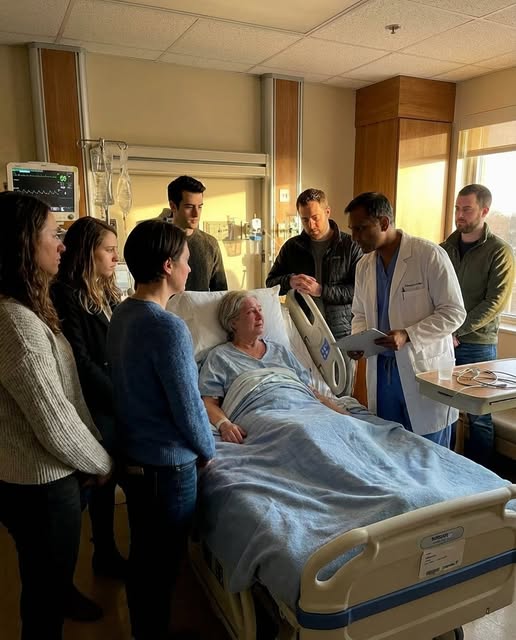
When the doctor said our mother could no longer live alone, the room went still in a way that felt louder than panic itself, as if even the machines had paused to listen. My six brothers and sisters stood clustered around her hospital bed, each of them wearing concern on their faces but carrying an entirely different kind of urgency underneath it. They were quick with reasons, rehearsed almost—work schedules that couldn’t bend, homes too far away, finances too tight, marriages that couldn’t absorb another responsibility, spaces that were already “just enough,” timing that would never be right.
One by one, they stepped back emotionally before they even stepped back physically. I watched our mother’s hopeful expression slowly collapse under the weight of their refusals, and with it, the last thin layer of certainty she had been holding onto. I was the youngest, the one who usually stayed quiet, the one no one expected to interrupt or insist, especially not after a lifetime of being treated as the least necessary voice in the room. But when I finally stepped forward and said I would take her in, it felt less like courage and more like something I had been carrying for years finally speaking for itself. The shift in the room was immediate, sharp, almost disbelieving.
Growing up, I had always felt like the extra child, the one who arrived not as a blessing but as an addition nobody had prepared for. My family was already stretched thin—emotionally, financially, and in ways nobody ever said out loud—and I learned early how to make myself smaller inside it. After our father left, my mother worked constantly, holding the household together with a kind of exhaustion that never fully left her face. Still, even in her hardest years, there was always a quiet distance between us that I could never quite bridge. I got the hand-me-down clothes that never fit properly, the softer but more distant versions of affection, and the unspoken sense that my existence had shifted the family’s balance in a way that made everything harder.
So when I told them I would take her in, the shock that crossed my siblings’ faces wasn’t just surprise—it was disbelief that I, of all people, would be the one to step into responsibility. But I didn’t stop there. I added the condition that we would have to sell the house. The air changed instantly. The problem was no longer care—it was ownership. And I realized then, with a clarity that made my stomach tighten, that my siblings weren’t simply avoiding responsibility for our mother; they were quietly protecting what they believed was their future inheritance.
Before they gathered the next evening to argue, I arrived at the house early, before the noise and defensiveness could fill every corner, and I finally asked my mother something I had rehearsed in my mind for years. Why had she always kept me at such a careful distance? The question came out softer than I expected, almost fragile. She didn’t respond immediately. When she finally did, there was no cruelty in her voice, only a tired honesty that felt heavier than any accusation.
She said I reminded her of everything that had gone wrong in her life at once—the abandonment, the fear of not having enough, the bills stacked on the table like threats, the future she had once imagined collapsing in real time. It wasn’t that she didn’t love me, she said. It was that her love for me had always been cautious, as if closeness might somehow reopen wounds she had never fully healed. Hearing that didn’t erase the years of feeling unwanted, but it reframed them in a way I wasn’t prepared for. So when my siblings arrived and the arguments began, I didn’t raise my voice. I didn’t need to. For the first time, my mother spoke clearly in my defense. And as the conversation unraveled more than they expected, it became obvious that none of them had been paying close enough attention to how unwell she had actually become.
Once the house was sold, I made sure the process was handled carefully, with most of the money placed aside specifically for her long-term care, but I also did something none of my siblings knew about at the time: I took her to a specialist for a full evaluation. What we discovered changed the entire story we had been telling ourselves. A significant part of her decline hadn’t been inevitable aging at all—it had been worsened by medication errors, inconsistent monitoring, and poorly managed treatment that had gone unnoticed for too long. With proper care, adjusted medication, and structured follow-ups, her condition began to improve in ways none of us had expected. Slowly, almost cautiously at first, my siblings started reappearing in her life.
Not perfectly, not all at once, but more honestly than before, as if the distance between them and her could finally be measured and crossed. Living with my mother became something I had never experienced with her before—not just responsibility, but a quiet learning of each other. One night, sitting in the dim light of the kitchen, she looked at me and admitted she never imagined I would be the one to step forward when everything fell apart. I told her I hadn’t expected it either. But by then, something inside me had settled. I no longer needed to be the favorite, or the chosen one, or the child who was finally understood. For the first time in my life, simply being seen clearly—without distance, without misunderstanding—was enough.