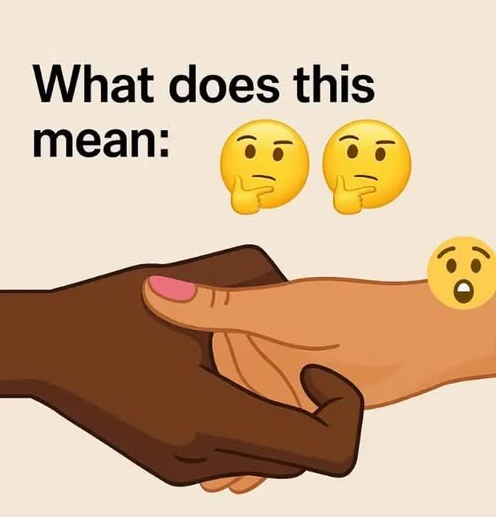
Body language often communicates what words leave unsaid. A look that lingers, a subtle shift closer, a pause that carries weight. Among the quietest yet most meaningful gestures is one that’s easy to overlook: a man gently rubbing or scratching the palm of your hand.
On the surface, it may seem harmless. A nervous tic. An absent-minded movement. But in many social and cultural settings—especially when paired with eye contact, lowered voices, or focused attention—this small touch can be intentional. Recognizing what it might signal, and knowing how to respond without doubting yourself, helps you stay confident and firmly in charge of your boundaries.
This isn’t about playing guessing games. It’s about awareness. About deciding who gets access to you—physically and emotionally—and making that choice on your own terms.
Why the Palm Is Significant
The palm is an especially sensitive and intimate part of the body. Unlike a quick touch on the arm or a formal handshake, palm contact activates nerves associated with closeness, trust, and vulnerability. That’s why it’s rarely accidental.
In certain cultures—particularly in parts of the American South, Latin America, and Mediterranean regions—a palm rub during a handshake or brief hand-holding has long been used as a discreet signal of romantic or sexual interest. It’s subtle, easily denied, and meant to be felt rather than noticed.
Of course, not every palm touch carries intention. Context matters. The relationship matters. But when the movement is slow, deliberate, and paired with attentive focus, it’s usually not random.
What matters most isn’t decoding his intent with certainty—it’s paying attention to how the gesture makes you feel.
When It Feels Welcome
Sometimes the moment lands naturally. You feel warmth, curiosity, or a quiet spark. Perhaps there’s already rapport, and the touch feels like a gentle continuation rather than an intrusion.
In those moments, clarity—not confusion—is your strength.
A relaxed smile or steady eye contact can signal openness without rushing anything. You don’t need to exaggerate your response. Simply being present is enough.
If you want to acknowledge it more clearly, subtly mirroring the touch—lingering for a second longer or lightly brushing his hand—communicates interest without giving up control. You’re recognizing the moment, not escalating beyond your comfort.
Humor works too. A light comment like, “Was that intentional?” or “That’s an interesting hello,” keeps things playful while inviting honesty. His response will tell you more than the gesture itself. Respectful engagement builds trust. Defensiveness or entitlement reveals itself quickly.
If the energy feels right, you can choose to continue—walk together, sit closer, stay in conversation longer. You’re not reacting. You’re deciding.
When It Feels Unwelcome
Your comfort is non-negotiable. If the touch feels intrusive, assumptive, or simply wrong, that feeling alone is enough.
Pulling your hand away immediately is a complete response. No explanation required.
If words feel necessary, keep them simple: “Please don’t do that,” or “That made me uncomfortable.” That isn’t rude—it’s clear. Anyone who respects you will honor it without hesitation.
If the mood becomes awkward afterward, let it. Awkwardness is information. Change seats. Change topics. End the interaction if needed. Courtesy should never come at the expense of your safety or self-respect.
You don’t owe anyone access to your body, space, or attention—regardless of age, familiarity, or expectations.
When You’re Unsure
Not every situation is black and white. Sometimes the gesture doesn’t offend you, but it doesn’t feel right either. Instead of intrigue, it leaves you alert.
In those moments, curiosity works better than overthinking.
A calm question like, “What did you mean by that?” or “Was that intentional?” places responsibility back where it belongs. You’re not accusing—you’re seeking clarity.
Listen to how he responds. Does he answer respectfully? Apologize if needed? Or dismiss your concern, joke it away, or suggest you imagined it? His reaction reveals far more than the touch itself.
Healthy interest feels respectful and open. Manipulation feels evasive. Your instincts recognize the difference.
The Strength of Boundaries at This Stage of Life
For many women—especially those who have spent years caring for others—this chapter is about reclaiming authority over their time, body, and choices.
You no longer need to tolerate discomfort to be polite. You don’t need to decipher mixed signals or accept behavior that unsettles you. You’re allowed to enjoy flirtation—and equally allowed to shut it down.
Boundaries aren’t barriers. They’re filters. They allow the right people closer and keep the wrong ones at a distance.
If a subtle touch feels mutual and appealing, you can explore it confidently. If it feels dismissive of your autonomy, you can disengage without guilt.
Real connection—romantic or otherwise—is built on respect that shows itself not just in words, but in how someone responds when you assert yourself.
You’ve earned the right to trust your instincts, protect your comfort, and choose interactions that enrich your life rather than unsettle it.
And when you move with that certainty, your own body language speaks louder than any gesture ever could.