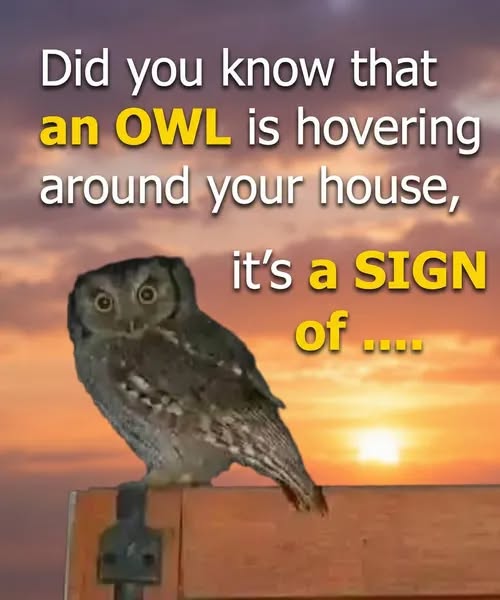
On the darkest nights, when the world has retreated into the safety of sleep, one of nature’s most enigmatic architects takes to the sky. With a wingspan that seems to devour the moonlight and a flight so silent it feels almost supernatural, the owl glides through the darkness. For centuries, humans have looked into the rafters of old barns or the hollows of ancient trees, only to meet the gaze of those glowing, unblinking eyes. To see an owl near your home at night is to witness a marvel of biological engineering—a living embodiment of ancient folklore. Owls are the silent sentinels standing at the threshold between day and night, watching the world with an intensity that suggests they hold secrets the sun can never reveal.
To truly understand what it means when an owl appears near your home, one must first appreciate the staggering biological mastery of these nocturnal hunters. The owl is no mere bird awake at night; it is a creature whose entire existence has been shaped by evolution to dominate the darkness. Their vision is perhaps their most famous feature, with large, tubular eyes packed with rod cells to capture even the faintest glimmer of light. Unlike human eyes, an owl’s eyes are fixed in place by bony structures called sclerotic rings. While this means they cannot “roll” their eyes, nature has compensated by granting them the remarkable ability to rotate their heads up to 270 degrees. This allows them to scan their surroundings with minimal movement, preserving their camouflage while tracking the faintest stirrings of life on the forest floor.
Equally impressive is the owl’s sense of hearing, which is arguably the sharpest in the avian world. In many species, the ears are placed asymmetrically on the head—one slightly higher than the other. This offset allows the owl to pinpoint the origin of sounds in three-dimensional space. By measuring the tiny time difference between when sound reaches each ear, the owl can determine the exact location of a mouse scurrying beneath a blanket of leaves or even deep under the snow. When an owl perches near your home, it’s not simply looking; it’s “mapping” the environment through a sophisticated acoustic landscape invisible to human ears.
Yet perhaps the most awe-inspiring aspect of the owl’s biology is its ability to move in complete silence. While most birds produce a distinct sound when air rushes over their stiff wing feathers, the owl’s feathers are edged with a soft, comb-like fringe that breaks up air turbulence into tiny “micro-turbulences.” This muffles the sound of their flight, allowing them to descend from the sky like a shadow. For the rodent below, there is no warning—no rustle of wind, no shadow cast by the sun—only the sudden, decisive strike of sharp talons. This mastery of stealth makes them invaluable to local ecosystems. By naturally controlling rodent and insect populations, a single owl near your home can perform the job of many chemical traps, safeguarding gardens and crops while maintaining the balance of the food chain. Their presence is a strong indicator of a thriving, healthy environment.
Beyond biology, the sight of an owl near a home carries deep symbolic meaning across cultures. In ancient Greece, the owl was the sacred companion of Athena, the goddess of wisdom and strategic warfare. To the Greeks, the owl’s ability to see in the dark symbolized the philosopher’s ability to perceive truth through the “darkness” of ignorance. If an owl nested near a home, it was often seen as a sign that the inhabitants were under the protection of divine wisdom. In this tradition, seeing an owl was a call to intellectual awakening—a reminder that wisdom often requires silence and observation before action.
In many Indigenous North American cultures, the owl’s symbolism is more layered, often representing a bridge between the physical world and the spirit realm. Some traditions saw the owl as a harbinger of change or a “night eagle,” while others believed owls were messengers from ancestors. Rather than a sign of danger, the owl’s presence was an invitation to reflect inwardly. It urged people to look beyond the surface and trust their intuition. When the world is noisy and chaotic during the day, the owl’s appearance at night serves as a reminder that true clarity often comes when we silence the noise of the crowd and listen to the whispers of our subconscious.
In modern spiritual circles, an owl’s “visit” is often interpreted as a sign of transition. Because owls are creatures of twilight—the “blue hour” between light and dark—they symbolize the ability to navigate through uncertainty. If you’re at a crossroads in your personal or professional life and an owl appears, it is often seen as a sign of encouragement. It suggests that you possess the “night vision” to navigate through challenging situations, even if the final destination remains unclear. The owl doesn’t fear the dark; it thrives in it. Its presence calls us to approach the unknown with quiet strength and adaptability.
Seeing an owl near your home is also a sensory experience that demands we slow down. In our fast-paced, hyper-connected world, the owl is the ultimate practitioner of the “slow movement.” It can remain motionless for hours, blending with the tree bark, waiting for the perfect moment to act. This patience may be one of the owl’s greatest lessons. They teach us that there’s a time for stillness and a time for action, and the former is the foundation for the success of the latter. When you hear that haunting, rhythmic “hoo-hoo” echoing through the trees near your window, it serves as a natural meditation, pulling your focus away from the glowing screens of technology and back to the ancient rhythms of the earth.
Ultimately, the owl remains a guardian of the night—an intersection of hard science and deep mystery. Whether seen through the eyes of a biologist admiring their specialized feathers and asymmetrical ears, or through the eyes of a dreamer seeking wisdom and intuition, their presence is a gift. They remind us that the night is not something to fear or avoid, but a space of beauty, activity, and insight. The next time the velvet wings of an owl pass over your roof or its amber eyes meet yours from a nearby branch, take a moment to be still. In that silence, you might discover that the owl isn’t just watching the world—it’s teaching you how to see it.