By the time Super Bowl 60 kicks off at Levi’s Stadium, it will be far more than a championship game. For many Americans, the event has already become a focal point where sports, politics, immigration, and identity intersect in ways that feel inseparable. What was intended to be a carefully orchestrated spectacle has instead evolved into a mirror reflecting the nation’s anxieties, divisions, and unresolved tensions, laying bare the challenges and fractures in contemporary American society.
In the weeks leading up to the game, a seemingly innocuous NFL graphic circulated online, initially dismissed as a quirky coincidence. Over time, however, it took on a darker, almost prophetic resonance, interpreted by some as a symbol of the larger cultural stakes at play. The Super Bowl, traditionally marketed as a unifying ritual, now unfolds against a backdrop of political confrontation, social anxiety, and heightened public scrutiny—forces that no halftime performance, no matter how grand, can fully distract from.
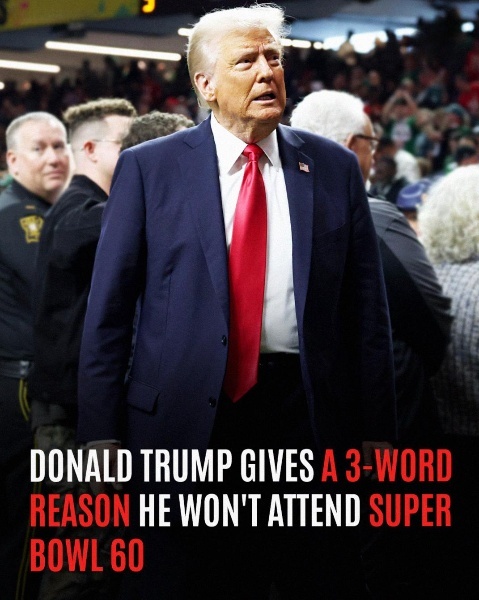
At the center of this swirling controversy is former President Donald Trump, whose public critiques of the league and the event reignited debates that never truly subsided after his time in office. Trump framed the Super Bowl not as a celebration of athletic excellence, but as a reflection of cultural decay and political signaling. His words polarized audiences instantly: supporters echoed his concerns, while opponents accused him of weaponizing a sporting event, turning it into yet another battlefield in America’s ongoing culture wars.
Compounding the tension were reports and speculation about Immigration and Customs Enforcement activity. Though federal officials spoke cautiously, the mere possibility of heightened ICE presence around the Super Bowl sparked fear among immigrant communities throughout the Bay Area. Even the perception of increased enforcement was enough to alter travel plans and attendance decisions for many, turning what should have been a joyful, communal experience into a calculated risk.
Local communities and advocacy organizations responded swiftly. Hotlines were established, legal observers were placed on standby, and city officials reminded residents of their rights while reaffirming California’s limits on cooperation with federal immigration enforcement. For thousands of families, these measures were not abstract recommendations—they were necessary precautions, a stark reminder that attending a football game in 2026 could feel like navigating a minefield.
Amid the heightened tension, cultural figures also played a role in shaping public perception. Bad Bunny, one of the most influential artists of his generation, openly challenged the narrative surrounding the Super Bowl. Through a mix of cryptic social media posts and pointed statements, he emphasized that the event—and American culture more broadly—does not belong to any single group. His perspective resonated with younger fans and immigrant communities alike, even as critics accused him of politicizing entertainment. The irony was unmistakable: the Super Bowl had already been politicized long before he weighed in.
Meanwhile, on the ground, fans had to make difficult decisions. Some chose to stay home, not out of indifference, but out of caution. For them, skipping the event became an act of self-preservation. Others went in the opposite direction, coordinating rides, forming groups, and attending as a quiet form of resistance. For these individuals, showing up, cheering, and claiming space in the stands was its own statement—a reminder that public life continues even amid fear and uncertainty.
Bay Area officials faced an almost impossible balancing act. They had to ensure safety without spreading panic, welcome visitors without dismissing the concerns of longtime residents, and coordinate multiple agencies while preserving the celebratory spirit of the event. Public statements emphasized preparedness, collaboration, and respect for local laws, but the underlying reality was clear: Super Bowl 60 could not occur in a vacuum, insulated from the social, political, and cultural currents swirling around it.
Even the matchup itself contributed symbolic weight. When the Seattle Seahawks face the New England Patriots, fans witness more than two teams competing for a title. Each franchise carries distinct regional identities, histories, and fan cultures, adding layers of emotional intensity to an already charged atmosphere. While the game itself may last only three hours, the debates, anxieties, and conversations surrounding it have been building for months, if not years.