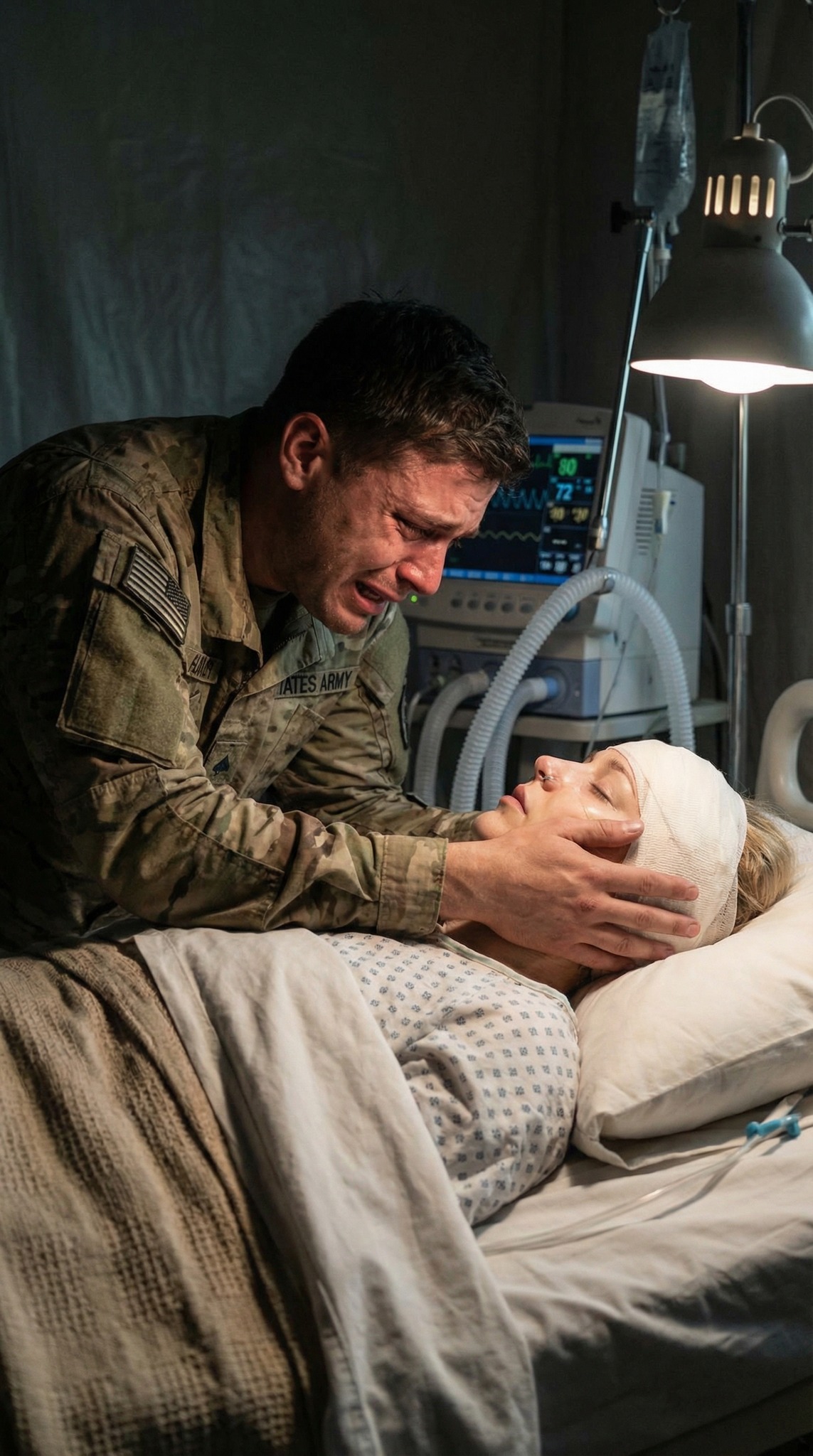
Most men dread a midnight phone call—the sudden ring that fractures the calm of an ordinary life. For a soldier, though, the greatest fear isn’t the chaos of combat. It’s not the snap of a sniper’s shot or the thunder of mortars. The true horror is returning home to silence—to a house that should be full, but isn’t.
I have seen bodies destroyed by IEDs in desert sands. I have watched entire villages reduced to ash beneath a merciless sun. Yet nothing—nothing at all—prepared me for seeing my wife, Tessa, broken in a hospital bed. Thirty-one fractures. That was the number the doctors gave me. A face I had kissed a thousand times, the same face that sustained me through endless nights overseas, had become a mosaic of deep purple and black bruises. And the most unbearable part? The people responsible were standing just outside her room, smiling.
The flight home from deployment is usually torture. You sit there, engines vibrating through your bones, replaying the moment you finally walk through your front door. I had been gone six months on a mission that officially never happened. Delta Force doesn’t allow phone calls. You don’t explain where you are. You vanish—and hope your life is still waiting when you return.
I had imagined it all: my gear dropping in the hallway, Tessa sliding across the hardwood floor in her socks, crashing into my arms. Instead, when my taxi stopped at our driveway at 0200 hours, the house was swallowed in darkness. Tessa always left the porch light on when she knew I was coming. She called it her lighthouse. That night, it felt more like a grave.
The front door stood slightly open. My hand instinctively moved to my waistband, searching for a weapon that wasn’t there. Inside, the smell hit me immediately—not food, not perfume, but bleach. Beneath it lingered the metallic scent of blood. I cleared each room by reflex until I reached the dining area. The rug was gone. The floor was damp. Someone had tried to erase what happened, but moonlight revealed stains no chemical could fully remove.
My phone vibrated. Detective Miller. He told me to go straight to the ICU at St. Jude’s.
At the hospital, the nurse’s expression said everything before a word was spoken. Outside Room 404 stood Victor Wolf and his seven sons—the Wolf Pack. Victor controlled half the county’s real estate and most of its politicians. His sons—Dominic, Evan, Felix, Grant, Ian, Kyle, and Mason—were men who believed everything had a price. They had never accepted me. To them, I was a disposable government asset, unworthy of their daughter.
“Finally,” Victor said, adjusting his tailored suit. “The soldier returns.”
Dominic tried to block me but backed away when he saw my eyes. Inside the room, the ventilator’s mechanical rhythm was the only sound. Tessa’s face was barely recognizable—swollen, wired shut, one eye completely sealed. Part of her head was shaved, stitches running like tracks across her skin. I touched her shoulder—the only place untouched by violence.
Detective Miller mentioned a “robbery gone wrong.”
“A robbery,” I repeated calmly. I examined Tessa’s hands. Her nails were clean. “My wife is a kickboxer. If a stranger attacked her, there would be skin under her nails. She didn’t fight back because she knew them—or because she was restrained.”
Outside, the Wolf Pack laughed. Only Mason, the youngest, was trembling, his coffee rippling in his cup. Victor told me to return to base, promising he would “take care of” his daughter. I stepped closer. “That’s exactly the issue, Victor. You look annoyed—not heartbroken.”
I glanced at the chart. “Thirty-one blows with a blunt object. Robbers don’t do that. That’s not theft. That’s hatred.”
I drove back home and let the operator replace the husband. Kneeling on the dining room floor, I studied the blood patterns. Vertical drops. No sweeping arcs. This wasn’t chaos—it was control. Four sets of boot prints surrounded the blood. They had held her down.
Before I deployed, Tessa warned me her father was growing fearful of what she knew about his shipping business. “Check the table,” she had said.
Under the dining table, taped to the frame, I found a digital recorder. I replaced the batteries and pressed play.
Static. Then Victor’s voice: “Hello, sweetheart. Daddy’s home.”
Tessa refused to sign documents allowing them to use my identity for shell companies. She called me honorable. Victor responded with a command: “Grab her.”
I stopped the recording. I didn’t need to hear the rest. The police report was fiction.
In the garage, behind a hidden latch, was the life I thought I’d left behind. I didn’t take a gun—guns are fast, and guns are mercy. I took my plate carrier, a KA-BAR knife, and industrial flex-cuffs. Then I bought plastic sheeting, a staple gun, and a framing hammer.
At 02:45, I waited in the shadows near Victor’s private club. The Wolf Pack stumbled out, drunk and celebrating. Mason lagged behind, claiming he needed air. His hands shook as he lit a cigarette.
He was the weakest link.
He was the one who held her legs.
I stepped out behind him. The night was silent—but not for long. Mason was going to talk. And by the time I was finished, the Wolf Pack would understand their mistake.
They had left her alive.
And they had left me with nothing left to lose.