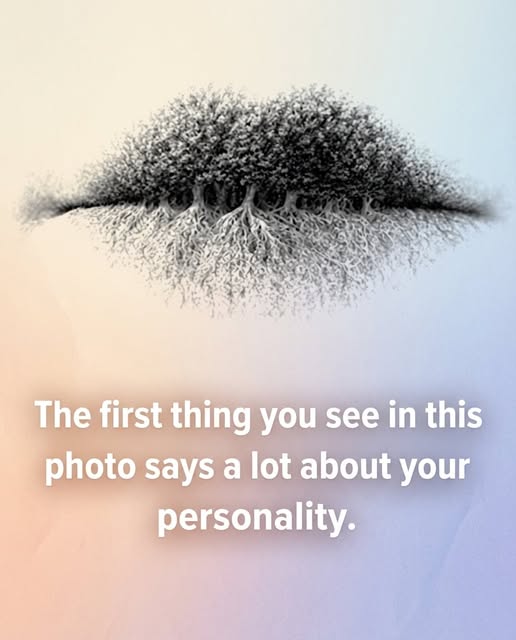
At first glance, it seems completely harmless. Just another pretty image on a screen, the kind you scroll past hundreds of times a day without a second thought. But the instant your eyes lock onto one small detail—whether it’s the curve of lips, the towering shape of trees, or the intricate tangle of roots—something deeper stirs. That almost automatic choice, the first thing your mind notices before your conscious brain has time to process it, may reveal far more about you than you’re ready to admit. Are you drawn to harmony, to connection, or to hidden depth? Do you focus on what is visible and comforting, or are you quietly curious about the foundations that hold everything together? Before you dismiss it as mere coincidence, pause and consider: your brain already made a choice. Your perception spoke before you did. And what it whispered about your quiet preferences, emotional patterns, and approach to life might surprise you more than any personality quiz ever could.
What you notice first in an image like this is not a verdict on who you are. It is not a label, a permanent judgment, or a final diagnosis. Instead, it is a gentle mirror, reflecting patterns that are already at work within you. If your eyes went straight to the lips, for instance, this may suggest a natural craving for peace, emotional clarity, and human connection. You might be someone who instinctively smooths the edges for others, seeking calm in chaos and harmony in conflict. That ability to maintain balance and mediate between people can be a remarkable gift, helping those around you feel safe and understood. Yet, it comes with a subtle reminder: while you prioritize the comfort and needs of others, your own needs matter just as much. Recognizing your own boundaries, desires, and emotional health is crucial to sustaining that gift without burning out.
If, instead, the trees drew your attention first, it may indicate that your energy is more outwardly directed. You are expressive, relational, and attuned to the broader landscape of human interaction. You notice how people connect, sense shifts in the mood of a room, and respond quickly to the emotional currents around you. Trees, with their expansive branches and living network of limbs, mirror your natural tendency to reach out and connect, to see the bigger picture rather than focusing solely on a single detail. You may find yourself organizing groups, bringing people together, or offering insights that others overlook. This inclination toward social awareness and relational intelligence can make you a bridge between individuals or communities, and it reflects a deep-seated attentiveness to the world beyond yourself.
If your eyes first settled on the roots, the interpretation takes a different tone. Roots speak to what lies beneath the surface, to hidden structures, unspoken truths, and the unseen forces that shape reality. A focus on roots suggests that you are drawn to depth, meaning, and understanding the foundations of situations or people. You may naturally probe motives, seek patterns, and wonder why things are the way they are. Your curiosity is less about appearances and more about essence, leading you to explore what is often overlooked. This inclination can make you a perceptive thinker, a reflective soul, or someone attuned to the subtle and complex layers of life that many miss entirely.
Ultimately, the image does not define you. It does not encapsulate the sum of your personality or predict every decision you will make. Rather, it invites you to observe the tendencies of your mind, the ways your perception instinctively navigates the world. It encourages self-reflection: how do you prioritize, what captures your attention first, and what might that reveal about your inner life? By paying attention to these subtle signals, you may also begin to reach for yourself with the same curiosity you naturally extend to your surroundings.
This simple exercise—a glance at lips, trees, or roots—serves as a quiet prompt. It reminds you that the mind is always at work, interpreting, sorting, and revealing patterns that you might not consciously recognize. It offers an opportunity to notice your preferences, embrace your tendencies, and perhaps learn something new about the ways you move through the world. In the end, these small revelations are not about labels or judgment; they are about awareness, self-compassion, and the ongoing journey of understanding yourself as intimately as you understand the world around you.