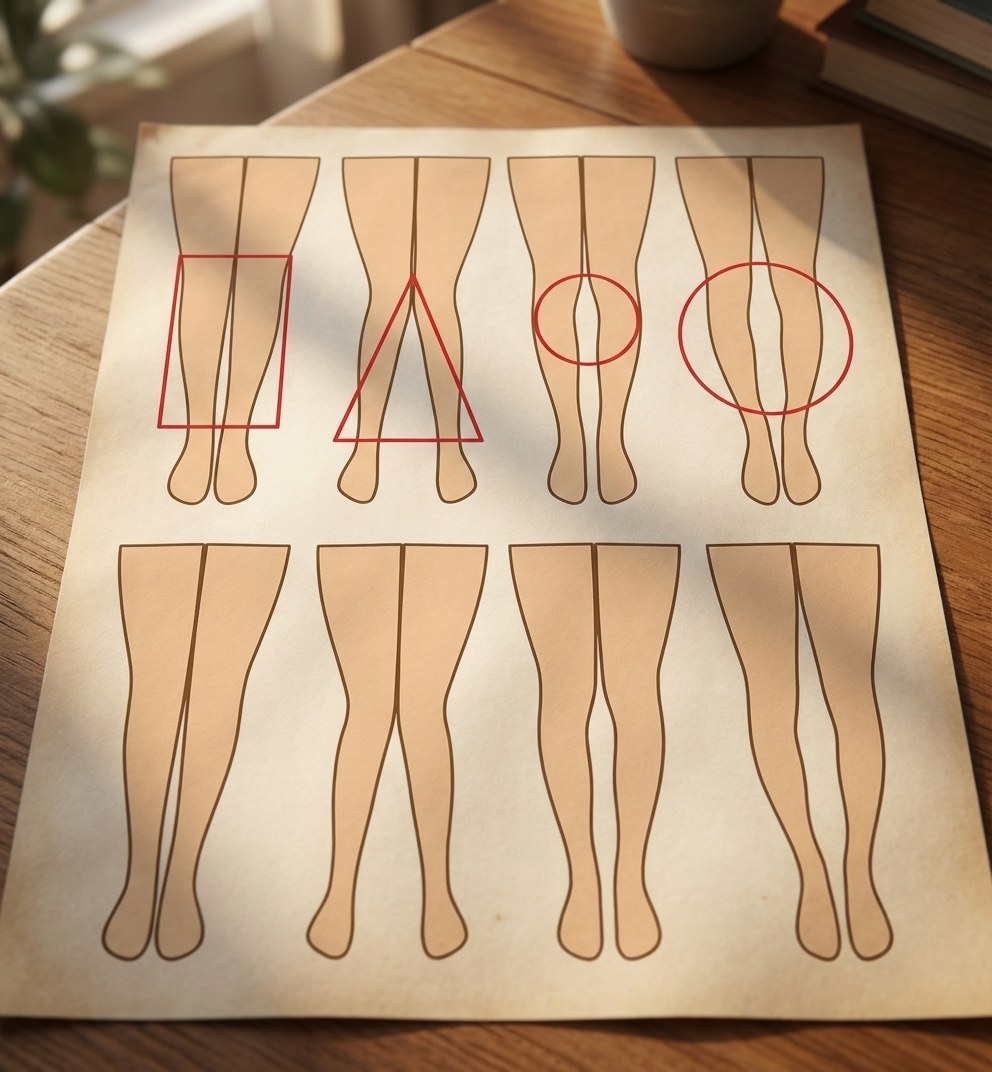
Legs are often treated as simple tools — the parts of our body that get us across a room, up a staircase, or through a long day on our feet. Yet in fashion, fitness culture, and everyday observation, people have always seen them as something more: subtle indicators of posture, balance, lifestyle, and personal style. Not in a judgmental or scientific way, but in the same lighthearted, curious way humans have always tried to read meaning in physical expression. Legs shape the silhouette in a way that catches the eye, and because of that, they often spark conversations about what form and movement can say about a person.
The truth is that most leg shapes — the ones people discuss, compare, or wonder about — stem from basic anatomy. Genetics plays a huge role. Bone alignment, hip width, joint orientation, muscle distribution… all of these determine how a person’s legs look when they stand or walk. Straight, parallel legs are often praised for their balanced alignment, but they aren’t rare or elite — they’re just one variation. The “diamond gap,” where the thighs and calves touch but the knees don’t, is another common natural structure. The famous — and often misunderstood — “thigh gap” is mostly the result of pelvic width and hip shape, not diet or exercise. That’s why two people with identical training routines can have completely different silhouettes.
Other shapes, like legs that angle inward slightly or bow outward, reflect the natural positioning of the knee joint. These differences can influence how someone moves — perhaps a slight inward sway while walking or a wide, steady stride — but they rarely signal any kind of problem. People often attach personality traits to these shapes in a playful, unscientific way: inward-leaning legs suggesting softness or gentleness, outward curvature hinting at liveliness, parallel legs giving an impression of grounded confidence. None of this is medical truth, of course. It’s just the human habit of blending anatomy with imagination.
Because leg shape influences movement, it also influences fashion decisions more than most people realize. Someone with straighter legs may gravitate toward slim trousers because they drape cleanly. Someone with natural curvature might prefer flowing skirts or wide-leg pants that move with their stride. Athletic women often choose leggings or compression wear that highlight muscle tone. These preferences aren’t about hiding or fixing anything — they’re about how certain clothes complement certain silhouettes and feel good while standing, sitting, walking, or stretching.
Fitness routines also play a part in how legs are perceived. Runners develop distinct calf definition. Cyclists tend to build strong quads. Dancers may show long, balanced muscle lines from controlled training. Yoga practitioners often develop stability around the knees and hips that affects the way they stand. None of this changes bone structure, but muscle tone can shift emphasis, giving the legs a different sense of shape or energy.
Despite how much people talk about legs — in magazines, in style advice, in casual social chatter — what they reveal is far simpler and far less dramatic than the commentary suggests. A pair of legs reflects how someone stands, how they balance, how they move through their environment. They tell you whether someone is relaxed in their posture or tends to brace themselves. They hint at the activities someone enjoys, the shoes they prefer, the way their body has learned to adapt to daily life. They show strength in one person, agility in another, and steadiness in someone else.
But what they don’t do is measure beauty, value, or confidence. Culture has a habit of turning body shapes into trends, ranking one form as desirable and another as something to “fix,” yet those standards shift constantly and ignore the basic truth: the shape of your legs is written mostly in your bones, not your choices. No amount of training will rearrange your joints. No diet will change the angle of your femur. All you can do — and all you need to do — is build strength, flexibility, and comfort in the body you already have.
When people fixate on leg shapes, they forget this. They forget that variety is normal. That symmetry is rare. That alignment differs widely from person to person. They forget that a silhouette is not a story about someone’s character or worth; it’s just the structure they inherited and the movement patterns they developed over time. Fitness may highlight those patterns, fashion may frame them, but the underlying architecture stays the same.
The more you look around, the clearer this becomes. A woman with straight, aligned legs may walk with quiet assurance, but that doesn’t mean she’s more confident than someone whose knees touch slightly. A woman with curved calves may have an energetic stride, but that doesn’t mean she’s more athletic than someone with slender legs and narrow ankles. These connections are fun to think about, but they’re not truths — they’re interpretations. They’re part of the human instinct to connect physical presence with personal style.
Ultimately, legs tell a story of movement, not judgment. They show how someone carries themselves through the world, how they balance their weight, how they’ve adapted to sports or work or long commutes. They reveal how the body has strengthened itself to support the life being lived. And if anything should be admired, it’s that — the strength, the adaptability, the quiet work of muscles and joints that allow someone to stand tall, walk forward, or climb the stairs at the end of a long day.
The diversity in leg shapes isn’t something to categorize or rank. It’s something to appreciate. Because every variation — straight, curved, angled, narrow, wide — comes from a unique blueprint shaped by genetics, lifestyle, and time. And when you see it that way, you stop trying to decode meaning and start recognizing the simple truth: every set of legs tells you that the person in front of you is built to move through life in their own distinct way. That’s all the meaning it needs.