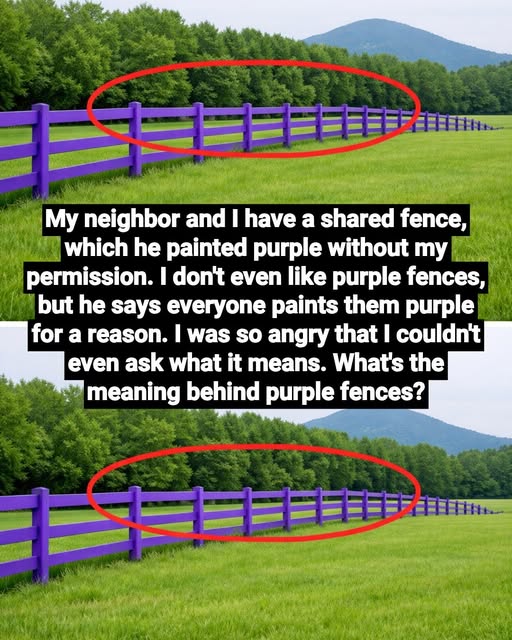
Across rural backroads and the edges of suburban neighborhoods, the signs of property ownership usually follow familiar patterns. White picket fences, aging wooden posts, or faded “No Trespassing” signs nailed to trees are sights most people recognize instantly. Lately, however, a striking and unexpected color has begun appearing throughout the American countryside: a bold shade of purple. To someone unfamiliar with its meaning, a fence or tree painted purple might look like a decorative choice or a homeowner’s eccentric whim. In truth, that vivid color serves as a legally recognized warning with serious authority. Known as the “Purple Paint Law,” it delivers a clear, unmistakable message without words: this land is private, and entry is not permitted.
The shift from traditional signage to purple paint arose from practical necessity. Property owners—especially those managing large plots of land, farms, or wooded areas—have long struggled to maintain standard “Keep Out” signs. Exposure to weather causes signs to fade, crack, or fall apart, while strong winds, animals, or vandals often remove them entirely. When signs disappear, property boundaries become unclear, increasing the risk of accidental trespassing and legal disputes. Purple paint offered a more durable alternative: a long-lasting marker that adheres directly to trees or fence posts and requires minimal upkeep compared to posted signs.
The choice of purple was intentional. Colors like bright orange or red were ruled out because they are already widely used in forestry, construction, and utility work to mark trees or underground lines. Using those colors for property boundaries could cause dangerous confusion. Purple, on the other hand, rarely appears naturally in large quantities, making it stand out clearly in forests, fields, and snowy landscapes alike. It is also highly visible to people with red-green color blindness, ensuring the warning can be recognized by as many people as possible.
For purple paint to carry legal weight, however, it must be applied correctly. States that recognize the Purple Paint Law require specific standards to be met. The markings must appear as vertical lines rather than random blotches, clearly signaling intentional boundary markers rather than graffiti or discoloration. Each stripe typically must be at least one inch wide and eight inches long so it can be easily noticed from a distance.
Placement matters just as much as size. The stripes are usually required to be positioned between three and five feet above the ground—high enough to avoid being hidden by vegetation or snow, yet low enough to remain in a natural line of sight. Spacing is also regulated: in many states, purple marks must be repeated roughly every 100 feet along the property line. This repetition creates a continuous visual boundary, leaving little room for someone to claim they were unaware they had crossed onto private land.
Although the Purple Paint Law has been adopted in many states, it is not yet universal. The concept originated in places like Arkansas and Texas, where large ranches and hunting lands made maintaining signs impractical. Since then, more than a dozen states—including Missouri, Illinois, Indiana, and North Carolina—have enacted similar laws. In those states, a purple stripe holds the same legal authority as a posted sign or a verbal warning, and ignoring it can result in criminal trespassing charges. In states without such laws, purple paint may not carry legal enforcement, but it still serves as a clear request for privacy. As a general rule, treating purple markings as a firm boundary is always the safest approach.
There is also a powerful psychological effect to seeing purple paint in a natural setting. A vivid artificial color in the middle of woods or farmland immediately draws attention and forces recognition. Unlike mass-produced signs, a hand-painted stripe feels personal—evidence of a landowner deliberately protecting their space. It communicates boundaries effectively without cluttering the landscape or relying on aggressive language.
As public and private spaces increasingly overlap, the purple paint marker stands as a smart and efficient solution to a modern problem. With nothing more than a brush and a can of paint, landowners can clearly define their boundaries, protect themselves from liability, and prevent unintentional trespass. At the same time, visitors benefit from clear guidance that helps them avoid legal trouble.
So the next time you’re hiking a trail, scouting a fishing spot, or driving through open country, watch for that unmistakable streak of purple on a tree or fence post. It isn’t a decorative choice or a random splash of color. It’s a boundary, clearly drawn and legally meaningful. In today’s countryside, purple no longer just signals creativity—it unmistakably means stop.