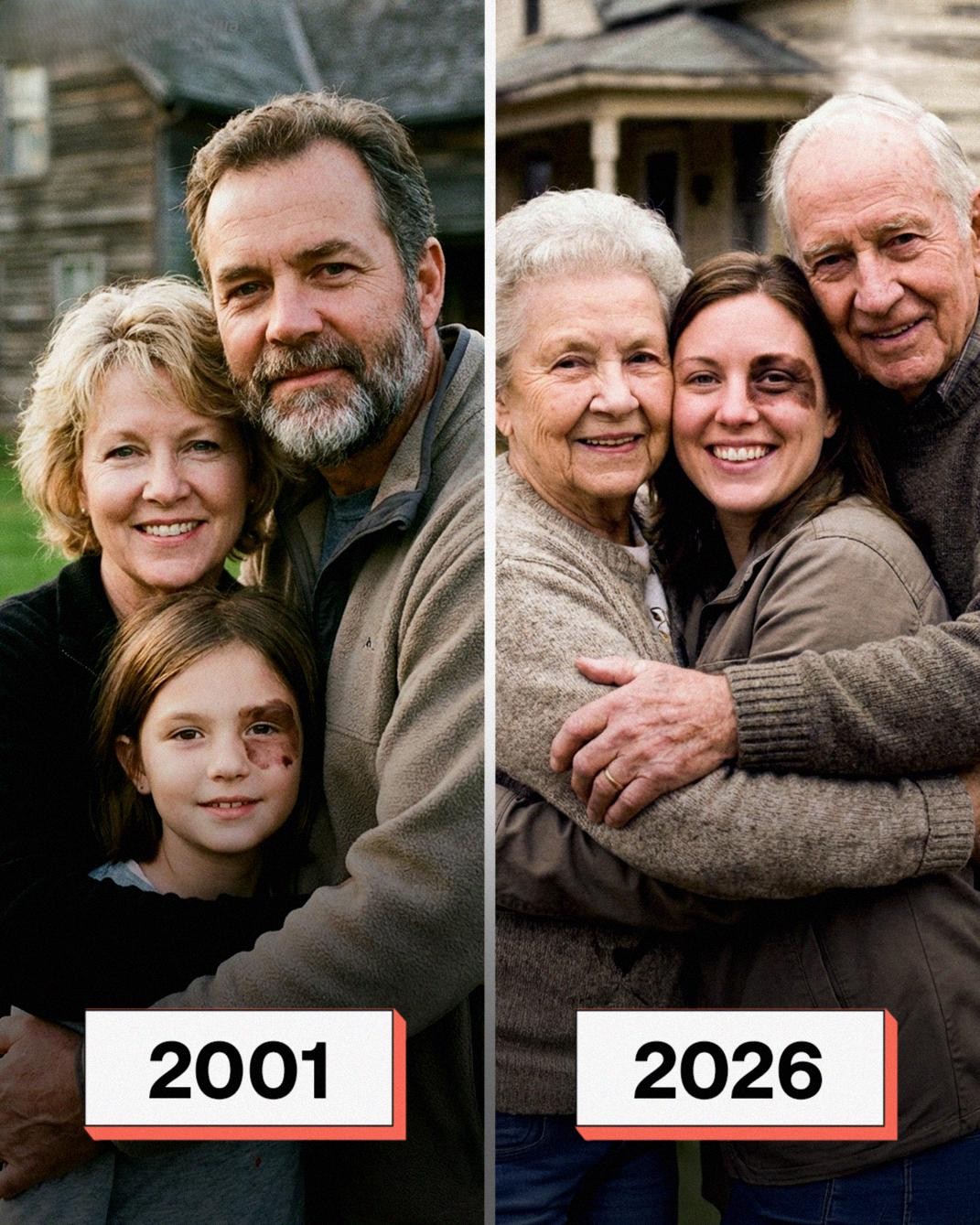
I am seventy-five years old now. My name is Margaret, and my husband, Thomas, and I have spent more than fifty years building a life side by side. For most of that time, our home was a quiet one—a refuge meant for just the two of us. We longed for children with an ache that felt almost physical. We endured a decade of tests, injections, and specialists, clinging to hope, until one day a doctor gently folded his hands and told us the truth: it would never happen. There was no miracle, no sudden turn of fate—just the soft, final sound of a door closing on a future we had imagined for years.
We learned how to live with that absence, carrying it until it became a familiar weight. By the time we reached fifty, we believed we had made peace with it. Then one casual remark from our neighbor, Mrs. Collins, changed everything. She mentioned a little girl living in a nearby children’s home. “She’s been there since birth,” she said quietly. “Five years now. People call, ask for photos… and then they disappear. She has a large birthmark on her face, covering most of the left side. People decide it’s too much.”
That night, I couldn’t stop thinking about a child who had waited five years for someone to come back. When I mentioned it to Thomas, I expected him to talk about our age or our settled routines. Instead, he looked at me with surprising clarity. “You can’t get her out of your mind, can you?” he asked. I admitted I couldn’t. He acknowledged the reality—we would be in our seventies by the time she was grown, with questions of energy, finances, and the boldness of starting so late. Then he softened. “Do you want to meet her?” he asked. “Just once. No promises.”
Two days later, we were guided into a bright playroom. The social workers were cautious; they didn’t want to raise false hope in a five-year-old who had already seen too many adults walk away. Lily sat at a small table, coloring with quiet concentration. Her dress was clearly a hand-me-down, and the birthmark was just as described—a deep port-wine stain covering the left side of her face. But it was her eyes that stayed with me. They were guarded, far older than her years, already calculating how long we might stay.
I knelt beside her and introduced myself. Thomas, in a moment I still treasure, squeezed himself into a tiny plastic chair across from her. Lily studied him carefully and asked, “Are you old?”
Thomas smiled. “Older than you, for sure.”
“Will you die soon?” she asked, her voice calm and practical.
My heart dropped, but Thomas didn’t hesitate. “Not if I have anything to say about it,” he replied. “I plan to be a nuisance for a very long time.”
A small smile slipped across her face. She was polite, but distant, her attention flicking toward the door. She was timing us. In the car afterward, the silence lasted only a moment before I said, “I want her.” Thomas nodded without hesitation. “So do I.”
The adoption process was an exhausting maze of paperwork that took months to complete. The day it became official, Lily walked out of the children’s home holding a backpack and a battered stuffed rabbit. When we arrived at our house, she stared at it with open suspicion. “Is this really mine?” she asked. When we said yes, she followed with the harder question: “For how long?”
“For always,” Thomas said gently. “We’re your parents.”
“Even if people stare at me?” she whispered.
“People stare because they’re rude,” I told her. “Not because you’re wrong. Your face will never embarrass us. Ever.”
The early weeks revealed how deeply neglect had shaped her. She asked permission for everything—to sit, to drink water, to turn on a light. She was trying to exist without taking up space. It took time to convince her that she didn’t have to earn her place. During one tearful night, I told her, “You might get in trouble sometimes, but you will never be sent back. You belong with us.”
School brought the cruelty we feared. One afternoon, she climbed into the car with tears streaming down her face. A boy had called her “monster face,” and others had laughed. I pulled over, held her hands, and told her the only monster was his behavior. She touched her cheek and whispered that she wished it would disappear. I told her I hated that she was hurting—but I would never wish she were anyone else.
We never hid her adoption from her. We told her she grew in another woman’s body, but in our hearts. When she was thirteen, the question finally came. “Do you know why my other mom left me?” she asked. We told her what little we knew—that her mother had been very young and left no name. I saw Lily’s shoulders stiffen as she absorbed the idea that she might have been something her biological mother couldn’t accept.
But Lily refused to be broken by that belief. She grew strong-minded and graceful in her defiance. At sixteen, she announced she wanted to become a doctor. “I want kids who feel different to see someone like me and know they aren’t broken,” she said. She worked relentlessly. Medical school, residency, endless nights—she never wavered. By the time she graduated, Thomas and I needed care ourselves, and Lily became our fiercest protector.
We thought that was the end of the story. Then one day, a plain white envelope appeared in our mailbox, addressed to me in careful handwriting. Inside was a letter from Emily—Lily’s biological mother.
Emily wrote that she had been seventeen when Lily was born. Her parents were strict and controlling, and they saw the birthmark as a punishment. They told her no one would ever want a “marked” baby and pressured her into giving Lily up while she was still a minor and had nothing. “I signed,” she wrote, “but I never stopped looking for her.” She confessed that she had watched Lily through the playroom window once, too ashamed to go inside. When she returned a year later, Lily was gone—adopted by an “older, kind couple.”
The final page revealed the reason for the letter: Emily was dying of cancer. She didn’t want to reclaim her daughter—only for Lily to know she had been wanted from the very beginning. Thomas and I knew immediately what to do. “It’s her story,” he said. “She deserves the truth.”
When Lily read the letter, something inside her finally broke free. “I thought she left me because of my face,” she cried. “I thought I was a mistake.”
We arranged to meet Emily at a quiet café. She was frail, pale, her head wrapped in a silk scarf—but her eyes were unmistakably Lily’s. There were no words that could erase decades of silence, but there was closure. On the drive home, Lily cried—not from grief, but from the exhaustion of finally knowing the truth.
The birthmark is still there, but the story has changed. Lily no longer sees herself as unwanted. She knows now that she was wanted twice—once by a frightened young girl who was forced to let go, and once by two aging souls who saw her and knew, without question, that she was exactly who they had been waiting for all their lives.